Nota Joins “K-On-Device AI Semiconductor Development” Project to Lead Humanoid AI Optimization
TECHWORLD ·
✦ AI Summary
Nota is expanding its AI model optimization technology into physical AI and taking part in humanoid development based on domestic NPU technology.
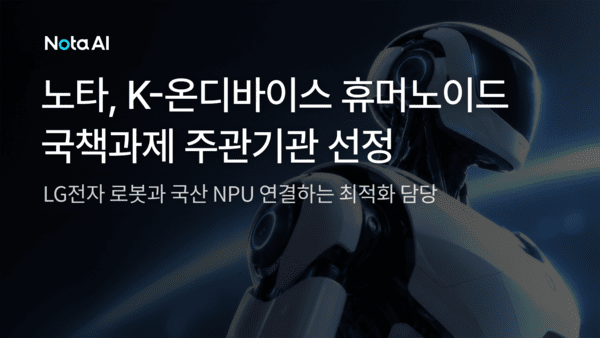
Nota was selected as the lead organization for the humanoid-specific subtask 3 in the "K-On-Device AI Semiconductor Development Project" led by the Ministry of Trade, Industry and Energy and KEIT, with the selection announced on the 8th.
Nota plans to lightweight VLA for the Mobilint NPU and develop software to optimize real-time on-device operation.
Nota is expanding its AI model optimization technology into physical AI and taking part in humanoid development based on domestic NPU technology. Nota was selected as the lead organization for the humanoid-specific subtask 3 in the "K-On-Device AI Semiconductor Development Project" led by the Ministry of Trade, Industry and Energy and the Korea Evaluation Institute of Industrial Technology (KEIT), with the selection announced on the 8th.
The goal of the project is to develop autonomous humanoids using domestic on-device AI semiconductors. Autonomous humanoids are being developed to recognize complex everyday environments and perform tasks.
LG Electronics will oversee the overall project and handle humanoid system development. Mobilint will be responsible for the domestic NPU. Nota will lead humanoid AI optimization and develop software to optimize AI model operation for the NPU and real robot environments.
Nota is participating in the project based on AI lightweighting and optimization technologies it has accumulated across mobile, edge, and data center environments. The core technology it will develop is to efficiently process large-scale robot AI models even with limited computing resources. Through this effort, Nota is extending its existing technical capabilities into the humanoid sector.
Humanoids need to process video collected by cameras in real time and respond to changes in their surroundings. As a result, if VLA inference is delayed, a time gap can emerge between the current situation and the robot's judgment. Accordingly, there is a need to maintain model performance within limited power and computing resources, along with technology that improves processing speed.
To that end, the lightweighting of the vision-language-action model (VLA) for humanoids is being pursued. The lightweighted VLA will be optimized for the Mobilint NPU, with the goal of building an on-device environment that runs VLA in real time inside the robot without relying on external servers. Nota plans to apply token compression, quantization, pruning, distillation, and layer-by-layer optimization. Through this, it will reduce the VLA model size, computing load, and memory usage.
In addition, the lightweighting process will take accuracy, computing load, and communication latency into account simultaneously. The lightweighted model will be converted into a form suited to the NPU's computing architecture. Nota also plans to build a workload-linked module for real-time inference.
The next stage of the project is to verify real-time operation performance and resource utilization efficiency in an environment combining the Mobilint NPU and a humanoid. Directly processing AI models inside the robot reduces cloud data transmission and reception, which in turn cuts communication latency and improves real-time control performance. The company also expects reduced external transmission of sensitive data and lower power consumption related to computation.
With this project, Nota plans to expand the scope of its AI optimization technology from mobile, edge, and data center applications to physical AI. Starting with humanoids, it aims to apply the technology and advance commercialization in fields that require real-time on-device AI, such as automobiles and industrial equipment.
Nota CEO Chae Myung-soo said this project is an important example of applying the company's accumulated AI optimization technology to humanoids based on domestic NPU technology. He also said Nota has technology that connects the efficiency of AI models and hardware across mobile, edge, and data center environments. He added that the company plans to expand technology application and business opportunities across physical AI, including various robots, automobiles, and industrial equipment that require real-time on-device AI, starting with humanoids.
Source: TECHWORLD · Kim Seung-gi
Original: https://www.epnc.co.kr/news/articleView.html?idxno=406668
References
This article was produced with the help of an automated content generation algorithm.
Source: TECHWORLD
View originalThis article was summarized and organized by BizCrush based on the original article from TECHWORLD. For exact quotations and full details, please refer to the original article.