What Matters Is What AI Changed: Samsung SDS to Support Enterprise AX With FDE and RX
IT DAILY ·
✦ AI Summary
Samsung SDS CEO Lee Jun-hee said companies are paying attention to what AI has actually changed, rather than whether it has been adopted.
Samsung SDS says it will support customer AX execution through FDE training, an AI full stack, and its RX business, while seeing business process redesign, data organization, and AI agent use as key tasks.
The company is also training about 200 FDEs by the end of this year, operating the Dongtan AI data center, planning to expand the national AI computing center in 2028 and the Gumi center in 2029, and participating as a pilot partner in OpenAI's 'Daybreak' program while expanding into defense.
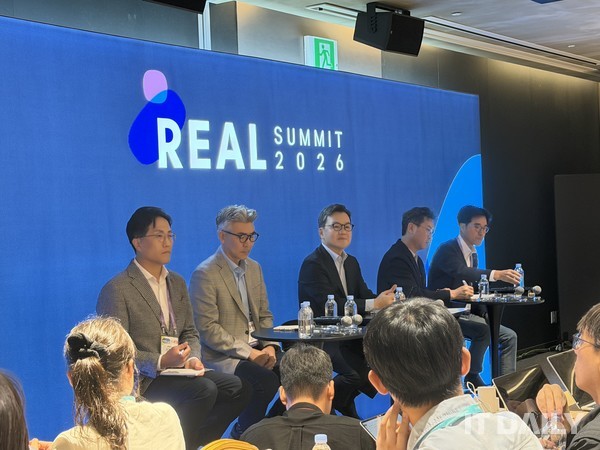
Samsung SDS CEO Lee Jun-hee said at a press briefing for the 'REAL Summit 2026' held on the 8th at COEX in Seoul that companies are now focusing less on whether to adopt AI and more on what they have actually changed with AI. He said Samsung SDS's AX standard is also based on tangible change and achieved results.
In line with that, Samsung SDS plans to support customer AX execution by training FDEs. It also announced support for customer AX execution through an AI full stack and through its RX business.
Samsung SDS sees the key tasks for AX as redesigning business processes, organizing data, and using AI agents. These tasks are being pushed forward in a way that supports customers' AX execution.
Samsung SDS is also pursuing a 'Client Zero' strategy, in which it applies and validates its solutions in its own operations first. The photo shows Samsung SDS Vice Presidents Shin Gye-young, Lee Ho-jun, CEO Lee Jun-hee, Vice President Song Hae-gu, and Vice President Ahn Dae-jung, and the photo was taken by reporter Yang Seung-gap.
The company is reviewing AI applicability after breaking down the seven major mega processes, including procurement, development, and marketing, into detailed work units. This is not a method that simply adds AI to part of existing work. The goal is to recombine work units and change their sequence to redesign the entire process for AI.
Lee said this involves restructuring entire work processes by recombining and redesigning several thousand small work units and changing their sequence. He added that this is not a task that can be completed in one or two months, but rather one that requires major effort over a long period.
To support this, the company plans to train about 200 field deployment engineers, or FDEs, by the end of this year. It will secure FDEs by combining reassigned existing staff and new hires.
The target for FDE deployment spans the broader industry, including not only Samsung affiliates but also external customers. Lee said the company plans to provide them in all areas needed by customers without favoring one side.
Samsung SDS said it is rolling out a 'Multi-Dimensional AI full stack' strategy in its AI business. The core of the strategy is to combine AI infrastructure, platform, and solutions with end-to-end capabilities covering consulting, development, deployment, and operations, along with industry expertise accumulated across various sectors. Lee said that if infrastructure, platform, and solutions are run separately, AI technology can remain at the PoC level, adding that Samsung SDS integrates and provides the full range of AI infrastructure, platform, and solutions.
Samsung SDS is operating the Dongtan AI data center to support this structure. It also plans to expand the national AI computing center in 2028 and expand the Gumi center in 2029.
Samsung SDS is also accelerating its RX business, which expands AX into physical manufacturing sites. To this end, it plans to verify robot applicability centered on production lines at Samsung manufacturing affiliates, and it also plans to verify robot applicability centered on the 430-plus manufacturing customers using Miracom Inc.'s manufacturing execution system, or MES. It then aims to expand the business into global markets, including the United States, where demand for robots is rising due to manufacturing reshoring, with a strategy of providing robots and MES at the same time.
At manufacturing sites, there are lines where automation has advanced, but many still rely on manual work, and Samsung SDS Vice President Ahn Dae-jun said the company sees those areas as the first targets for automation and plans to use general-purpose robots. To that end, Samsung SDS presented 'robot orchestration' — the ability to integrate and operate multiple robots tailored to manufacturing processes — as a differentiating factor.
Lee said the company is focusing on completing various types of robots and a robot orchestration platform, and on pushing them into actual use. He also mentioned the possibility of announcing related details soon.
Its cooperation with OpenAI has expanded into AI cybersecurity. Samsung SDS is participating as a pilot partner in OpenAI's cybersecurity program, 'Daybreak,' and Lee explained that the process of detecting and verifying security vulnerabilities in enterprise systems using AI itself could create new security risks. He also said it is important to verify the security capabilities of participating partners.
Lee said that a very high level of security capability verification is required in the process of obtaining partner status. He added that the partnership could become an opportunity to raise security standards in Korea's enterprise and financial sectors.
He also said the company is seeking to expand into the defense sector. Lee said defense is an area where security is extremely important, and noted that development, validation, and PoC work related to an SCP-based defense cloud are under way. He added that the company plans to continue developing the related business.
Source: IT DAILY · Yang Seung-gap
Original: https://www.itdaily.kr/news/articleView.html?idxno=241471
References
This article was produced with the help of an automated content generation algorithm.
Source: IT DAILY
View originalThis article was summarized and organized by BizCrush based on the original article from IT DAILY. For exact quotations and full details, please refer to the original article.