AIM Intelligence Says AI Security Needs End-to-End 'Control' as It Prepares for Physical AI Security
TECHWORLD ·
✦ AI Summary
AIM Intelligence sees control as the core challenge in AI security and is responding with a control layer that covers the full AI lifecycle.
The company said it applies offense and defense together through Stinger and Starport, and has conducted red teaming on more than 160 AI models while providing solutions to more than 20 large companies.
AIM Intelligence expects AI use to expand from AI agents to physical AI, and has launched the Physical AI Security Consortium to discuss security definitions, benchmarks, and red teaming and guardrail methods.
As AI evolves from simple chatbots to AI agents, 'control' is emerging as a key challenge in AI security. AIM Intelligence is responding by making a 'control layer' that covers the full AI lifecycle a core part of its market strategy. As the scope of AI use is expected to expand further to include physical AI, AIM Intelligence is accelerating preparations for the future by developing security technologies related to physical AI and building a cooperative framework.
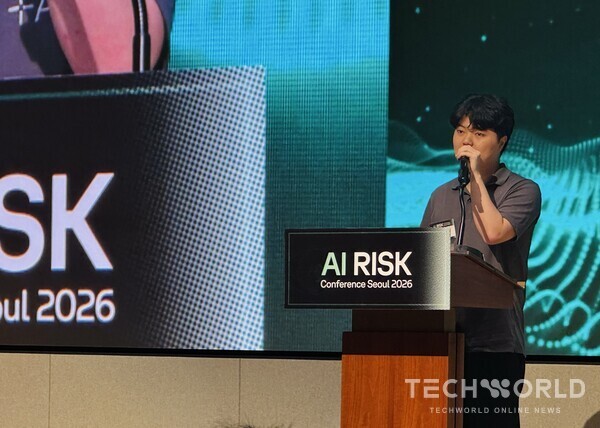
AIM Intelligence held an AI Risk Conference on the 7th and gave an afternoon presentation. The presentation was titled 'The Frontline of AI Control: From Models to Agents and Physical AI.' It introduced the company's AI security strategy and key solutions.
AIM Intelligence's approach to AI control is structured to apply offense and defense at the same time. The goal is to quickly identify AI vulnerabilities and reflect the findings in the system. On the offensive side, it offers the automated attack agent 'Stinger'; on the defensive side, it provides the 'Starport' platform. The company said it is continuously addressing vulnerabilities and strengthening security by feeding the vulnerabilities found by Stinger into its guardrail policies.
Park Ha-eon, CTO of AIM Intelligence, said that in the existing chatbot stage, AI could be controlled through inputs and outputs, but once it shifted to AI agents, it became difficult to control the entire process with the traditional approach alone. He added that Starport can identify the MCPs, tools, and agents used by companies, as well as the movement data and behavior between them, making control possible through that visibility. He said Starport's capabilities go beyond simple risk detection and play a role in controlling the actual AI usage process.
AIM Intelligence said it has conducted red teaming and diagnostics on more than 160 AI models and is providing red teaming and guardrail solutions to more than 20 large companies in Korea and overseas. It also said that more than 12 million users and services are operating live behind its guardrails, and that the number of AI agents controlled through Starport exceeds 100,000.
AIM Intelligence expects AI use to expand and believes the scope of AI use will widen beyond chatbots and agents to physical AI. Based on cases of the transition from chatbots to agents, the company predicted that the use of physical AI will expand in the future, and that the need for AI control will likewise broaden. It also said it is preparing in advance for the risks in the areas that are expanding.
He stressed that agents and chatbots are text-based, so they can be rolled back. In contrast, physical AI leads to real-world actions whose results are difficult to reverse. Accordingly, he emphasized the need to prepare for risks when transitioning to physical AI.
AIM Intelligence believes that physical AI requires both red teaming and guardrails, and is planning to apply its existing AI security framework in the same way to physical AI. To that end, the guardrails currently under development are designed to analyze both the surrounding environment recognized by robots and the actions they perform, while also judging the safety of those actions. It is also developing functions to block dangerous behavior.
After establishing a related cooperation framework, it launched the 'Physical AI Security Consortium.'
The consortium discusses the definition of physical AI security, benchmarks, red teaming methods, and guardrail methods. The speaker said the physical AI security field still lacks a definitive answer even globally, and that through the consortium the company and its partners review the benchmark direction they need as well as red teaming and guardrail approaches.
He added that the company aims to provide a control layer for the entire AI lifecycle and will continue reviewing ways to ensure AI is used within human control.
Source: TECHWORLD · Kim Hye-jin
Original: https://www.epnc.co.kr/news/articleView.html?idxno=406662
References
This article was produced with the help of an automated content generation algorithm.
Source: TECHWORLD
View originalThis article was summarized and organized by BizCrush based on the original article from TECHWORLD. For exact quotations and full details, please refer to the original article.