Samsung SDS Goes Beyond AI Adoption to Deliver Results, Unveils Multi-Dimensional Full-Stack Strategy
IT DAILY ·
✦ AI Summary
Samsung SDS unveiled an AX strategy and a 'Multi-Dimensional AI full-stack' execution roadmap to connect AI adoption with business results. It said it will redesign work processes and organizational systems around AI and expand specialized talent and AI infrastructure to support AX for each company. It also presented 'Client Zero,' FDE training, data center expansion, cooperation with global AI companies, and an RX business roadmap.
Samsung SDS presented an AX strategy aimed at turning AI adoption into business results. The company said it would go beyond simply introducing AI and instead focus on delivering actual outcomes. The goal of the strategy is to narrow the gap between AI adoption and real business performance.
To that end, Samsung SDS unveiled a plan to redesign work processes and organizational systems around AI. It also outlined a policy to expand specialized talent and AI infrastructure. Based on this strategy, Samsung SDS said it aims to support AX initiatives tailored to each company.
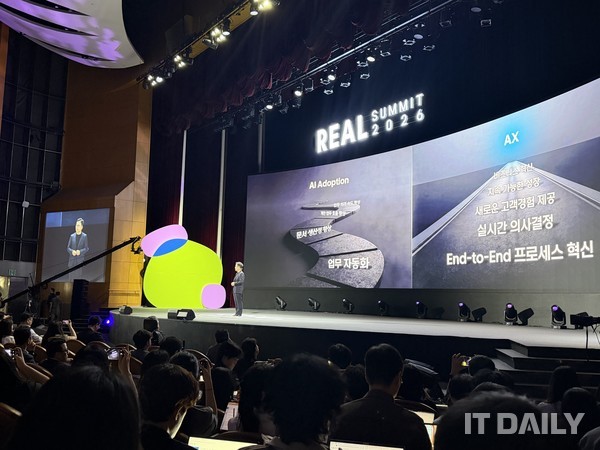
On the 8th, Samsung SDS held the enterprise AX conference, 'REAL Summit 2026,' at COEX in Seoul. At the event, the company shared details of its related strategy.
Lee Jun-hee, CEO of Samsung SDS, took the stage at the event. He outlined an execution strategy and roadmap based on the 'Multi-Dimensional' AI full-stack strategy. At 'REAL Summit 2026,' he explained Samsung SDS's AX strategy in terms of implementation measures.
Lee said AI is a change in work, while AX is a change in business. Distinguishing between broader AI adoption and AX, he noted that mere adoption alone does not produce sufficient management results.
He said AI adoption is expanding at companies, but it is not directly translating into tangible management performance. He added that while companies are rolling out AI, the business results side remains weak.
Citing a McKinsey survey, Lee explained that 88% of companies are using AI in at least one task, and about half are using AI in 3 or more major tasks. By contrast, 39% said AI affected operating profit, while only 6% said AI contributed 5% or more to operating profit.
Lee said that to achieve meaningful AX results, existing work methods must be redesigned. As for the direction of that redesign, he said it should be aligned with a structure in which AI and people work together.
For AX to be realized at companies, he said, two tasks are needed: redesigning existing work processes and preparing internal data in a form that AI can use. He also said necessary conditions include establishing an operating system for the smooth functioning of multiple AI agents and building governance that ensures AI acts in line with corporate intent.
Lee said companies need to clearly define the organizational structure and roles for using AI. He also said evaluation and compensation systems should be changed to encourage this, and that employees and executives directly using AI technology and internalizing the capability is a true condition for AX.
Samsung SDS is promoting a 'Client Zero' strategy. Under this approach, core AX elements are first applied and validated internally across 7 major in-house megaprocesses: development, procurement, quality, management support, business execution, marketing, and sales. Samsung SDS said it plans to apply the experience and know-how accumulated through internal use to customer businesses.
Samsung SDS will expand its AX support specialists to strengthen on-site execution capabilities for AX. Based on partnerships with OpenAI, Anthropic, and Accenture, Samsung SDS plans to train more than 200 specialized Forward Deployed Engineers by the end of this year. FDEs are responsible for identifying and implementing company-specific AX tasks at customer sites.
Samsung SDS is also pushing to expand AI infrastructure. The company is currently operating the Dongtan Center, the first AI data center in South Korea.
In 2028, a national AI computing center, in which Samsung SDS will participate as the consortium's lead company, is also planned. In 2029, construction of the Gumi Center will also be pursued.
Lee Jun-hee said strong AI data center support is a prerequisite for successful AX. He also expressed his intention to build a 'Korea AX Expressway' that spans both the private and public sectors.
Samsung SDS has named its integrated AI capabilities strategy 'Multi-Dimensional AI full-stack' and plans to apply it to company-specific AX businesses. 'Multi-Dimensional AI full-stack' consists of AI infrastructure, AI platforms, and AI solutions. The strategy is characterized by combining end-to-end capabilities spanning consulting, development, construction, and operations with industry expertise accumulated across multiple sectors.
Lee said that a true AI full-stack must provide specialized capabilities in consulting, development, construction, and operations to support AX execution. He explained that this capability requires a precise understanding of the customer's industry.
On that basis, Samsung SDS plans to expand cooperation with global AI companies. Samsung SDS and Anthropic plan to jointly support proof-of-concept (PoC) projects for corporate AX by combining their technological capabilities and business know-how, and to identify new AX businesses.
For example, Samsung SDS and OpenAI signed the first partnership in South Korea last year, and Samsung SDS is providing ChatGPT Enterprise adoption and related services. Samsung SDS recently joined OpenAI's 'Daybreak' program as a pilot partner, and through it plans to provide comprehensive AI security services, including solutions for automatically detecting, verifying, and patching security vulnerabilities at customer companies.
Lee said that because the business environment is changing rapidly, AX tasks differ by company. He added that Samsung SDS is working to provide optimal AI solutions suited to each company's situation, and that it is expanding partnerships with top companies to do so.
Samsung SDS unveiled its RX(Robotics Transformation) business roadmap and said it will expand the scope of AX from digital domains to physical manufacturing sites. The company said it is validating technologies related to robot-based manufacturing automation in real-world environments, and plans to unveil a 'robot orchestration platform' next year that integrates production equipment and robots.
Lee said Samsung SDS has led manufacturing automation for the past 25 years, adding that it has supported manufacturing automation for more than 430 companies in key national industry sites such as semiconductors, secondary batteries, and biotech, as well as in automotive materials and components and the food and beverage sector. He added that interest in RX has recently increased, but RX cannot be completed with robots alone.
Lee said that for robots to be used more widely in manufacturing sites, robot tasks must be continuously produced and the quality of those tasks must be raised to human levels. He added that Samsung SDS has accumulated manufacturing-site data and manufacturing-site experience, and that based on this it has been developing technologies to operate the entire robot-based manufacturing automation process.
Lee said he hopes REAL Summit will offer a chance to explore an answer to the true meaning of AX. He added that Samsung SDS will accompany each customer on the journey to turn their own answers into reality.
Source: IT DAILY · Yang Seung-gap
Original: https://www.itdaily.kr/news/articleView.html?idxno=241465
References
This article was produced with the help of an automated content generation algorithm.
Source: IT DAILY
View originalThis article was summarized and organized by BizCrush based on the original article from IT DAILY. For exact quotations and full details, please refer to the original article.