Bigvalue: “AI-Ready Data Must Narrow the Gap With Reality”
IT DAILY ·
✦ AI Summary
Bigvalue emphasized that building "AI-ready data" is necessary to improve the results of AI adoption by narrowing the gap between reality and data.
Gu explained that organizations must verify not only whether they have the data, but also field experience, data timeliness, and data connectivity to make it usable in real work.
Based on this field experience, Bigvalue plans to fully launch AI-ready data consulting.
Bigvalue emphasized the need to build "AI-ready data" to improve the results of AI adoption. As a key condition, it pointed to narrowing the gap between reality and data. It explained that, as a requirement for practical work use, organizations must verify not only whether they have the data, but also field experience, data timeliness, and connectivity at the same time.
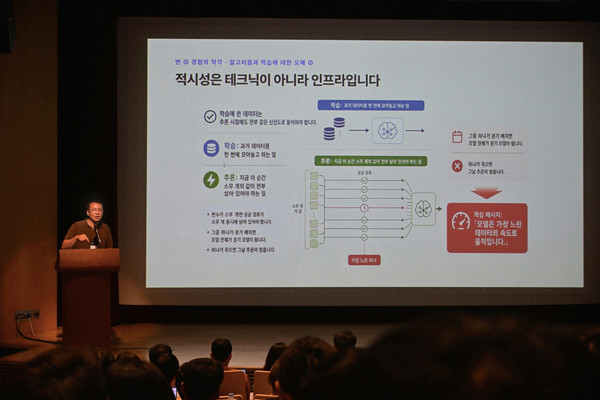
Guum, CEO of Bigvalue, spoke at "AI Ready Data 2026" on the 3rd. His presentation was titled "Conditions for AI-Ready Data Seen in the Field." Bigvalue announced these details on the 8th.
The seminar was held at the event hall in Posco Tower Yeoksam in Seoul. It was hosted and organized by the HIKE Lab in the Department of Library and Information Science at Chung-Ang University. The seminar was titled "What Must Data Have for AI to Work in an Organization?"
At the seminar, participants discussed public AX, corporate data strategies, ontology and knowledge graphs, AI agents, and standards and development for AI-ready data. The event served as a forum to examine, from industry and academic perspectives, the data challenges that support AI use in organizations. The issues raised by Bigvalue aligned with the broader trend of industry and academia discussing these challenges together.
Gu said that the prerequisite for making AI a collaborative colleague that does not require repeated review is designing trust conditions. He said AI's limitation lies in its inability to directly confirm reality, and that the basis for AI's judgments lies within the data provided. Accordingly, he said organizations must identify the gap between reality and data and prepare data to the level required for AI-related tasks.
Gu then presented three gaps involving working experts, accumulated data, AI, and data specialists as obstacles to AI adoption in the field. He explained that the first gap is the organization's "illusion of possession," meaning the belief that it already has the necessary data. As an example, he cited a case in which nationwide field survey data could not be used because of input errors and differences among surveyors.
He also cited a case in which farmland data updates were delayed and satellite image analysis was used to supplement them. He also mentioned a case involving the prediction of avian influenza risk. In store sales analysis, Gu explained, a company's own sales data alone is insufficient to explain store sales, and that the explanation can be strengthened with external card sales data and competitive environment data.
The problem point that arises when field experience and AI and data specialists' analysis clash in AI and data use was described as the "illusion of experience." He said it is best not to immediately dismiss long-standing field judgment, and that data is needed as a means to verify the conditions and scope of that judgment. He also noted that expert experience needs to be converted into measurable variables. In addition, he explained that even if a company has a large amount of training data, results can become unstable if data inflow is delayed at the actual decision-making point, and that this timeliness issue is not simply a matter of data cleansing. He then linked the challenge of securing timeliness to supply infrastructure that requires long-term investment.
Another problem that makes practical use difficult, separate from whether data is aggregated, was described as the "illusion of availability." There are issues that are difficult to find through error checks on a single table format alone, and to uncover such issues it is necessary to connect entities and standards across different data sets. Gu cited cases in which area values for the same parcel listed in multiple public registers did not match, and where address data did not align with the actual commercial district, saying that data linkage reveals errors and serves as the starting point for establishing a standard of trust.
One should be cautious about viewing data standards as the finished state of AI-ready data. Standards are more like a starting line for data connection and experimentation in various ways. To secure reliable results in actual work, practitioners and AI and data specialists must understand each other's limitations, and field verification and feedback must be repeated.
Based on this field experience, Bigvalue plans to fully launch AI-ready data consulting. The consulting includes diagnosing a company's data status and its potential for AI use, designing data acquisition aligned with the purpose of AI adoption, designing data linkage aligned with the purpose of AI adoption, designing data quality verification, and designing an operating system.
Source: IT DAILY · Yang Seung-gap
Original: https://www.itdaily.kr/news/articleView.html?idxno=241466
References
This article was produced with the help of an automated content generation algorithm.
Source: IT DAILY
View originalThis article was summarized and organized by BizCrush based on the original article from IT DAILY. For exact quotations and full details, please refer to the original article.