Beyond EVs: UGVs and Drones Take Center Stage at 'Future Mobility Week'
TECHWORLD ·
✦ AI Summary
The '2026 Future Mobility Week,' held at COEX in Seoul from the 25th to the 27th, was the first event to integrate three separate mobility exhibitions this year.
The event consisted of 'EV Trend Korea 2026,' '2026 Autonomous Mobility Industry Exhibition (AME 2026),' and '2026 Unmanned System X Civil-Military Cooperation Expo (UWC X CIMEX 2026)'.
The exhibitions spanned EVs, batteries, and charging infrastructure through autonomous driving, AI, drones, and unmanned systems, showing industry change as one continuous flow.
The '2026 Future Mobility Week,' held at COEX in Seoul from the 25th to the 27th, was the first event to bring together three separate mobility exhibitions this year. The event consisted of 'EV Trend Korea 2026,' '2026 Autonomous Mobility Industry Exhibition (AME 2026),' and '2026 Unmanned System X Civil-Military Cooperation Expo (UWC X CIMEX 2026)'.
The event offered a comprehensive look at changes in the mobility industry, spanning EVs, batteries, charging infrastructure, autonomous driving, artificial intelligence (AI), drones, and unmanned systems. The layout of the exhibition floor created a flow from EVs to autonomous vehicles to unmanned systems, allowing visitors to see the industry's broader transformation step by step in one place.
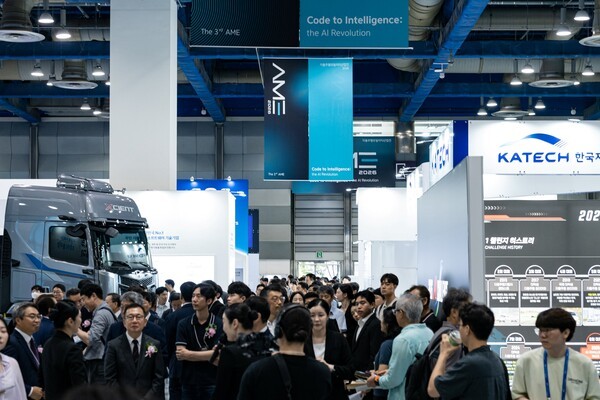
At the entrance to the exhibition hall, visitors first encountered a large number of EV displays before moving along the redesigned exhibition route. As military unmanned ground vehicles (UGVs), drones, and quadruped robots appeared, the structure shifted from an EV-centered area to autonomous driving and then to non-passenger unmanned systems.
At EV Trend Korea, 89 companies from the auto, charging, battery, parts, and services sectors participated, showcasing the electrification ecosystem in one place.
At the front of the hall, five automakers — Kia, KG Mobility (KGM), Volvo, BMW, and BYD — drew visitors eager to see new models as they displayed 12 electrified vehicles.
Kia exhibited the EV3, EV5, and the purpose-built vehicle (PBV) PV5 Passenger, while KGM displayed the Actyon Hybrid, Torres EVX, and the Musso EV electric pickup. Chinese brands also stood out, with BYD showcasing an electric SUV and a plug-in hybrid (PHEV) side by side while operating test-drive programs.
Visitors kept moving toward the BYD booth to check the vehicles' interiors and specifications, and the BYD display offered attractions different from those of domestic automakers.
On one side of the exhibition hall, a comparison display of vehicles that won 'EV Awards 2026' continued. The Kia EV5 won 'Korea's EV of the Year' and 'Consumer's EV of the Year,' while Hyundai Motor's Ioniq 6 N, Polestar 3, and Volvo ES90 were also listed among the category winners at EV Awards 2026.
At the EV-related exhibits, attention shifted from completed vehicles to the technologies that drive and maintain them. Battery management systems (BMS), thermal management, power electronics, chargers, control systems, and vehicle software — all technologies that support EV adoption — were put at the center.
In charging, factors beyond charging speed emerged as a competitive edge. Chaevi announced that it operates a total of 14,711 stalls at direct-run charging stations nationwide, of which 6,146 are fast chargers and 8,565 are slow chargers.
The scope of the charging business also expanded to include charging authentication, payment, operations, control, and automation technologies. After the EV exhibition area, visitors moved on to the Autonomous Mobility Industry Exhibition.
What stood out at the Autonomous Mobility Industry Exhibition was the driving technology behind vehicles rather than the vehicles themselves. AME was held for the third time this year, with 40 companies participating, and it highlighted autonomous vehicles, AI, data, sensors, high-definition maps, and software-defined vehicle (SDV) technologies as its exhibition categories.
At the site, several companies showcased Level 4 autonomous vehicles along with related core technologies. Autonomous A2Z introduced its unmanned Level 4 autonomous shuttle 'Roi' at the front, while RideFlux presented a Level 4 autonomous vehicle. RideFlux's use cases have expanded beyond passenger transport to cargo delivery. At the SWM booth, an urban robo-taxi operating in Gangnam, Seoul, was unveiled.
The SWM booth also unveiled visual-language-action (VLA)-based autonomous driving technology. Nearby booths featured lidar technology and high-definition road map technology. Lidar and high-definition road maps are technologies needed to understand a vehicle's surroundings and position.
However, what stood out on site was AI and software that integrate individual sensors and components rather than the sensors and parts themselves. The use cases for autonomous driving were defined as robo-taxis, robo-shuttles, and cargo transport. Accordingly, the focus of technological competition was also shown shifting toward the implementation of stable services on actual roads.
A broader trend — expanding from roads into the battlefield — also appeared. AI spread into the UGV and drone sectors as well.
In the exhibition hall, UGVs, drones, and quadruped robots replaced the spaces traditionally occupied by cars, shifting the center of attention. UWC X CIMEX included 88 companies from home and abroad across 187 booths, and the exhibition categories consisted of ground and aerial unmanned systems, counter-drone (C-UAS), and defense AI.
At the Hanwha Aerospace booth, the tracked UGV 'GRUNT' was on display. The description next to 'GRUNT' called it a 'next-generation UGV hybrid platform for global battlefields,' and visitors gathered in front of it.
The appearance of 'GRUNT' differed from that of an EV. Seats and a steering wheel were replaced by tracks and various equipment, showing the shift in mobility from manned transportation to unmanned systems.
Displays of unmanned platforms used in both air and ground operations followed. LIG D&A exhibited the MPD, the KCD-40 cargo drone, and the quadruped robot 'Vision 60,' which moved in front of visitors as part of a live demonstration.
As AI's role became more prominent alongside the rise of unmanned systems, PUNGIN introduced AI-based image and data analysis technology under the slogan 'Battlefield AI specialist company.' AI for understanding the vehicle's surroundings, first shown in the autonomous driving exhibition, was linked to defense technologies, and in defense applications it was extended to unmanned platform recognition and operational support.
The uses of the unmanned systems on display were not limited to the battlefield. The exhibits included military transport drones, multi-purpose unmanned rotary-wing aircraft, small drones for indoor search at fire scenes, and walking robots, showing that unmanned technologies developed in defense also have points of contact with civilian areas such as disaster response and safety.
After visiting the three exhibitions in sequence, visitors could also see the points of connection between industries that had previously been separate. If the core of EVs is batteries and charging, the core of autonomous vehicles is sensors and AI, and those sensors and AI were presented as replacing the role of the driver.
This trend continued to the point where human onboard presence disappeared at the UGV and drone stages. The exhibition route, which expanded from EVs to the battlefield, was presented as showing how industry is gradually reducing human involvement.
As the scale of the exhibition expanded, the range of attractions widened to include automakers, batteries, charging, autonomous driving, drones, and defense, making it difficult to thoroughly tour the entire exhibition given the large number of fields and booths. While the ability to compare multiple industries in one place was clear, the need to set priorities and plan viewing routes in advance grew more important, with concerns that major booths could be missed otherwise.
As the first integrated Future Mobility Week, the significance of this event lay in the ability to view EVs, autonomous driving, and unmanned systems as a single flow. The areas covered by the exhibition expanded beyond vehicles, the starting point of competition was battery and charging technologies, and the route of competition spread through AI and software before extending to mobility systems.
Source: TECHWORLD · Kim Seung-gi
Original: https://www.epnc.co.kr/news/articleView.html?idxno=406246
References
This article was produced with the help of an automated content generation algorithm.
Source: TECHWORLD
View originalThis article was summarized and organized by BizCrush based on the original article from TECHWORLD. For exact quotations and full details, please refer to the original article.