'All-People AI': Three Players, Three Styles ... The Battleground Is Everyday Life
IT DAILY ·
✦ AI Summary
The Ministry of Science and ICT selected SK Telecom, Kakao, and KT consortia as operators of "All-People AI."
The government plans to support 512 Nvidia B200 GPUs and sign agreements in September.
The 3 consortia plan to launch AI within the year that connects general-purpose chatbots with public and daily-life services to handle real tasks such as applications and reservations.
The 3 companies selected as operators of the government’s nationwide AI service project, dubbed "All-People AI," are SK Telecom (SKT), Kakao, and KT. Each of the 3 is developing AI that can handle everyday tasks by combining domestic AI models and specialized services at user touchpoints. Starting with general-purpose chatbots, the 3 consortia plan to launch AI services within the year that connect public and daily-life services and even carry out real-world tasks such as applications and reservations.
The target areas for everyday tasks are finance, healthcare, education, and shopping. For AI to handle these tasks, services, data, AI models, and infrastructure in each field must be connected. Accordingly, SKT, Kakao, and KT have brought together companies with strengths in services, data, AI models, and infrastructure, centering on existing user touchpoints such as telecom, messenger, portal, and media platforms.
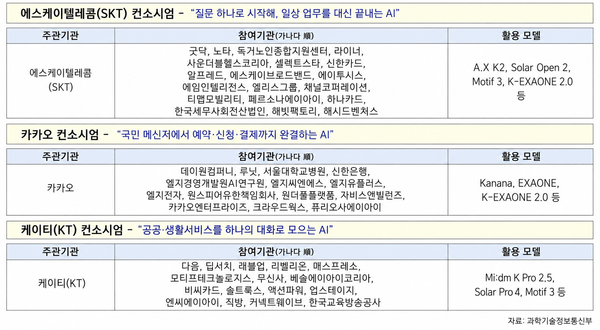
The combinations of AI models used by the 3 consortia differ by company, but some overlap. SKT is using 'A.X K2,' Upstage's 'Solar Open 2,' Motif Technologies' 'Motif 3,' and LG AI Research's 'K-Exaone 2.0.' The Kakao consortium is using Kakao's 'Kanana' and models in the Exaone lineup from LG AI Research, while the KT consortium is using KT's 'Mideum K Pro 2.5,' Upstage's 'Solar Pro 4,' and 'Motif 3.'
Because the project is not based on designating a single national representative model, it was designed around a structure that provides multiple domestic models, with each model delivered to the public through a different service ecosystem. As a result, the competition point for "All-People AI" has shifted from benchmark performance to natural integration within services, and the scope of action delegation after answering has also been presented as a key criterion.
In line with that direction, the Ministry of Science and ICT conducted written and presentation evaluations of 6 consortia that had applied to the open call, and on the 28th announced that the SKT, Kakao, and KT consortia had been selected as project operators. The written evaluation covered AI model competitiveness, service competitiveness, GPU utilization, and infrastructure operation plans, while the presentation evaluation included a prototype video demonstration.
The presentation evaluation examined service convenience, user acquisition strategy, quality assurance measures, safety assurance measures, and plans to contribute to the domestic AI ecosystem. However, the evaluation scores were not disclosed, and the rankings of the operators were also kept secret. The reason for the nondisclosure was a request from the participating companies.
According to the Ministry of Science and ICT, the government selected 3 operators for "All-People AI" on the 28th, and the selected entities are the SKT (SK Telecom), Kakao, and KT consortia. This year’s support allocation is 512 Nvidia B200 GPUs, and the distribution by operator will not be disclosed. The ministry plans to sign agreements with the operators in September.
The government plans to begin an official service within the year after a beta service, and from next year it will support the costs needed to provide services to the entire public through the budget. The source of the material is the Ministry of Science and ICT.
In the early days of the generative AI market, competition centered on building larger models and securing higher performance, but as model performance reached a certain level and an environment emerged in which multiple models could be switched and used depending on the purpose, a shift in the center of competition is taking place. Accordingly, having an excellent model is becoming important, but so is securing repeated user touchpoints.
Against this backdrop, SKT is presenting a direction for realizing "agentic AI" through links to specialized services in each field.
The latest operator selection reflects recent changes. The key difference among the 3 consortia lies not in AI itself but in the channel through which AI is delivered. The focus of comparison is also not on which AI each consortium has, but on how it connects that AI to users and combines it with field-specific expertise for delivery.
SKT has laid out a strategy that combines AI models, infrastructure, and large-scale service operation experience, while integrating the capabilities of specialized companies in finance, mobility, education, and healthcare. The areas requiring expertise are handled by participating companies, with regulatory finance, medical data, and tax systems presented as examples. SKT's role is to connect the AI models, technologies, and services suited to user requests, and SKT describes this role as that of an "orchestrator."
The consortium composition was also organized around this role structure. Liner is handling specialized search, Shinhan Card and Hana Card are handling finance and payments, Tmap Mobility is handling mobility, SK Broadband is handling content, and Ellis Group is handling education. Goodoc and Soundable Health are participating in healthcare and medical services, while Nota, SelectStar, and AIM Intelligence are taking on roles supporting AI models, infrastructure, and security.
The use of these capabilities is aimed at realizing "agentic AI" that proceeds from analyzing a user's request to planning, execution, and result confirmation. To this end, the plan presented includes supporting the issuance of 83 types of certificates, including resident registration copies, based on links with Government24 and PASS, as well as providing guidance on medical information based on health records and connecting users to hospital reservations. It also envisions functions targeting stores and public offices without official application programming interfaces (APIs), and includes a plan to handle user requests through direct phone calls by AI.
A SelectStar official said the company aims to support the building of "All-People AI" that operates accurately and stably in real service environments based on its expertise in data.
Yoo Kyung-sang, head of SKT AI CIC, explained in remarks on the consortium structure that a single-company approach has limits in meeting the diverse needs of people in everyday life. He added that SKT's role is to connect user intent with the appropriate models, technologies, and specialized services.
This structure places the AI, telecom, and systems capabilities of Kakao and LG affiliates on top of the user touchpoint of KakaoTalk, the center of the Kakao consortium, along with expertise in healthcare, finance, taxation, and education. Kakao and LG AI Research will use domestic AI models, LG Uplus will provide the telecom touchpoint, and LG Electronics and LG CNS will reinforce technological capabilities.
By field, Seoul National University Hospital and Lunit are participating in healthcare; Shinhan Bank in finance; and Javis & Villains and Day1Company in taxation and education. Crowdworks will support improvements in AI answer quality and safety verification based on data infrastructure.
The feature of this structure is connecting KakaoTalk's large user touchpoint with specialized services and data in each field. Based on this, Kakao is promoting a method in which users first use a general chatbot within KakaoTalk and, when needed, are linked to public or specialized AI agents, with the goal of handling information searches, reservations, applications, and payments in a single flow.
Users will be able to start with a general chatbot in KakaoTalk and then move to field-specific AI agents when needed, processing several procedures consecutively. In addition, under a cooperation plan with LG Uplus, the company will also provide a phone-based general AI.
Kakao is moving to create a channel for additional participation by outside specialist companies. It has established a policy to link with the PlayMCP- AI agent marketplace and also unveiled plans to support outside companies in developing, testing, and distributing specialized agents.
Regarding this service, Kim Se-woong, Kakao AI Synergy Performance Lead, said the key point is strengthening AI accessibility based on the KakaoTalk platform. He also stressed the goal of moving beyond simple information searches to the completion of everyday tasks.
Meanwhile, KT is promoting a consortium aimed at a nationwide AI service. The KT consortium is built around 3 areas: services, AI models, platforms, and infrastructure, and its structure combines lifestyle services, operating AI models, and computing infrastructure.
Companies participating in KT's service area include Daum, Musinsa, Zigbang, EBS, Mathpresso, BC, ConnectWave, and DeepSearch. This service area will cover everyday services such as search, shopping, housing, education, and finance.
Companies participating in the model and platform area are Upstage, Motif Technologies, NC AI, and ActionPower. Companies participating in the AI infrastructure area are Rebllup, Rebellions, and Bespin Global Korea.
KT plans to apply AI across its own services and those of participating companies so that users can move from information provision to connections with specialized services and follow-up tasks within the flow they already use. The areas where its capabilities will be used are the "All-People AI" app, Daum, participating consortium services, and Genie TV. When AI is called up during use of existing services, it will provide needed information, connect users to specialized services, and handle follow-up tasks.
In this process, personalization features will be applied between services with user consent as a prerequisite. The personalization linkage items include interests, schedules, and the context of tasks in progress. As an example, KT presented a method that would suggest follow-up work such as moving-in registration, address changes, and utility transfers to a user who has found a home, based on previous consultation content. KT said the combined user touchpoints of consortium participants exceed 60 million.
As another example, if a small business owner asks about the cause of declining sales, it is planning a service that analyzes market and consumer information and searches for related support policies. An NC AI official said the consortium plans to unveil specialized technologies for public services based on 3D and sound models with global competitiveness.
The Ministry of Science and ICT announced on the 28th that it had selected the SK Telecom, Kakao, and KT consortia as the operators of "All-People AI." The article image was generated by AI.
The All-People AI project presents a single AI to users on the surface. Internally, however, it is being pursued through the use of multiple domestic models.
Behind this approach is the judgment that a single model is unlikely to achieve top performance across all areas. Examples of such areas include search, reasoning, Korean-language understanding, multimodality, and specialized knowledge.
Accordingly, it is necessary to select and connect the most suitable model for each user question or task, and a core capability is being called "model orchestration." The use of a large model for complex reasoning and relatively smaller models for simple search and classification has been presented as an effective way to manage response speed and cost at the same time.
Lee Jin-hyung, executive vice president and head of KT's AX business division, said the company intends to expand AI into the various services used by the public. He also said the goal is to connect the needed AI and specialized services regardless of where the process begins. The consortium's ability to work together will be tested through the services to be launched within the year, and the key issue is sustainability.
From the perspective of domestic AI companies, "All-People AI" represents an opportunity to verify their own models in real large-scale services. The existing competition among domestic AI models has centered on development scale and benchmark scores, but this project will make actual user choice, usage volume, processing costs, and outage response capabilities new evaluation criteria.
However, simply using multiple models does not guarantee the natural growth of the domestic AI ecosystem. That is because the criteria for model selection and the allocation of requests by model can affect the benefits for participating companies. If the operator's own model is used first and external models are used only as supplements, this project could end up merely expanding telecom and platform companies' services.
To create a competitive structure for external AI models and agents, clear standards are needed for evaluating model call volume, performance, and costs. On top of that, a settlement system must be established so that excellent models and services can generate revenue in line with usage. If those conditions are met, "All-People AI" could develop beyond a one-off demonstration project into a platform for shaping the domestic AI market.
The ministry plans to begin signing agreements and forming working councils with the operators in September, then move ahead with a beta service after consultations with relevant ministries and public data linkage, and launch the official service within the year. The actual scope and timing of linkage for functions proposed by the operators will be specified during the consultation process.
The key challenge of this project is sustainability. The government will provide support for 512 B200 GPUs this year and begin supporting service provision costs through the budget from next year. The initial cost of providing high-performance AI to the entire public will be borne by the government, and the government's support method is to cover the initial costs in order to open the market.
However, AI services are expected to incur higher inference costs as user numbers grow. While a free-use assumption makes it possible to quickly secure users, no concrete revenue model has yet been established after government support is reduced. This remains a sustainability issue.
It has been pointed out that the revenue model for AI services could place a burden on the goal of free universal service and the neutrality of recommendations. Introducing advertising or paid subscriptions could weaken the purpose of the project as a free universal service, and reliance on commission fees from shopping, finance, or reservation brokerage could create a profitability bias in AI recommendations. In that case, AI recommendations may favor more profitable products over the best choice for users, and the challenge of ensuring recommendation neutrality also remains when public and commercial services are provided together in a single AI.
The government's simultaneous selection of 3 consortia is intended to avoid concentrating national data and users in a single service and to encourage competition among different approaches. However, it could also lead to the overlapping development of 3 similar services, which in turn could result in a dispersion of GPUs and budgets.
Under the consortium model, it is necessary to implement the data, technology, and services of different companies within a consortium as a single AI service. To do that, linkage among participating companies and service completeness must be supported. An industry official said that rapid implementation of actual services and user acquisition are important, and that in a consortium structure with multiple participating companies, the organic connection of each participant's technology and data is the key issue.
Source: IT DAILY · Kim Byung-ju
Original: https://www.itdaily.kr/news/articleView.html?idxno=241267
References
This article was produced with the help of an automated content generation algorithm.
Source: IT DAILY
View originalThis article was summarized and organized by BizCrush based on the original article from IT DAILY. For exact quotations and full details, please refer to the original article.