Apple Bets on Usability for Its First Foldable iPhone: Folded Like an iPhone, Opened Like an iPad
IT DAILY ·
✦ AI Summary
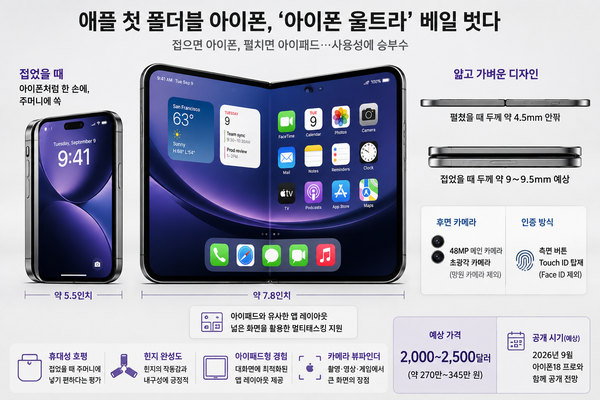
Apple's first foldable iPhone is said to be a book-type model that opens left and right like a book, with an external display of about 5.5 inches and an internal display of about 7.8 inches.
It is expected to be about 4.5 mm thick when unfolded and about 9–9.5 mm thick when folded, and early feedback on pocketability and the hinge feel and durability when folded has reportedly been positive.
However, the telephoto camera and Face ID are likely to be excluded, and Apple is said to be trying to differentiate the user experience through foldable support in iOS 27 and an iPad-like app layout.
In addition to previously reported details such as screen size and thickness, more concrete usability assessments are now emerging around Apple's first foldable iPhone. According to a Bloomberg report on the 23rd (local time), user reactions before launch are being cited as an even more important point of attention.
On the usability front, emphasis is being placed on the convenience of fitting the device in a pocket when folded and on the iPad-like app experience when unfolded. This is said to reflect a design choice by Apple to prioritize thinness and the form factor in its first foldable iPhone.
In the process, some existing iPhone Pro features, including the telephoto camera and Face ID, are said to have been sacrificed. The first foldable product is being interpreted as prioritizing the fold-and-unfold experience over packing in every top-spec feature, and the product design priorities are also said to be centered on the foldable user experience itself.
The internal name for the product inside Apple is known as iPhone Ultra. However, the final product name has not yet been decided.
People who have used Apple's first foldable iPhone are said to have given the most positive marks to its portability. A common criticism of foldable devices is portability, because they become thicker when folded, but early users reportedly praised the Apple foldable's pocketability. Their praise was not limited to the screen size alone; the hinge feel also received favorable reviews, and the hinge's durability reportedly did as well.
The Apple foldable known so far is a book-type model that opens left and right like a book. The expected external display size is about 5.5 inches, and the expected internal display size is about 7.8 inches when unfolded. In its unfolded state, the screen aspect ratio and usable space are said to be closer to the iPad mini than to a standard iPhone, while the thickness in the unfolded state is reportedly around 4.5 mm and the expected thickness when folded is about 9–9.5 mm.
According to the Bloomberg report, Apple is preparing iPad-like app layouts for the large internal display. Rather than simply enlarging existing iPhone apps, this approach reorganizes information and functions to fit the wider screen. As a result, the device is said to aim for a screen experience closer to the iPad mini than to the iPhone when unfolded.
Apple's key battleground is becoming clearer. In the foldable smartphone market, Samsung Electronics, Google, and Chinese manufacturers have already entered early and released several generations of products, so the flow suggests Apple cannot easily outperform rivals on hardware specifications alone. In this landscape, Apple is positioned to differentiate itself with software polish that lets users move naturally between smartphone and tablet experiences on a single device, based on its installed base across iPhone and iPad devices.
According to early user feedback, the large unfolded display is being praised not only for video, gaming, and productivity tasks but also for camera shooting. The same reports say the large unfolded screen is also considered a good viewfinder.
However, Apple's first foldable is expected not to include every feature of the existing iPhone Pro. The camera is being cited as a representative trade-off. The currently reported rear camera setup is a dual system consisting of a 48-megapixel main camera and an ultrawide camera, while the telephoto camera is expected to be left out. The expected price is USD 2,000–2,500 (KRW 2.7–3.45 million), and at that ultra-premium level, the absence of a telephoto camera could be a consumer disadvantage.
Apple is reportedly prioritizing the foldable device's thinness and internal space, making it highly likely to exclude Face ID as part of its effort to minimize thickness when unfolded. Instead of the sensors required for Face ID, the company is said to have opted for Touch ID on the side button. Given that Face ID is effectively the standard biometric authentication method on the iPhone, reintroducing Touch ID is unusual. The move is being viewed as a choice driven by the need for thinness and internal space in the new foldable form factor.
The real competitiveness of Apple's foldable is likely to depend less on camera megapixels or processor benchmarks and more on how well iOS 27 handles foldable devices. Key factors include how naturally apps used on the folded screen switch to a large-screen UI after unfolding, how smoothly multitasking with two or more apps is supported, and to what extent the iPad app ecosystem can be used on the foldable iPhone.
While Samsung Electronics and other Android manufacturers rely on outside developers and Google support during the process of optimizing apps for foldables, Apple directly controls the iPhone and iPad operating systems, development tools, and the App Store. That structure is being cited as an advantage for Apple.
Although Apple is a late entrant to the foldable market, it could use that structure to make software integration the main battleground rather than the hardware experience. Apple is expected to unveil its first foldable iPhone next month alongside the 'iPhone 18 Pro' series. Samsung Electronics launched the first Galaxy Fold in 2019 and pioneered the foldable market, making this Apple's full-scale entry into competition about 7 years after Samsung Electronics' debut Galaxy Fold launch. Existing manufacturers such as Samsung Electronics and Google have spent multiple generations improving hardware polish, including screen creases, thickness, weight, and cameras.
For its first foldable product, Apple is focusing on combining the iPhone experience and the iPad experience into a single device. The core user experience is 'Fold it, and it's an iPhone; open it, and it's an iPad.' The key variable in the success of Apple's first foldable is expected to be not whether it reaches the highest-end specifications, but whether users recognize the value of the experience. Whether consumers accept the value at a price above USD 2,000 is being presented as the key question. Apple's entry is also expected to change the competitive benchmark in the foldable phone market.
Source: IT DAILY · Lee Jae-young
Original: https://www.itdaily.kr/news/articleView.html?idxno=241161
References
This article was produced with the help of an automated content generation algorithm.
Source: IT DAILY
View originalThis article was summarized and organized by BizCrush based on the original article from IT DAILY. For exact quotations and full details, please refer to the original article.