Government, Mobile Carriers Improve Firefighting Communications on Commercial Networks to Prevent Blackouts in Disasters
IT DAILY ·
✦ AI Summary
On the 7th, the Ministry of Science and ICT selected 8 cases for the '3rd 2026 Active Administration Best Practices' and held an awards ceremony.
The top case was 'Permitting priority handling of emergency rescue communications based on commercial networks,' which prioritizes firefighters' communications over those of general users during disasters.
The project was pursued through discussions among the Ministry of Science and ICT, the National Fire Agency, SK Telecom, KT, and LG Uplus, with the goal of establishing a supplementary communications means based on commercial networks.
As the Ministry of Science and ICT, the government, and the three mobile carriers move to improve firefighting communications based on commercial networks, the ministry on the 7th selected 8 cases for the '3rd 2026 Active Administration Best Practices' and held an awards ceremony.
Among them, the ministry's top active-administration case was 'Permitting priority handling of emergency rescue communications based on commercial networks.'
The core of this top project is to prioritize firefighters' communications over those of general users during disasters such as large fires.
During disasters, traffic from general users can surge temporarily, which may delay call connections and make data use unstable.
Accordingly, the project focused on ensuring the stable use of communication services essential to carrying out public safety duties.
The project was pursued through discussions among the Ministry of Science and ICT, the National Fire Agency, SK Telecom, KT, and LG Uplus. The ministry handled policy support and institutional review to strengthen communication quality in the disaster and safety sectors.
The National Fire Agency cooperated to reflect on-site needs and apply the system in actual disaster response environments. The scope of application covers wireless line subscribers under corporate names, including mobile phones, tablet PCs, and IoT devices for the agency's public duties.
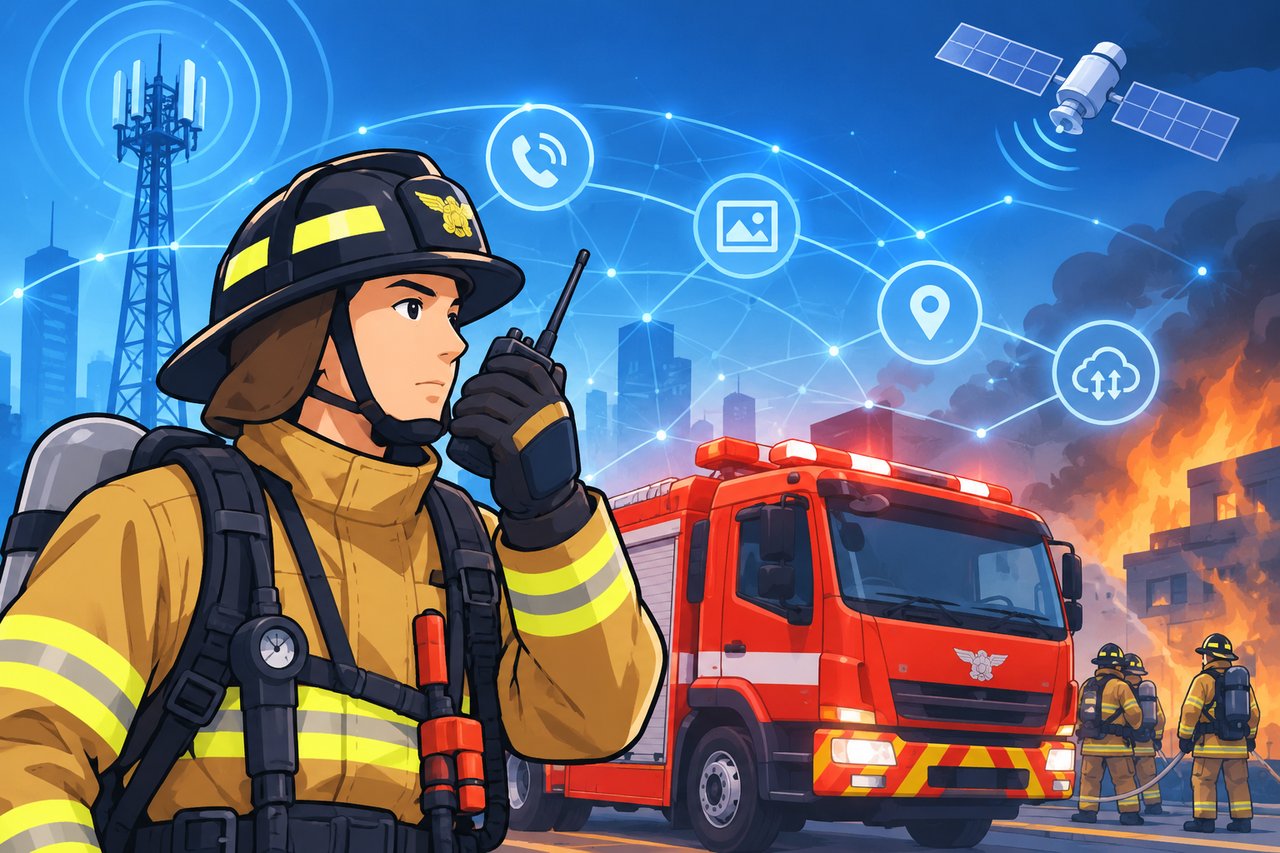
Functions used by firefighters in the field include essential voice calls, transmission of现场 photos and videos, sharing the location of rescue targets, and real-time data sending and receiving. Accordingly, the three mobile carriers are applying priority communication services for devices used for the National Fire Agency's work by leveraging their respective communication infrastructure.
SK Telecom plans to provide the service based on its commercial network. SK Telecom says it will operate the service in a complementary manner with the Public Safety-LTE, or PS-LTE, network.
The Public Safety-LTE, or PS-LTE, network was built under government leadership. It is a nationwide single wireless communications network used for disaster response operations by disaster-related agencies such as the police and fire services.
In South Korea, carriers are applying 5G-based dedicated networks and priority access systems to the National Fire Agency's communications environment. KT introduced enterprise-dedicated 5G SA to the agency's administrative network. 5G SA differs from LTE-connected non-standalone mode, or NSA, and provides communication services using only a 5G dedicated network.
About 60%, or more than 8,400, of the devices used for National Fire Agency work are using KT lines. These devices support priority communication services.
LG Uplus has been replacing USIMs used at firefighting sites since last May, starting with the Changwon Fire Headquarters in Gyeongnam, with the aim of providing a priority access service for firefighters.
Overseas, too, moves are emerging to combine 5G and satellite communications with existing dedicated networks in order to enhance the stability of public safety communications. For the same purpose, the trend of adding 5G and satellite communications to existing public safety networks is continuing.
The United States is upgrading its public safety communications network, FirstNet, from LTE to a 5G SA-based system. In July, it began operating a separate 5G SA core for public safety. This marks progress from a model that allocates some resources of the commercial network for public safety, toward separately building a public safety 5G core to strengthen communication stability and security.
To ensure communication continuity during disasters, using satellite communications alongside terrestrial networks is also being discussed. Through cooperation with AST SpaceMobile, satellite communications enabling direct phone-to-satellite connections are being pursued, and plans have been proposed to supplement public safety communications in areas not reached by terrestrial base stations and even when terrestrial communications networks are damaged by disasters.
Japan secures communication stability in disasters by operating terrestrial and satellite networks in parallel. The Japan Fire and Disaster Management Agency operates the firefighting and disaster-prevention wireless network connecting the agency with prefectures nationwide, and uses satellite communications as a backup network in case of disruptions. Prefectures operate disaster-prevention administrative wireless networks that connect key disaster-prevention agencies such as local governments and fire headquarters, with terrestrial and satellite communications as the connection means and disaster information transmission and reception as the purpose.
The trend in disaster-safety communications is not limited to building separate dedicated networks, but is expanding to the situation-specific use of a variety of infrastructures such as commercial mobile networks, 5G, and satellite communications. In South Korea, a priority handling service for emergency rescue communications based on commercial networks has been introduced, and it is seen as having provided a supplementary communications option to the existing Public Safety-LTE network.
The Ministry of Science and ICT selected active-administration cases by dividing them into best practices and encouraging cases.
Best practices included the data safety option (QoS), expansion of all-data plans without price increases, nationwide inspections to resolve the issue of common electricity charges for internet equipment burdening residents, and the establishment of an integrated compensation system related to common electricity charges for internet equipment.
Encouraging cases included preemptive responses to cyberattacks through amendments to the Act on Promotion of Information and Communications Network Utilization and Information Protection, plans to build a Korean-style low-Earth-orbit satellite communications network, support for young talent in AI and AX fields through the specialist research personnel system, and support for restoring disaster-response capabilities in special disaster zones affected by forest fires through 'Radio All One Day (All One Day).'
Source: IT DAILY · Seong Won-young
Original: https://www.itdaily.kr/news/articleView.html?idxno=241454
References
This article was produced with the help of an automated content generation algorithm.
Source: IT DAILY
View originalThis article was summarized and organized by BizCrush based on the original article from IT DAILY. For exact quotations and full details, please refer to the original article.