[DigiKey Tech Forum] Thermal Derating in Power Supplies: Why a 550W Unit Can Only Deliver 230W
TECHWORLD ·
✦ AI Summary
The actual output of a power supply and the lifespan of equipment are affected not only by the rated value, but also by operating conditions, cooling design, and thermal management. The example product XP Power CCR550PS12 requires different cooling methods depending on output conditions: 450W requires a heat sink with 1.0°C/W thermal resistance, 230W uses natural convection cooling, and 550W uses fan cooling. High temperature, dust, filter maintenance, and heat sink performance affect capacitor life and overall equipment lifespan, and long-term stable use requires keeping the temperature sufficiently below 50°C.
A power supply's output is not determined by its rated value alone, but varies depending on operating conditions. For long-term, stable operation of equipment, it is necessary to review the power supply conditions in the actual application environment.
Cooling design and thermal management in equipment have a major impact on power supply lifespan. Accordingly, it is necessary to examine thermal management factors together with output conditions.
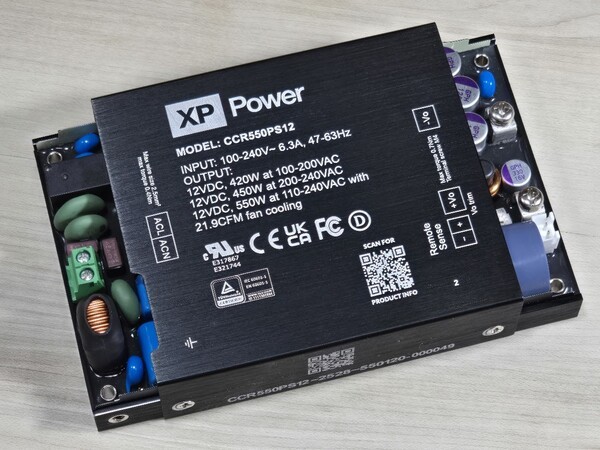
[Figure 1] The example product is XP Power's 'CCR550PS12.' 'CCR550PS12' is a case-type AC-DC converter with a maximum rated output of 550W, and this article uses it as an example to examine the conditions that affect output.
This analysis was well suited because XP Power provided sufficient data for analyzing the relationship between output and heat generation. Accordingly, the analysis used data provided by XP Power.
To understand the specifications accurately, XP Power's reference guide, 'Your Essential Guide to Power Supplies,' can also be used. The guide is 154 pages long and covers basic power supply concepts, cooling, high-temperature derating, and other advanced topics.
The actual performance of a power supply and equipment is not determined by the stated rating alone. The point at which actual available output and equipment lifespan are determined is the design stage.
The effective conditions for the marked rated output of a power supply are appropriate operating conditions. Whether the full rated output can be realized depends on the operating conditions.
For this reason, designs based on ideal conditions should be avoided. If the possibility of decades of use is considered, decisions made at the design stage become even more important.
In particular, cooling design is highly important. One factor behind CCR550 output variation is the cooling method.
It should not be assumed that a metal case alone provides sufficient cooling performance. When using an enclosed case, a design that accounts for high-temperature environments is necessary.
In addition, if dust accumulates or filter maintenance is inadequate, cooling performance deteriorates. This is also a factor that affects output availability.
If the heat sink's dissipation performance is insufficient, capacitor life decreases dramatically. As capacitor life decreases, the service life of the equipment may also be shortened.
Ultimately, the actual performance of the power supply and equipment is affected by the design and operating environment. Depending on the enclosure structure, high temperature, dust, filter maintenance condition, and heat sink performance, output availability and the lifespan of components and equipment will vary.
The required cooling method changes depending on the output level. The cooling method for 230W is natural convection, the cooling method for 450W is conduction cooling, and the cooling method for 550W is fan cooling.
The article presents an example to explain 450W output and specifies the required heat sink conditions. The condition for securing 450W output is the use of a heat sink with a thermal resistance of 1.0°C/W.
Wakefield 127684 is presented as an example usable under natural convection conditions. This component has a thermal resistance of 1.04°C/W and is made of aluminum.
Wakefield 127684 has an installation area of 108 square inches and a height of 0.9 inches. The installation area of the natural convection heat sink is about 6 times that of the power supply.
This area difference underscores its importance. To handle this output with natural convection, a large aluminum heat sink is needed, and its size becomes much larger than that of the power supply.
The possibility of using the equipment chassis as a heat sink is also mentioned in the design phase. However, using the equipment chassis for cooling makes it difficult to secure adequate cooling performance.
The reason is that in most cases, the case thermal resistance is higher than that of a large 1.0°C/W heat sink. The exception is a very robust metal case.
Using a cooling fan can reduce the size of the heat sink.
However, prolonged exposure to high temperatures accelerates component degradation and failure.
In high-temperature environments, electrolytic capacitors are particularly affected.
The power supply structure in [Figure 3] is semi-potted.
As a result of the semi-potted structure, the temperature level of the internal components is similar, and the capacitor temperature rises to nearly the same level as the power supply's metal base.
In this regard, XP Power's guide discusses capacitor-related content.
Datasheets usually include a projected life curve based on the temperature of major electrolytic capacitors, and electrolytic capacitors are representative components inside power supplies whose lifespan decreases with use. Additional related information is also included in the XP Power guide.
The Arrhenius equation is used as the basis for calculating the lifespan of all electrolytic capacitors. In general, the reaction rate doubles for every 10°C increase in temperature, and the relationship that lifespan is halved for every 10°C increase in temperature is applied. For this reason, temperature is a key factor in determining the final system lifespan and maintenance cycle.
A detailed explanation of the Arrhenius equation is covered in a separate article. This article introduces the Rule of 10, which states that for every 10°C increase in temperature, equipment lifespan decreases by about half.
Ripple current is also a factor that affects capacitor lifespan. Accordingly, this article presents the application of the Rule of 10 to output capacitors.
[Figure 3] identifies Gemcon0's output capacitor as the item under review. This output capacitor product family is the GPH series, a conductive polymer aluminum solid capacitor. The maximum operating temperature is 125°C, and the endurance rating is 2000 hours at 125°C.
A power supply lifespan based on a simplified application of the temperature-lifespan relationship using the Rule of 10 was presented.
At 125°C, it is 2000 hours (83 days).
At 115°C, it is 4000 hours (167 days).
At 105°C, it is 8000 hours (0.9 years).
At 95°C, it is 16,000 hours (1.8 years).
At 85°C, it is 32,000 hours (3.7 years).
At 75°C, it is 64,000 hours (7.3 years).
At 65°C, it is 128,000 hours (14.6 years), and to secure a lifespan of about 30 years, the temperature must be kept at 55°C or below; at 55°C, it is presented as 256,000 hours (29 years).
However, this simple calculation does not reflect the effect of ripple current, and it also does not reflect self-heating caused by the high-frequency components of a switching-mode power supply.
55°C is a level that people feel quite hot, is at a level where burns are possible, and is similar to hot water.
As a technical tip, it was noted that the basis for judging system lifespan is the sum of the lifespans of individual components, and that the factor determining overall lifespan is the component with the shortest lifespan.
It was also noted that the actual lifespan of the polymer capacitor in [Figure 3] may be much longer than the earlier simple calculation, and Würth Elektronik's application note ANP701 provides an explanation related to this.
The degree to which lifespan increases as temperature decreases varies by capacitor type. For liquid electrolytic capacitors, expected lifespan doubles for every 10°C drop in component temperature, while for polymer electrolytic capacitors, lifespan increases 10-fold for every 20°C drop in component temperature.
The components covered in the Würth Elektronik application note are similar to the capacitors supplied by DigiKey. In view of the operating conditions for these components, temperature is presented as the key variable that separates lifespan from performance.
When used for long periods, the factor with the greatest impact on lifespan is capacitor aging. It was also explained that use in environments above 50°C is not desirable, and that use in environments above 50°C is not recommended.
By contrast, in short-term use at very high temperatures, the limiting factor is different. In that case, the main constraint is the semiconductor temperature limit, and short-term use at high temperatures shows the linear derating characteristics generally applied to semiconductors.
In this regard, [Figure 4] shows output gradually decreasing in the 50°C to 80°C range. In other words, if capacitor aging and environments above 50°C are the problem during long-term operation, then in short-term operation at very high temperatures, semiconductor temperature limits and linear derating act as the key constraints, as shown by the output drop in [Figure 4].
Many common semiconductors derate a specified amount of power for each 1°C rise above 25°C. By contrast, XP Power power supplies begin derating at 50°C, which shows that XP Power power supplies have a large design margin.
This difference is also connected to thermal resistance effects. In power supplies, the thermal resistance effect makes the power supply chassis temperature lower than the semiconductor junction temperature.
Under natural convection cooling, the blue curve applies to 110VAC and the purple curve applies to 220VAC. The rated output of the power supply under the two conditions is 230W and 260W, respectively.
The reason for the difference between these two curves is the difference in DC voltage after rectification. It can also be seen that the lower the input voltage, the greater the current that flows.
As current increases, losses and heat generation increase, and the lower efficiency at low input voltage is also reflected. These factors lead to a difference in rated output between the 110VAC and 220VAC input conditions under natural convection cooling.
The power supply operation checklist is a practical guide for equipment design reference, summarizing items to check at the design stage in relation to power supply operation.
Fields where fan noise is a frequent issue include AV equipment and medical equipment. In such cases, one way to reduce noise is to lower the power supply output.
Other noise reduction methods include applying a larger heat sink and using a slower fan. This should be considered at the design stage as well, since noise can be reduced by adjusting output and changing the heat dissipation and fan configuration.
When dust and contaminants accumulate, cooling efficiency declines. [Figure 5] shows a case of severe dust accumulation in an old fan-cooled power supply, resulting in reduced cooling performance. Therefore, the possibility of dust accumulation should be reflected in the design.
To ensure long-term stable use, the temperature must be kept sufficiently below 50°C. To do this, the design must strike a balance among equipment lifespan, size, fan cooling performance, and heat sink size so that long-term stable use is possible while keeping the temperature sufficiently below 50°C.
As an operating-condition example, intermittent use at very high temperatures is possible. However, prolonged use at high temperatures should be avoided, and long-term use in environments close to 80°C can significantly shorten equipment lifespan. One example of lifespan change is a reduction from decades to years.
Adding temperature sensing functionality to the equipment was suggested. Examples of installation-environment problems included installation in narrow spaces and blocked ventilation openings, and these were summarized as situations that could lead to inadequate cooling.
If the equipment is placed in a narrow space or the ventilation openings are blocked, cooling may not proceed smoothly and could lead to overheating. It was suggested that detecting such conditions through temperature sensing and alerting the user to an overheating state would help protect the equipment and extend its lifespan.
Source: TECHWORLD · Lee Gwang-jae
Original: https://www.epnc.co.kr/news/articleView.html?idxno=406566
References
This article was produced with the help of an automated content generation algorithm.
Source: TECHWORLD
View originalThis article was summarized and organized by BizCrush based on the original article from TECHWORLD. For exact quotations and full details, please refer to the original article.