Seoul AI Hub Hosts TOYTHON, 107 People Take on Physical AI Challenge, Yielding 41 Working Prototypes in 5 Hours
TECHWORLD ·
✦ AI Summary
Seoul AI Hub held the physical AI hackathon TOYTHON, which wrapped up on August 22.
The event drew 107 participants across 42 teams, and 41 physical AI outputs were produced within 5 hours.
Of the 42 teams, 41 completed working physical outputs, and the 20 teams in the finals demonstrated projects on a range of themes, including health, safety, and care.
Seoul AI Hub held the physical AI hackathon "TOYTHON," which wrapped up at Seoul AI Hub on August 22. The event took place amid a broader trend of extending generative AI-based "vibe coding" from screens to actual working hardware.
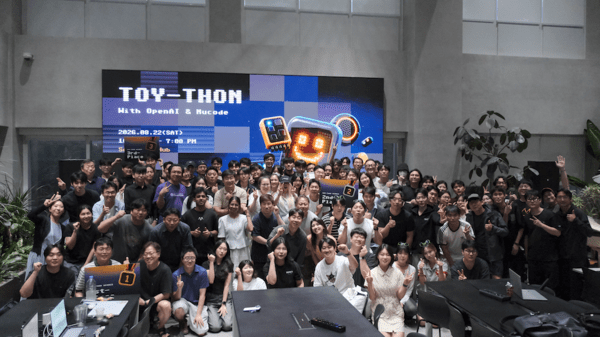
TOYTHON was hosted by Team Human and Korea Investment Accelerator, with Seoul AI Hub as a partner, and sponsored by OpenAI and NUCODE. The event ended successfully.
The event brought together 107 participants, made up of young people, startup founders, and industry professionals, across 42 teams. Participants took part by producing multiple outcomes in a short period of time.
This TOYTHON was introduced as a physical AI hackathon. It was run as a format in which code written with AI coding tools was connected to hardware such as sensors, motors, and displays to create working outputs.
During the event, 41 physical AI outputs were produced within 5 hours. The deliverables were notable for being actual working products.
To prevent teams from preparing in advance, development boards were distributed only on site, and no-code development boards were handed out to participants on the day of the event. After the boards were distributed, participants completed the full process of ideation, coding, assembly, and physical implementation within 5 hours of actual build time, under restrictions that barred prior preparation.
In the process, participants connected sensors and motors and implemented functions using AI coding tools. In addition, to make it possible for people without hardware experience to build something in a short time, the event used solder-free development boards, and an online pre-event orientation was held two days earlier to explain how to set up the development environment and use the boards.
As a result, 41 of the 42 teams completed working physical outputs. Of the 107 participants, 40 people, or 37%, were using hardware for the first time, according to the hub.
The hub said the hackathon confirmed that generative AI and vibe coding can extend beyond web- and app-centered software into the physical environment where sensors and devices operate.
Interest among young people and people on the industrial front line in physical AI was also confirmed. An analysis of 95 respondents to participant information surveys showed that people in their 20s and 30s accounted for 85.3%, while those aged 39 or younger accounted for 86.3%. Of the 107 total participants, 34 were startup CEOs or C-level executives, 60 were company practitioners, and 13 were students or job seekers. Twenty employees from large and mid-sized companies, including Samsung Electronics, LG CNS, SK hynix, Hyundai Mobis, Hyundai AutoEver, and Qualcomm, also took part, underscoring broad interest in physical AI.
Participants from a wide range of backgrounds, including startup founders, developers, planners, and students, came together and built physical AI directly on site. As a result, outputs from 42 teams were created.
The themes of the outputs were left open, and the projects expanded into games, healthcare, industrial safety, care, and education. Seoul AI Hub described these outputs.
Seoul AI Hub cited the first-place team, "Save the Earth," as an example. The team’s entry was a gyroscope-guided smart gun called "Ddaengdaengi Blaster," a work in which a spatial-aiming, heart-beam-firing trigger device is linked in real time with a game on screen.
The award-winning teams produced outputs addressing health and safety issues, such as wearable devices for posture correction and smart helmets for industrial safety. The second-place team, "AntiTurtle," created a wearable device that detects neck and head angles and sends alerts when a forward-head posture is sustained.
The third-place team, DEVICENET, built a smart helmet for industrial sites. The device was designed to detect heat illness, falls, and exits from hazardous zones, and it demonstrated potential for on-site use.
Even though there were no separate topic restrictions, 9 of the 20 teams that advanced to the finals chose health, safety, and care-related problems as their focus. The issues participants sought to solve included rehabilitation assistance, posture correction, industrial safety, elder care, infant speech, and pet care.
Participants turned problems they had found in their own work and daily lives into physical AI. A physical therapist at Seoul National University Hospital built a device to support rehabilitation data use, an on-site engineer created an industrial safety helmet, and the CEO of an education startup presented an AI toy for infants.
According to the hub’s announcement, participants themselves took part in the judging process. In the first round, participants and organizers jointly reviewed demo videos and presentation materials from all 42 teams, then held an online vote. A total of 504 votes were tallied, and the top 20 teams were selected for the finals.
Twenty teams advanced to the finals, where each team gave a 3-minute live demonstration of the prototype they had built. Participants and organizers handled the evaluation, which covered four categories: creativity, completeness, design, and business potential. The assessment was conducted in real time, and the total amount of evaluation data tallied was 928 entries.
Byun Woo-seok, head of Seoul AI Hub, said that with the spread of generative AI, anyone can accelerate the software realization of their ideas. He added that the next step is connecting AI with products and services in the real world. He also said the hackathon proved that even people without hardware experience can use AI to build working outputs within a few hours.
Byun Woo-seok, head of Seoul AI Hub, presented robots, mobility, manufacturing, healthcare, safety, care, and daily life as the expanded fields of physical AI. He also said Seoul AI Hub’s future plan is to support startups and young talent in experimenting with AI technologies. He added that the hub will expand cooperation with companies, investment institutions, and technology partners to link experimental results with industry and business.
Source: TECHWORLD · Lee Gwang-jae
Original: https://www.epnc.co.kr/news/articleView.html?idxno=406579
References
This article was produced with the help of an automated content generation algorithm.
Source: TECHWORLD
View originalThis article was summarized and organized by BizCrush based on the original article from TECHWORLD. For exact quotations and full details, please refer to the original article.