AIDC Competition Shifts From Capacity to Speed, as LGU+ Standardizes 100MW PMDC
IT DAILY ·
✦ AI Summary
LG Uplus said on the 6th that it signed a memorandum of understanding (MOU) with GS Engineering & Construction, Xi C&A, Gansam Architecture, and D&O CM to build an PMDC alliance at the Pyeongchon Mega Center on the 4th.
The partnership focuses on developing a standard model for a 100MW Pre-fabricated Modular Data Center (PMDC) and standardizing design, construction, operations and project management.
The goal is to reduce construction delays and quality variations, and strengthen AIDC supply capabilities to match customer demand timing.
In the AIDC market, the focus of competition has been shifting away from facility scale and toward construction speed for supplying computing resources at the time customers need them. The growing importance of construction speed in AIDC competition is what is driving this initiative.
In response, LG Uplus has joined forces with construction, facilities, design and project management companies and begun developing a standard model for a 100MW Pre-fabricated Modular Data Center (PMDC). While data centers were previously designed and built on a project-by-project basis, the plan going forward is to standardize building structures, power facilities and cooling facilities, and repeatedly apply a proven model across multiple projects.
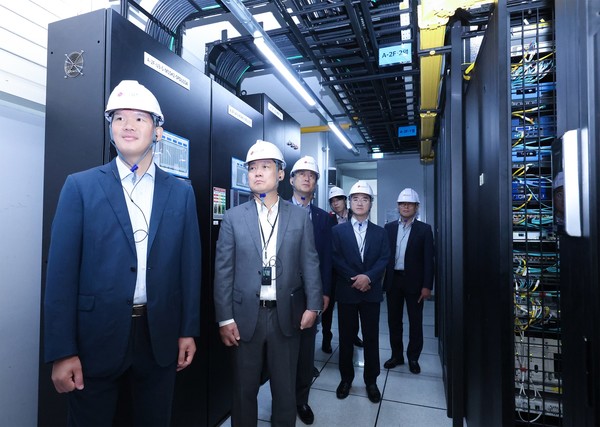
The goal of using this kind of standardization and proven model is to reduce construction delays and quality variations, with the core objective being to strengthen supply capabilities for AIDC demand. A photo taken at LG Uplus's Pyeongchon Mega Center shows Hong Bum-shik, CEO of LG Uplus, and Hur Yoon-hong, CEO of GS Engineering & Construction.
LG Uplus said on the 6th that it signed a memorandum of understanding (MOU) for building an PMDC alliance with GS Engineering & Construction, Xi C&A, Gansam Architecture, and D&O CM on the 4th at the Pyeongchon Mega Center in Anyang, Gyeonggi Province.
PMDC stands for Pre-fabricated Modular Data Center. It is a method in which a data center's building structure, power facilities and cooling facilities are prefabricated in a factory and then assembled on site, allowing for fewer on-site processes and shorter construction periods. It is also expected to reduce quality variations among facilities by applying the same design and components.
A defining feature of PMDC is that modules can be added according to the required capacity. As a result, compared with a model in which the entire facility is built at once, it offers greater flexibility in responding to demand changes, and it makes it possible to stagger investment timing depending on the scale of GPU deployment and customer acquisition. This approach can also be used as a way for AIDC operators to manage capital burdens.
The alliance is focused not on cooperation in supplying equipment, but on standardizing the entire data center process. The scope of standardization covers design, construction, operations and project management.
Accordingly, LG Uplus and the participating companies have been jointly reviewing the PMDC model since April. The purpose of the review is actual application to AIDC projects, and the development target is a 100MW hyperscale PMDC. There are two development models: a new-site construction model and a retrofit model for converting existing buildings into data centers.
The background to developing the existing-facility conversion model is competition to secure AIDC locations. Large-scale data centers must simultaneously meet requirements for power, water, land and permits, and if suitable existing buildings can be used, market entry time can be shortened. However, LG Uplus has not disclosed a specific construction period reduction target compared with the existing approach.
Within the alliance, LG Uplus, as the telecom carrier, will serve as the data center operator. Based on its experience in building and operating data centers nationwide and the Paju AIDC, LG Uplus will be responsible for defining PMDC operating standards and PMDC technical requirements, as well as setting the business direction and validating the model. In this structure, the telecom carrier is in charge of operating standards.
LG Uplus plans to incorporate 27 years of experience in keeping data centers running at a 99.999% uptime level into the design stage. This reflects its goal of moving away from the previous approach, in which building and facilities were decided first without considering post-completion operations. The standard design will include maintenance, failure response and operational efficiency.
In line with this, GS Engineering & Construction, the builder, will handle construction feasibility reviews for new-build PMDCs and optimization reviews for new-build PMDC processes, drawing on its experience in building large-scale data centers. In this structure, the builder is responsible for construction and facilities standardization.
GS Engineering & Construction will also provide EPC capabilities. EPC stands for a method that integrates design, procurement and construction.
Rather than participating as one-off partners on individual projects, the three companies will collaborate by developing and validating a joint standard model before applying it to multiple AIDC projects. In this process, Xi C&A will draw on its experience in MEP (Mechanical, Electrical, Plumbing) to handle the retrofit model, power optimization and cooling optimization. Gansam Architecture will take on the creation of a standard PMDC design model, and D&O CM will provide project and construction management (CM) capabilities to manage schedules, costs and quality.
Through this structure, LG Uplus expects to reflect its data center operations know-how in the standardization of building and facilities, secure external construction company supply chains, and secure external construction company on-site execution capabilities. The alliance also represents an expansion of LG Uplus's 'One LG' strategy to include external specialists.
'One LG' is LG Group's strategy to consolidate AIDC capabilities at the group level. LG Uplus aims to raise the practical applicability of PMDC by combining LG Group's data center capabilities, its power- and cooling-related capabilities, and the expertise of construction and design firms.
A key element of the AIDC business is whether customer GPUs and servers can be accommodated at the scheduled time. While securing land and announcing large-scale facility plans remain important, meeting the actual delivery timing is more important. If PMDC standardization proceeds as planned, LG Uplus will be able to reduce project-by-project design and verification work, and PMDC standardization could bring forward LG Uplus's new data center supply timeline.
What determines PMDC competitiveness is not the modules themselves, but how well disparate conditions such as power incoming lines, permits, on-site assembly and cooling methods are absorbed into the standard model. In particular, 100MW-scale facilities have characteristics distinct from small modular data centers, and they require large-scale power infrastructure and large-scale cooling infrastructure. The key question for this alliance is whether it can secure standard specifications suited to domestic conditions and whether it can secure real-world application cases.
Hong Bum-shik, CEO of LG Uplus, said the core competitive edge of data centers in the AI era is the ability to build infrastructure on time in line with rapidly changing customer demand. He added that the company will push ahead with building a PMDC model with global-level competitiveness and continue strengthening its next-generation AIDC construction capabilities.
Source: IT DAILY · Lee Jae-young
Original: https://www.itdaily.kr/news/articleView.html?idxno=241425
References
This article was produced with the help of an automated content generation algorithm.
Source: IT DAILY
View originalThis article was summarized and organized by BizCrush based on the original article from IT DAILY. For exact quotations and full details, please refer to the original article.