Machina Rocks Sets Out Industrial AI Strategy at “ATTENTION 2026,” Pushes Toward a Fully Autonomous Factory by 2028
TECHWORLD ·
✦ AI Summary
Machina Rocks said it is pushing toward a fully autonomous factory by 2028 and is strategically focusing on connecting AI with on-site data, work processes, and equipment across manufacturing, energy, and defense.
With EnerTork, it identified more than 80 AX initiatives and outlined a roadmap of a “visible factory” in 2026, a “connected factory” in 2027, and an “autonomous factory” in 2028.
It held “ATTENTION 2026” at The Westin Seoul Parnas on the 3rd, and CEO Yoon Sung-ho emphasized field deployment and productivity linkage over benchmark performance.
Machina Rocks said it aims to realize a fully autonomous factory by 2028 by putting AI that is actually used on industrial sites to the forefront. The target sectors are manufacturing, energy, and defense. Rather than competing on the performance of general-purpose AI models, the strategy focuses on connecting AI with on-site data, work processes, and equipment, with the goal of linking it to productivity and business outcomes.
As a concrete example of this direction, Machina Rocks identified more than 80 AX initiatives with actuator manufacturer EnerTork. The scope of those AX initiatives covers the automation of overall factory operations.
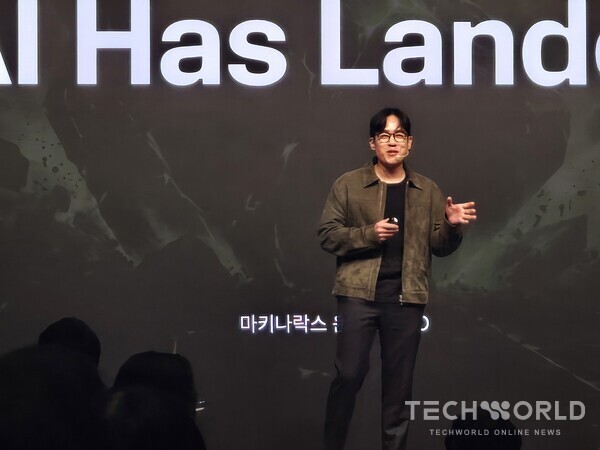
Machina Rocks held its industrial AI conference, “ATTENTION 2026,” at The Westin Seoul Parnas on the 3rd. The event theme was “AI Has Landed.” About 1,600 people preregistered, and about 700 people from the manufacturing, energy, semiconductor, defense, and public sectors attended.
The Grand Keynote featured Machina Rocks CEO Yoon Sung-ho, KAIST endowed professor and Daim Research CEO Jang Young-jae, Korea & Company Group Executive Vice President Kim Seong-jin, HD Hyundai Managing Director Kim Young-ok, and Stefan Hudelmaier, director of device insights cloud architecture.
CEO Yoon said there is a gap between the pace of AI advancement and the productivity gains companies actually feel, adding that improvements in AI performance metrics do not translate into equally fast productivity improvements in the corporate field.
He noted in particular that in manufacturing, semiconductors, and defense, even small errors can lead to production disruptions and safety issues, saying that high benchmark performance alone makes field deployment difficult.
Yoon said that, on the ground, 80% accuracy is not acceptable, and that high benchmark performance does not directly translate into enterprise AI productivity.
As the background to this, he pointed to the Long-tail problem in industrial settings. Equipment data, blueprints, worker judgment criteria, and expert know-how are difficult to learn from public data alone, and general-purpose models have limitations in handling exceptional situations, he explained.
Through FDE-centered operations, Machina Rocks has analyzed customer data and work processes and connected AI to actual systems. In that process, it said it had visited more than 80 customer sites in 32 cities across 5 countries, spent 70,000 hours in the field, and deployed more than 6,000 AI models in live operations.
These applications led to annual savings of more than 1,000 hours in blueprint change reviews, and AI was also applied to more than 1,400 robots at 6 global automobile plants. The company also participated in the combined U.S.-South Korea exercise “Ulchi Freedom Shield (UFS)” and conducted a pilot AI deployment for military battlefield networks.
To preserve these accumulated achievements as corporate competitiveness, Machina Rocks presented “Enterprise AI Sovereignty” as a condition. The company said that “Enterprise AI Sovereignty” means retaining internal ownership of corporate data, work know-how, and AI outputs, and includes an architecture that is not dependent on a specific foundation model and not dependent on GPU or cloud environments.
CEO Yoon said that internal corporate data, know-how, and the AI and outputs created using them must be fully owned by the company. He also said that companies should not be tied to a specific foundation model and should not be bound to a single infrastructure environment.
To support these principles, the AI operating system “Runway” was also introduced. “Runway” is aimed at data centers, factory servers, and edge devices.
“Runway” has functions that integrate the development, deployment, and operation of AI models and agents in heterogeneous environments. It was also presented as being designed for use in closed networks.
Machina Rocks identified more than 80 AX initiatives with EnerTork across office and production operations. It also presented a transition roadmap of a “visible factory” in 2026, a “connected factory” in 2027, and an “autonomous factory” in 2028.
Jang Young-jae, a KAIST endowed professor and CEO of Daim Research, presented “factory orchestration,” in which AI integrates and operates the entire factory, as the next stage for manufacturing.
Professor Jang said that in autonomous factory operations, the importance of focusing on individual factory equipment is matched by the need for collaboration and alignment among multiple pieces of equipment. He also said that operation orchestration based on the overall process flow is necessary.
In line with this direction, KAIST and Daim Research are developing “KAIROS,” an autonomous factory platform based on physical AI. “KAIROS” connects sensors, control systems, production systems, and logistics systems, and uses AI to integrate control of heterogeneous robots and equipment. Development began with 2016 research on swarm control based on reinforcement learning, and combines digital twins, simulation, LLMs, and robot control technologies. As for progress, the company completed the first phase of system construction this year.
Korea & Company Group also introduced examples of applying AI to product development and corporate operations. The group is based on an integrated data platform and is expanding its use cases to include in-house conversational AI, translation, demand forecasting, logistics analysis, and quality analysis.
Korea & Company Group is approaching AI with a focus on combining it with product development and business execution.
The group has been co-developing a “tire pattern generation AI” with Machina Rocks for the third year. The method works by having the designer input product characteristics and performance conditions, after which AI generates patterns and the results of human evaluation and selection are fed back in.
In this regard, Executive Vice President Kim Seong-jin said AI’s role is not to replace designers. He added that the point is to expand the designer’s scope of exploration, and explained that creating joint human-AI outcomes is more important than AI working alone.
On the business innovation front, Korea & Company Group introduced vibe coding to create AI-utilization work programs for employees in the field. Executive Vice President Kim said that partial task automation alone has limits in improving productivity across the company, and emphasized “PI on AI,” a redesign of processes based on AI.
HD Hyundai, meanwhile, is expanding the scope of manufacturing AX application to design, production, and ship operation. HD Hyundai identifies responses to a shrinking skilled workforce and tighter environmental regulations as core to manufacturing AX, and is focusing on converting accumulated site knowledge and manufacturing know-how into data and AI assets.
Executive Vice President Kim Young-ok pointed to the decline in manufacturing labor and said that if skilled techniques disappear, the foundation of manufacturing competitiveness could weaken. In response, HD Hyundai has begun pushing manufacturing AX.
HD Hyundai presented people, data, and platforms as the 3 pillars of manufacturing AX, and in shipyards it has begun promoting the Future Advanced Shipyard (FOS) strategy. The FOS strategy aims to improve visibility on production sites, connect processes and data, and shift to an intelligent autonomous operation system.
In the design phase, the company is pushing a shift from 2D drawing-centered work to 3D model-based work, based on digital twin use and SSOT use. It is also moving ahead with building a “shipbuilding AI master craftsman agent” based on the use of design, production, quality, and safety knowledge.
HD Hyundai is also expanding the scope of AI applications to ship operation. The company’s solutions include engine diagnostics, safety management, economic operation, and autonomous navigation, and it is pushing to improve vessel operating efficiency and enhance vessel safety based on these solutions. As a long-term plan, it presented the combination of eco-friendly propulsion systems and the development of SDV.
As an overseas case, the agentic AI assistant “Nora,” co-developed by device insights and Machina Rocks, was introduced. First, it was noted that a wind turbine has more than 4,000 sensors per unit and maintenance requires 5 to 10 visits by technicians a year, making the process complex. If the cause of a fault cannot be identified on-site, components must be replaced one by one to check the issue or the site must be revisited, increasing both downtime and costs, it was explained.
Because of these characteristics, it was also noted that solving issues on the first visit is key in service engineers’ on-site response. Stefan Hudelmaier, director of device insights cloud architecture, explained that Nora helps on-site response based on past service cases and manuals and plays a role in providing the information needed to resolve issues on the first visit.
Nora analyzes wind turbine manuals, maintenance histories, ERP, and telemetry data to present technicians on-site with the cause of a fault, inspection procedures, and required parts information in natural language. It was introduced as a support tool that can reduce inefficiencies such as return visits when the cause cannot be identified in the field, or repeated unnecessary parts replacement.
Using Nora, device insights is increasing the first-time fix rate (FTFR) in on-site maintenance, reducing repeat dispatches, and cutting unnecessary parts replacements. It also supports offline mode for remote field response and allows experience accumulated during maintenance to be fed back into the knowledge base.
Based on these cases, the stage of AI adoption in industrial settings is shifting from individual technology verification to changes across production and operations. In industries such as manufacturing, shipbuilding, and energy, where on-site data and expert judgment are critical, the competitive variable is moving from general-purpose model performance to the ability to connect AI with actual work and equipment and continuously advance it.
Source: TECHWORLD · Kim Seung-gi
Original: https://www.epnc.co.kr/news/articleView.html?idxno=406516
References
This article was produced with the help of an automated content generation algorithm.
Source: TECHWORLD
View originalThis article was summarized and organized by BizCrush based on the original article from TECHWORLD. For exact quotations and full details, please refer to the original article.