Kakao Builds AI for Everyone on KakaoTalk, Targets 10 Million Users by 2027
TECHWORLD ·
✦ AI Summary
Kakao is developing an "AI for everyone" platform that links domestic AI models with public and private agents based on familiar services such as KakaoTalk and phone calls.
The Kakao consortium consists of Kakao and the LG Group, with Kakao overseeing planning, development, and operations and using KakaoTalk as the main channel.
The consortium is pushing platform construction, beta testing, and broader participation by outside companies and developers, with targets of 5 million MAU by December this year and 10 million users by the end of 2027.
Kakao is moving to build an "AI for everyone" based on familiar services such as KakaoTalk and phone calls, services that people in Korea already use comfortably. The company is developing a nationwide AI platform by connecting domestic AI models with public and private agents.
To that end, the Kakao consortium consists of Kakao and the LG Group, combining each company’s service touchpoints with capabilities in AI, telecommunications, home appliances, and public systems. Kakao is in charge of overall service planning, development, and operations, and will use KakaoTalk as the main service channel. KakaoTalk has about 50 million user touchpoints.
The Kakao consortium is advancing the project following its selection as the operator of the Ministry of Science and ICT and the National IT Industry Promotion Agency (NIPA)-led "AI for everyone" initiative. On the 4th, the consortium announced its service development plan at a briefing for operators of the Ministry of Science and ICT’s "AI for everyone" project at the Korea Press Center in Seoul.
At the event, the Kakao consortium set goals of reaching 5 million monthly active users by December this year and expanding to 10 million users by the end of 2027.
Each participating organization has divided responsibilities among infrastructure operations, service planning and expansion, AI model provision, device integration, public-sector linkage, and specialized development. Kakao Enterprise is responsible for operating infrastructure such as AI cloud and data centers, while LG Uplus will handle joint service planning and operations, as well as the spread of phone-based AI. LG AI Research will provide domestic AI models, and LG Electronics will support appliance-linked services. LG CNS will support public data and system integration and the development of specialized services.
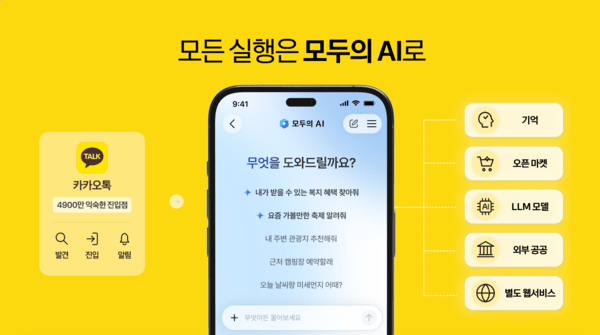
The service will adopt Kakao’s "Kanana" and LG AI Research’s "K-EXAONE" as the applied models. At its core, the structure is designed so that after users search for information through KakaoTalk or phone-based AI during a conversation, they can go on to apply, make reservations, and complete payments.
For this purpose, Government24 and AI National Secretary are included among the connection targets, while public services and private specialty services will be linked in the form of AI agents. Specialized services will be developed mainly in employment, finance, health and medical care, and life care, based on areas closely tied to everyday life and with high user demand.
In the public sector, the plan presented was to connect an AI agent from a request for a resident registration certificate to KakaoTalk authentication, electronic certificate issuance, and submission to a bank. It also includes a structure in which AI analyzes the contents of public documents received through the National Secretary and then provides, in conversational form, the information needed, such as whether the user is eligible for support and how to use it.
In the private sector, the company is pushing a plan to link Kakao’s existing services with AI agents. Through this, it is envisioning functions that recommend products based on user requests and carry out payment processing, as well as multiple sequential tasks such as making Kakao T reservations to match travel time, drafting a trip itinerary, and registering it in Talk Calendar.
In the initial stage, the consortium will proceed by developing and verifying specialized services together with participating companies and field-specific specialists. Later, it plans to open the platform by using tools such as "PlayMCP," allowing outside companies and developers to register and provide AI services.
In the service expansion phase, the consortium will pursue a direction of "one AI agent per person." Under the concept of building personal AI according to each user’s purpose and needs, it will push ahead with plans to enhance personalization features and to deepen collaboration among specialized agents, while also presenting a concept in which a single AI handles the search, connection, and execution of needed services.
To expand the user base, the consortium will use Kakao and LG’s online and offline channels as a means of securing a large number of users. The channels include KakaoTalk channels and Wallet, LG Uplus text messages and RCS, and the U+ONE app and web, all aimed at driving service use. For seniors who are less familiar with digital services, offline counseling and training will also be provided.
For this year, the Kakao consortium plans to build the platform and conduct beta testing, with a target of securing 5 million MAU by December. It also set a goal of expanding to 10 million users by the end of 2027. After that, it plans to expand links between personalized functions and specialized services, broaden participation by outside companies, and increase developer participation, while also laying out a plan to build an ecosystem for the joint use of domestic AI models and services.
Source: TECHWORLD · Kim Seung-gi
Original: https://www.epnc.co.kr/news/articleView.html?idxno=406550
References
This article was produced with the help of an automated content generation algorithm.
Source: TECHWORLD
View originalThis article was summarized and organized by BizCrush based on the original article from TECHWORLD. For exact quotations and full details, please refer to the original article.