Korea Proposes Industry-Centered AI Standards and Supply Chain Cooperation at G20
TECHWORLD ·
✦ AI Summary
The government proposed at the G20 Innovation Ministers' Meeting ways to strengthen global supply chain resilience through AI standards that reflect industrial demand and the use of AI in manufacturing.
Minister Kim Jung-kwan said the main agenda items were intellectual property policy in the AI era, AI standards, industrial innovation, and supply chain investment, and stressed the need for an institutional foundation to advance AI innovation and protect intellectual property rights in parallel.
The government also shared its Manufacturing AI Transformation (M.AX) example and experience in international standards cooperation, while emphasizing supplier diversification and trust-based cooperation in key resources, materials, and components.
The Ministry of Trade, Industry and Energy said the government proposed to the G20 ways to strengthen global supply chain resilience through AI standards that reflect industry demand and the use of AI in manufacturing.
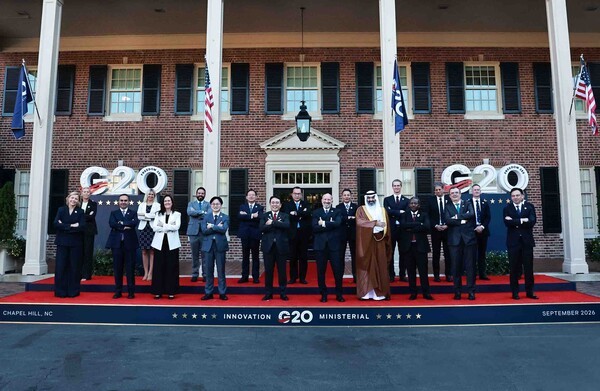
Minister Kim Jung-kwan attended the '2026 G20 Innovation Ministers' Meeting' held on the 2nd local time in Chapel Hill, North Carolina, as Korea's chief delegate. The United States is the 2026 G20 chair, and it also hosted this meeting.
The main agenda items at the meeting were intellectual property policy in the AI era, AI standards, industrial innovation, and supply chain investment. Member countries discussed changes to intellectual property systems driven by the spread of AI, standards needed in industrial settings, and ways to strengthen supply chain resilience.
Kim said AI is changing the ways research and development, creation, and innovation are carried out, and that an institutional foundation is needed to simultaneously support AI innovation and the protection of intellectual property rights. He also stressed that the use of AI in the patent field could expand opportunities to participate in innovation, and that this should be backed by a trustworthy patent system.
In the copyright field, participants shared Korea's experience operating the fair use principle and its experience running guidelines related to AI training. Based on this, they presented the view that protecting creators' rights and creating a predictable environment for AI development and use should be pursued in parallel.
On the industrial side, a key agenda item was establishing standards to support AI use in industrial settings. Kim emphasized the need to reflect actual industrial demand and usage experience in standards, and introduced Korea's cases of identifying and developing AI standards in major industries such as autonomous manufacturing, AI future mobility, and robotics. Korea also shared that these cases involved identifying and developing AI standards based on company participation.
The need for international standards cooperation to connect technologies and systems across countries was also raised. The government has experience participating in AI standards discussions at organizations such as ISO and IEC, and it also said it will cooperate in establishing international standards to improve interoperability and reliability.
In the supply chain area, the government shared examples of promoting Manufacturing AI Transformation (M.AX). Manufacturing AI Transformation (M.AX) involves applying AI to production planning, demand forecasting, and supply chain management, with the goal of helping manufacturers adapt to change. It also aims to improve supply chain operating efficiency and flexibility.
Kim explained that the use of AI in manufacturing sites can contribute not only to improving the productivity of individual companies but also to enhancing the crisis-response capability of global production networks. He connected the effects of AI use in manufacturing sites not only to internal productivity at companies but also to strengthening the crisis-response capacity of the global production system.
He then stressed that to secure this competitiveness, it is necessary to diversify suppliers, link industrial competitiveness across countries, and expand trust-based cooperation in key resources, materials, and components. He also said that for AI innovation to lead to real industrial competitiveness, not only technological progress but also intellectual property systems, standards, and resilient supply chains must develop together, and that Korea plans to actively cooperate with G20 member countries based on its experience in industrial settings.
Source: TECHWORLD · Kim Seung-gi
Original: https://www.epnc.co.kr/news/articleView.html?idxno=406547
References
This article was produced with the help of an automated content generation algorithm.
Source: TECHWORLD
View originalThis article was summarized and organized by BizCrush based on the original article from TECHWORLD. For exact quotations and full details, please refer to the original article.