PrivateAI Says Control Is Falling Behind AI's Rapid Spread, Lays Out Vision to Connect the Entire Stack
TECHWORLD ·
✦ AI Summary
As AI spreads inside companies, the scope of management has widened to endpoints, networks, prompts, and models, but the control framework to handle it remains insufficient.
At Tech Summit on the 4th, PrivateAI presented new risks and management strategies for the AI era and said it would connect each part of the flow into a single platform to close control gaps.
CEO Kim Young-rang said the core problem with AI's spread is that control systems cannot keep up, and said an end-to-end control framework and the Private AI platform are needed.
As AI spreads across companies, security and control issues are coming to the fore. In particular, as corporate use of AI expands from simple search and answer generation to direct execution of business systems, the scope of risks companies must manage is also widening. The areas requiring management have expanded to endpoints, networks, prompts, and models, but the control framework needed to handle that expanded scope remains insufficient.
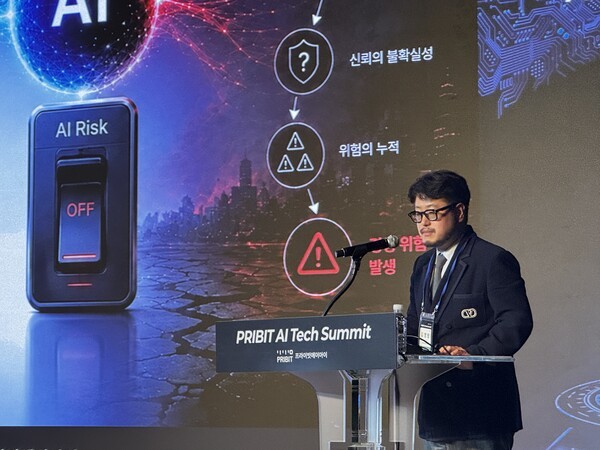
Against this backdrop, PrivateAI held Tech Summit on the 4th. At the event, the company presented new risks for businesses in the AI era and risk management strategies, and said it would push to close control gaps by linking each area of the AI flow into a single platform. It also unveiled a vision for responding to the expanded risk landscape.
At the event, Kim Young-rang, CEO of PrivateAI, gave a presentation under the theme, "In an era where people and AI coexist, what risks should we prepare for?" Kim explained that the scope of risks companies must manage has expanded, but said AI adoption itself is not the problem. The core issue, he said, is that AI control systems are not keeping pace with the speed of that spread.
He explained that what appears externally to be a single AI request from the user's perspective actually triggers multiple rounds of data retrieval, model selection, comparison, judgment, and API and tool calls inside the system. He also said that as AI connects not only to internal documents and RAG but also to ERP, CRM, other business systems, external AI, and the cloud, the complexity of control targets and paths continues to increase.
He said this expanded connectivity creates gaps in data access permissions and execution management. He added that these control gaps lead to lower quality and reliability, as well as higher costs, and can ultimately result in delays or even suspension of AI adoption.
He said that as AI use expands rapidly, greater AI autonomy must be accompanied by real control and accountability verification. He also pointed out that the gap problem cannot be solved by simply adding features, and that adding individual security functions is not enough. Instead, he stressed the need for an end-to-end control framework that integrates AI execution across the board.
PrivateAI proposed a way to fill the current gap by connecting users, data, models, agents, tools, and business execution results on a single platform. He referred to this as the Private AI platform.
He explained that unified management of five risks related to data security, quality, trust, cost efficiency, execution, operations, value, and performance would enable integrated control over the entire AI execution process. The Private AI platform consists of Risk Intelligence, PacketGo OS, and Private Workspace. Risk Intelligence handles risk analysis and policy decision support, PacketGo OS is responsible for the actual enforcement of access and connections, and Private Workspace serves as the space where users carry out AI tasks.
He said PrivateAI's goal is not to restrict AI. He also explained that maintaining corporate control is a prerequisite. He added that the purpose is to help companies keep control while safely assigning more work to AI and operating it.
Source: TECHWORLD · Kim Hye-jin
Original: https://www.epnc.co.kr/news/articleView.html?idxno=406545
References
This article was produced with the help of an automated content generation algorithm.
Source: TECHWORLD
View originalThis article was summarized and organized by BizCrush based on the original article from TECHWORLD. For exact quotations and full details, please refer to the original article.