NVIDIA Expands 'Local AI' Ecosystem at IFA 2026, Unveils 'RTX Spark' and 'PAIR'
TECHWORLD · · 1 views
✦ AI Summary
NVIDIA announced new technologies to improve local AI accessibility and performance, along with partner collaborations, at IFA 2026.
RTX Spark and PAIR were presented as the disclosed products, and RTX Spark is a small Windows PC set to launch in October.
PAIR distributes inference requests across multiple PCs on a local network, while Perplexity Portable Computer runs locally on Linux systems such as DGX Spark.
NVIDIA is moving to accelerate the expansion of its ecosystem for running AI in local environments. On the 4th, NVIDIA laid out plans at 'IFA 2026' in Berlin, Germany, to announce new technologies that improve local AI accessibility and performance, while also announcing efforts to expand the local AI ecosystem with a range of partners. The products disclosed in the article title are 'RTX Spark' and 'PAIR'.
Frontier intelligence is a trend extending into local environments. Within that trend, NVIDIA is working with partners including Microsoft to help make it easier to set up and run AI agents on NVIDIA hardware.
NVIDIA's strategy is focused on simplifying local AI use through faster inference performance and new tools. The goal is to make it easier to run AI agents on hardware-based systems.
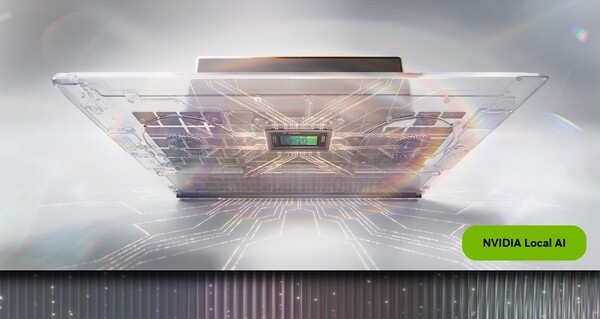
A concrete product in this direction is RTX Spark. RTX Spark is a small Windows PC set to launch in October, aimed at AI enthusiasts, developers, and creators, and designed for the local execution of powerful AI agents.
At IFA 2026, NVIDIA announced expanded local AI support for NVIDIA GPUs. Examples of supported offerings include Hermes Agent, OpenClaw, and Perplexity Portable Computer. Simplified local AI support based on NVIDIA GPUs will also be provided.
Along with that, NVIDIA is strengthening local inference performance and enabling local inference that is up to 1.9 times faster. Users will also be able to take advantage of new llama.cpp optimizations and new vLLM optimizations directly, and access them through LM Studio and Ollama.
Until now, running AI agents based on local models required a certain amount of preparatory work. Pre-run tasks included selecting a model, finding a compatible inference server, adjusting quantization settings, and keeping components up to date.
NVIDIA has set a policy to further simplify that process on RTX and DGX systems, and plans to provide simplified local model setup for Windows environments for three of the most widely used agent applications. Each application was built on llama.cpp and uses NVIDIA's latest inference optimizations.
NVIDIA also unveiled 'NVIDIA PAIR.' PAIR is a 'Personal AI Router' tool that automatically discovers PCs on a local network and routes individual inference requests to systems with spare compute capacity.
PAIR can split AI agent tasks into multiple smaller tasks and run those tasks in parallel. Rather than relying on a single GPU to handle everything centrally, it distributes processing across multiple PCs, increasing the overall computing performance available to local AI. The purpose of PAIR is to make the computing resources of multiple PCs connected to a local network usable for AI.
Hermes has the ability to split a single task into multiple subagents, along with examples such as sorting a complex inbox by prioritizing items that need attention, can be deferred, or can be skipped. PAIR provides a function that distributes each of those divided tasks across multiple PCs available on the network.
This configuration expands parallel execution of tasks. It also makes it possible to move AI workloads to other PCs while the main PC is being used for gaming or content creation.
PAIR can be used in Ollama and LM Studio, and supports both connected and disconnected devices on a network. The NVIDIA PAIR beta is available on Windows, macOS, and Linux through both a graphical interface and a terminal interface. Supported products include NVIDIA GeForce RTX 20 series and later, RTX PRO workstation GPUs based on the Turing or later architecture, DGX Spark, and Apple M4 and later products.
Perplexity Portable Computer, unveiled last month, has been folded into NVIDIA's local AI ecosystem. As a result, Perplexity can run locally on Linux systems such as NVIDIA DGX Spark with an integrated app environment spanning models, orchestration, and tools. Using Perplexity Portable Computer requires Linux and an NVIDIA RTX GPU with at least 24GB VRAM, and Windows support will be provided later.
On this device, users can run the entire workflow locally without credits. If additional research or inference is needed, the structure allows part of the task to be expanded to more than 15 frontier models in the cloud. In that case, the portable computer requests user permission before sending content to the cloud, and it supports keeping sensitive information on the device.
NVIDIA plans to launch the RTX Spark Windows PC in October. At IFA 2026, Lenovo and Acer unveiled new products based on RTX Spark. Acer presented a compact desktop RTX Spark concept, while Lenovo announced the Yoga Pro 9n and Yoga 9n 2-in-1.
RTX Spark is aimed at creators, gamers, and AI agents. The RTX Spark configuration includes a 1 petaflop RTX Blackwell GPU, up to 128GB of unified memory, and a 20-core Grace CPU.
The RTX Spark Superchip support range extends from high-performance slim laptops to compact desktops for always-on AI agents. Combined with the new Windows agent framework, it supports OS-level control and secure background execution of AI agents.
The gaming ecosystem is also expanding. Last week at gamescom, NVIDIA announced that Electronic Arts (EA), Embark, and Ubisoft had joined the ranks of developers and publishers delivering the latest blockbuster titles for RTX Spark Windows PCs, and at Computex in May, support for RTX Spark was announced for Krafton, NetEase, Riot Games, and Xbox. Electronic Arts (EA), Embark, and Ubisoft are expanding the RTX Spark support ecosystem alongside the companies announced earlier.
In August, NVIDIA continued its push to expand the ecosystem by unveiling a range of local AI models and technologies. As part of that effort, Nemotron 3.5 Lightning was presented as a 30 billion parameter model.
Nemotron 3.5 Lightning can run on RTX PCs, RTX PRO workstations, DGX Spark, and Jetson. NVIDIA is accelerating the expansion of the local AI market ecosystem by connecting AI models, inference optimization, agents, dedicated hardware, and the gaming ecosystem.
Source: TECHWORLD · Park Kyu-chan
Original: https://www.epnc.co.kr/news/articleView.html?idxno=406538
References
This article was produced with the help of an automated content generation algorithm.
Source: TECHWORLD
View originalThis article was summarized and organized by BizCrush based on the original article from TECHWORLD. For exact quotations and full details, please refer to the original article.