Xiaomi to Develop AI Acceleration and Vehicle Chips In-House, with O100 and D100 Set for 2027
IT DAILY ·
✦ AI Summary
Xiaomi said at IFA 2026 that it is expanding semiconductor in-house development beyond smartphones to AI and automobiles while unveiling its self-developed XRING chips.
Xiaomi introduced the Xiaomi 18 Fold with XRING O3, along with XRING O100 for AI computing and XRING D100 for intelligent driving.
Under its "Human × Car × Home" strategy, Xiaomi plans to connect smartphones, home appliances, and automobiles around the AI model MiMo, OS HyperOS, and semiconductors XRING, while pursuing European expansion in 2027 and investment of more than CNY 200 billion from 2026 to 2030.
Xiaomi is expanding its business focus by broadening its semiconductor in-house development beyond smartphones to AI and automobiles. It has extended the use of its self-designed chips from smartphones to AI and vehicles, while also securing its own AI model, OS, and semiconductors. Xiaomi's strategy is to connect a single technology framework across smartphones, home appliances, and automobiles.
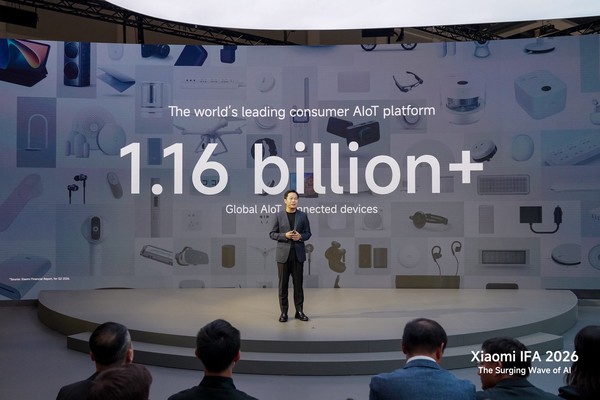
Xiaomi unveiled this direction in a keynote speech at IFA 2026 in Berlin, Germany, on the 3rd local time. William Lu, Xiaomi Group partner and president, made the announcement at IFA 2026 in Berlin, and Xiaomi said its presentation outlined a technology strategy for applying its in-house semiconductors and AI to smartphones, home appliances, and automobiles.
A large-scale exhibition was held to mark Xiaomi's first participation in IFA. The exhibition hall covered 3,300 square meters (about 998 pyeong), and Xiaomi showcased more than 380 products and technologies, including smartphones, smart home devices, and electric vehicles.
Lu Weibing, president of Xiaomi, said in the keynote that the company is continuing to invest in foundational technologies, citing its self-developed XRING semiconductor as an example. Xiaomi has in fact expanded its chip development from the first in-house 3-nanometer (nm) flagship system-on-chip (SoC), XRING O1, unveiled in 2025, into AI and automobiles.
At this year's IFA exhibition, Xiaomi showcased the foldable smartphone Xiaomi 18 Fold, equipped with its next-generation flagship AI SoC, XRING O3. XRING O3 is a mobile SoC that integrates CPU, GPU, NPU, and image processing functions, and the Xiaomi 18 Fold is the first flagship product to feature O3.
Xiaomi said it is expanding the scope of its in-house chips beyond mobile devices to AI computing and automobiles. XRING O100 is an AI-optimized acceleration chip, and Xiaomi said it offers about 16 times the memory bandwidth of a typical flagship smartphone. XRING D100 is a 3-nanometer chip designed for intelligent driving, and both XRING O100 and XRING D100 have completed development and verification and are scheduled to be installed in products starting in 2027.
Xiaomi unveiled its self-developed XRING chips at IFA 2026. Photo courtesy of Xiaomi.
Lu said the three on-device chips serve as the AI driving foundation for Xiaomi's entire ecosystem. He also explained that the three on-device chips are the basis for supporting AI capabilities across a range of devices.
In line with this, Xiaomi's self-designed semiconductor portfolio is expanding from smartphone chips to AI accelerators and automotive chips. According to foreign media reports, Xiaomi has invested more than CNY 20 billion in XRING development and has also expanded its semiconductor design organization to more than 3,000 people.
This broader expansion of in-house semiconductors is linked to Xiaomi's "Human × Car × Home" strategy. Under this strategy, personal devices such as smartphones and tablets are classified as "Human," electric vehicles as "Car," and smart appliances as "Home."
Through the "Human × Car × Home" strategy, Xiaomi is pushing to connect the three areas with a common technology base. The expansion of in-house semiconductors is proceeding alongside this effort to build that common technological foundation.
Xiaomi has positioned the LLM MiMo, AI platform HyperAI, OS HyperOS, and semiconductor XRING as its core technology pillars, and these technologies underpin its structure. Xiaomi's strategy does not stop at expanding its product lineup; it is a method of strengthening connectivity across hardware by directly securing AI models, OS, and semiconductors.
Along with this, Xiaomi is also developing AI models in parallel. Xiaomi said MiMo-V2.5 ranked first in weekly token usage in OpenRouter's July aggregate, with weekly usage exceeding 10 trillion tokens.
Xiaomi has outlined a plan to expand AI applications from on-screen Q&A to actual devices and spaces. AI operates based on the user's location, time, and surrounding environment, and works by linking smartphones, home appliances, and automobiles to perform the functions needed.
Xu Fei, Xiaomi Group vice president and chief marketing officer (CMO), said that Xiaomi's broad product portfolio is its biggest strength in the AI era, and added that the company plans to extend AI beyond the screen into the physical environment.
Xiaomi said it uses Mijia as the linkage axis for smart homes. As examples, it cited pre-adjusting lighting and air conditioning based on location and weather when arriving home, and simultaneously controlling lighting, curtains, and indoor temperature while reading. It also presented, as part of its smart home expansion vision, a move beyond device-by-device control toward simultaneous operation of multiple devices based on AI's understanding of the usage environment.
Xiaomi also presented automobiles as one pillar of the ecosystem. At the IFA exhibition, it showcased the electric vehicles SU7 and SU7 Ultra, as well as the concept car Vision Gran Turismo.
Xiaomi Auto has signed MOUs with eight major German automotive dealer groups and has begun building a sales and service network in preparation for entering the European market in 2027. Lu said Xiaomi Auto plans to enter the European market in 2027 and explained that it aims to build a trustworthy sales and service network for European consumers through broader partner cooperation.
Xiaomi is pursuing business expansion and technology in-house development at the same time. The company is expanding its smartphone-centered growth business into home appliances and automobiles, while building AI, OS, and semiconductors as its own technology pillars connecting home appliances and automobiles. As part of its efforts to increase R&D investment to support technology in-house development, Xiaomi plans to invest more than CNY 200 billion from 2026 to 2030 in AI, OS, in-house semiconductors, electric vehicles, robots, and smart manufacturing.
Source: IT DAILY · Kim Byung-joo
Original: https://www.itdaily.kr/news/articleView.html?idxno=241403
References
This article was produced with the help of an automated content generation algorithm.
Source: IT DAILY
View originalThis article was summarized and organized by BizCrush based on the original article from IT DAILY. For exact quotations and full details, please refer to the original article.