Nvidia to Acquire Hugging Face for USD 12.9303 Billion
IT DAILY ·
✦ AI Summary
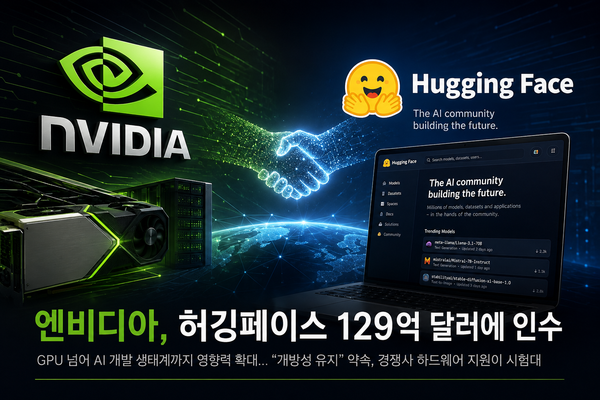
Nvidia has agreed to acquire Hugging Face for USD 12.9303 billion, or about KRW 17.5 trillion.
Hugging Face is a platform for developing, sharing, and deploying AI models, datasets, and applications, and it is used by more than 18 million developers and more than 200,000 companies.
Nvidia said it will keep Hugging Face open after the acquisition and continue supporting other semiconductor companies as well as multi-cloud, multi-accelerator development environments.
Nvidia said on the 3rd, local time, that it has agreed to acquire Hugging Face, one of the world's largest open AI platforms. According to SEC filings, the deal value is USD 12.9303 billion, or about KRW 17.5 trillion. Nvidia's decision to acquire Hugging Face was presented as a transaction with implications beyond simply adding another AI software company.
Nvidia has long dominated the GPU-based AI infrastructure market and secured a strong position built on GPU and CUDA. The acquisition target is an AI model development and distribution platform, and Hugging Face has provided functions that allow developers to explore and share models and datasets, as well as deploy them into real-world services. With this deal, Nvidia will extend its reach into the broader ecosystem for AI model development and distribution platforms.
The deal could expand Nvidia's influence beyond GPU and CUDA to the wider AI development ecosystem. In other words, its sphere of influence could grow beyond hardware and development tools to the area where AI developers actually build services. This aligns with the view that the Hugging Face acquisition carries significance beyond simply adding a software company.
Under the deal structure, about USD 11.9 billion, or about KRW 16 trillion, will be paid to Hugging Face shareholders. Nvidia will also provide up to USD 1 billion, or about KRW 1.3 trillion, in stock-based retention programs for employees joining the company. The transaction is subject to regulatory approvals and other conditions, with completion expected in the first half of next year.
Hugging Face is a platform for developing, sharing, and deploying AI models, datasets, and applications. The platform is used by more than 18 million developers and more than 200,000 companies.
After the acquisition, Nvidia plans to expand Hugging Face's infrastructure and the platform itself, while also improving access to AI for developers and institutions. The deal has drawn attention because of Hugging Face's position within the AI development ecosystem.
Nvidia's existing influence in the AI market has been based on GPU and the CUDA software platform. Once the acquisition is completed, Nvidia will be connected to AI developers during model selection, during data acquisition, and during application deployment.
The significance of this shift is being highlighted against the backdrop of growing influence of open-weight models in the AI market. Hugging Face hosts AI models developed by companies and research institutions, including Meta's Llama, along with datasets developed by various companies and research institutions. After downloading resources from Hugging Face, developers can fine-tune them with their own data and deploy them in ways suited to enterprise environments.
WIRED analyzed the deal as a strategy for Nvidia to expand its influence not only in AI infrastructure but also in the software side of generative AI development. Nvidia is also working to expand its own open-weight model, Nemotron.
The deal is also tied to recent changes in the AI semiconductor market. Major Big Tech companies such as Amazon, Google, and Meta are developing their own AI accelerators, and the long-term goal of these major Big Tech companies is to reduce reliance on Nvidia GPUs.
In this trend, defending GPU market share is a key strategy for Nvidia. At the same time, it is becoming increasingly important to steer users toward Nvidia's software and development ecosystem regardless of which AI accelerator they use.
Hugging Face could become a powerful developer touchpoint for that strategy. The deal matters in that sense.
However, the transaction also raises questions about Hugging Face's neutrality. Nvidia referred to its promise to preserve openness.
The issue is the impact on the open AI ecosystem of one particular GPU vendor owning one of the world's largest open AI platforms. The key question is whether Nvidia's acquisition of Hugging Face could change the character of the open AI ecosystem. Nvidia is aware of that issue.
In its SEC disclosure, Nvidia said it will keep the Hugging Face platform open in its existing form even after the acquisition. It also promised to continue allowing developers and model developers to upload and download models and datasets.
Nvidia said it will also continue supporting other semiconductor companies. Jensen Huang, Nvidia CEO, also emphasized that Hugging Face's open platform operations will continue.
According to AP, Nvidia plans to support a multi-cloud, multi-accelerator development environment even after the acquisition. However, market concerns have not been fully resolved.
One reason for concern is the possibility that if Nvidia owns the platform, it could eventually prioritize optimization services for its own GPUs and software. Some market analysts worry that Nvidia could favor its own hardware and that competing semiconductor companies could be placed at a disadvantage.
AMD and Amazon also invest in Hugging Face. AMD is a competitor to Nvidia GPUs, while Amazon is expanding its own AI semiconductors within the cloud market. Accordingly, a key issue after the Nvidia acquisition is whether Hugging Face can maintain its character as a 'neutral AI development platform.'
The implication of this acquisition lies in Nvidia's move beyond a GPU maker. Nvidia expanded its business from GPUs to CUDA, and then broadened into networking, AI servers and systems, and AI models and software.
A combination with Hugging Face will create touchpoints with Nvidia's ecosystem during AI developers' model exploration phase, and also during the training phase. It will also create touchpoints during the fine-tuning phase and the actual infrastructure deployment phase.
This is tied to securing a defensive line that can preserve influence over the developer ecosystem even as the number of Big Tech companies developing their own AI chips increases. The deal is seen as a way for Nvidia to expand developer touchpoints as it broadens its business beyond GPUs across the entire AI development process.
The deciding factor in the success of the deal may be something other than the USD 12.9 billion acquisition price, and that factor is likely to be whether Nvidia fulfills its promises. Nvidia has said it will give equal support on Hugging Face to competing hardware, including AMD, as well as to various clouds and AI models, and the key issue is whether it can maintain that equal support while expanding its own AI ecosystem.
As ownership of Hugging Face, which has served as the 'commons' for AI developers, shifts to Nvidia, the main point to watch is whether Hugging Face will remain open after the acquisition.
Source: IT DAILY · Lee Jae-young
Original: https://www.itdaily.kr/news/articleView.html?idxno=241399
References
This article was produced with the help of an automated content generation algorithm.
Source: IT DAILY
View originalThis article was summarized and organized by BizCrush based on the original article from IT DAILY. For exact quotations and full details, please refer to the original article.