SDT Demonstrates Quantum Computer Manufacturing Capabilities at SiQEW 2026, From Superconductors and Ion Traps to Silicon Spin
TECHWORLD ·
✦ AI Summary
SDT said on the 4th that it participated in SiQEW 2026 and unveiled its QDM(Quantum Design and Manufacturing) capabilities spanning quantum design and manufacturing.
The conference was co-hosted by the National Research Foundation of Korea and Seoul National University (Next Quantum), and SDT showcased multi-platform capabilities spanning superconductors, ion traps, and silicon spin.
SDT presented a blueprint for the joint development of a "6-qubit silicon spin quantum computer" that it is pursuing in collaboration with Seoul City, with SDT, Semicon, and Seoul National University divided into roles for a joint demonstration planned for the end of this year.
SDT said on the 4th that it participated in SiQEW 2026 and unveiled its QDM(Quantum Design and Manufacturing) capabilities spanning quantum design and manufacturing.
SiQEW 2026 is an international academic conference held annually since 2007, with the goal of sharing cutting-edge research achievements in the semiconductor qubit field. This year's event was co-hosted by the National Research Foundation of Korea and Seoul National University (Next Quantum), and drew a large number of domestic and international scholars and industry officials in the silicon and germanium spin qubit field.
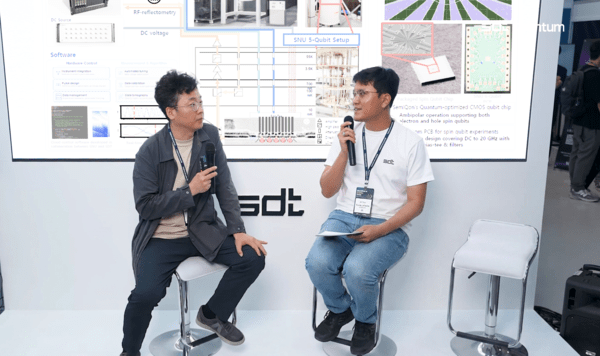
SDT said the conference demonstrated its multi-platform capabilities spanning superconductors, ion traps, and silicon spin, while also helping promote its technological prowess. The exhibition was centered on QDM, and visits from global researchers continued steadily. Inquiries related to cryogenic environment measurement and control performance, as well as integration with HPC(high-performance computing), also increased.
SDT presented a blueprint for the joint development of a "6-qubit silicon spin quantum computer" that it is pursuing in collaboration with Seoul City. The joint development will involve the Quantum Integrated Circuit Laboratory at the Center for Hybrid Quantum Computing at Seoul National University, Semicon, and SDT, with a joint demonstration planned for the end of this year.
The roles are also divided. SDT will handle the integration and operation of the overall quantum computer system, Semicon will provide tested quantum chips, and Seoul National University will offer academic advisory support on measurement-related matters.
A Semicon official said the company has been combining SDT control and measurement systems with its own silicon technology since its early startup days. The official added that, in the 6-qubit silicon spin quantum computer to be built with Seoul City's support by the end of this year, SDT's integration capabilities are a key driver for advancing chip-level research into a commercial system.
Kim Do-heon, a professor in the Department of Physics and Astronomy at Seoul National University, said he is working with SDT QDM infrastructure in actual research settings. He also explained that SDT's latest quantum control equipment, QCU, has secured the essential functions needed to replace foreign-made equipment and support localization, and said that through cooperation between Seoul National University and SDT, they succeeded in domestically developing QCU control for silicon spin qubits.
SDT said it is looking ahead to the next leap forward with the 6-qubit demonstration involving Seoul National University and Semicon, and aims to use the project as a means to overcome the limits of a specific architecture and ultimately position itself as a leading company driving a heterogeneous quantum ecosystem.
Source: TECHWORLD · Kim Hye-jin
Original: https://www.epnc.co.kr/news/articleView.html?idxno=406525
References
This article was produced with the help of an automated content generation algorithm.
Source: TECHWORLD
View originalThis article was summarized and organized by BizCrush based on the original article from TECHWORLD. For exact quotations and full details, please refer to the original article.