Korea & Company Group Diagnoses ‘ROI Stagnation’ After AI Adoption at ‘ATTENTION 2026,’ Shares Case Studies
TECHWORLD ·
✦ AI Summary
Korea & Company Group Chairman Cho Hyun-bum attended the grand keynote session at the industrial AI conference 'ATTENTION 2026' on the 3rd.
At the event, Korea & Company Group introduced examples of AI-based business operation innovation and presented its AI transformation (AX) strategy.
Kim Sung-jin, executive vice president of the Digital Strategy Office at Korea & Company, pointed to ROI stagnation and PoC-stage stagnation after the adoption of generative AI, and, against the backdrop of data fragmentation and the limitations of the traditional large-scale system-building approach, introduced a cloud-based group data platform, AI Vibe Coding, a tire pattern generation AI, and an AI demand forecasting model.
Korea & Company Group Chairman Cho Hyun-bum attended the grand keynote session at the industrial AI conference 'ATTENTION 2026' on the 3rd. At the event, Korea & Company Group introduced examples of AI-based business operation innovation and presented its AI transformation (AX) strategy.
'ATTENTION' is the flagship AI conference hosted every year since 2024 by physical AI company MakinaRocks. This year’s theme for 'ATTENTION 2026' was 'AI Has Landed.'
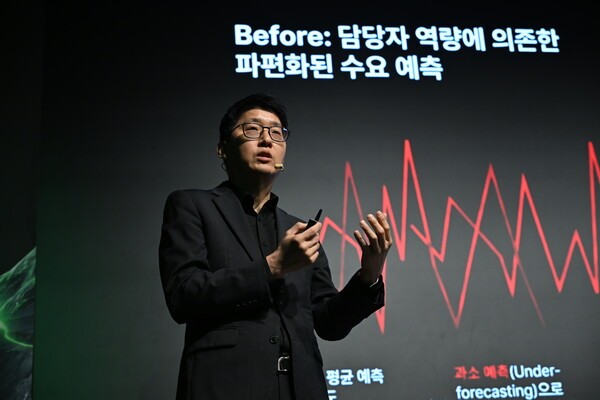
Kim Sung-jin, executive vice president of the Digital Strategy Office at Korea & Company, also took part as a grand keynote speaker and gave a presentation on 'How AI Changes Enterprise Operation.' Kim diagnosed that many companies have seen 'ROI stagnation' after introducing generative AI, then introduced enterprise AI innovation cases that improved the speed and agility of business operations through AI.
Kim said that among companies adopting AI, less than 30% are actually connecting it to business value creation. He also said that a significant number of companies remain stuck at the PoC (proof of concept) stage.
As the background for this, Kim pointed to data fragmentation across the entire value chain. Data is distributed across R&D, production, quality, logistics, and finance, and he said the traditional approach to building large-scale systems has limitations because planning through construction and deployment takes a long time and requires many people. As a result, he said it is difficult to respond quickly to market changes and business needs.
In response, Korea & Company built a cloud-based group data platform. The platform is designed to connect key business data, and Korea & Company secured a companywide common data standard, 'SSOT (Single Source of Truth).' Through this, it improved data accessibility for business units and increased data utilization, while also creating an environment for AI to be used in actual work and decision-making processes.
Korea & Company applied the 'AI Vibe Coding' framework across its enterprise processes. The framework enables business users and AI to collaborate and directly design and develop the software and work tools they need.
By easing existing development procedures and technical barriers, the organization made it possible for business users who know the work best to directly define problems and rapidly implement solutions.
Within this flow, the company pushed ahead with a core business initiative, the 'tire pattern generation AI' project in collaboration with MakinaRocks. Through this effort, the company combined designers' expertise with AI generation capabilities and built a 'Human-AI Collaboration Loop,' which was presented as leading to greater design diversity and improved development efficiency.
On the operations side, it internalized an 'AI demand forecasting model' that combines 17 internal and external variables, moving to support more precise demand forecasting and data-based supply chain decision-making.
Kim then explained that 'Essential Thinking,' rather than technology, is the key competitive advantage in the AI era. He also said that even if AI lowers the barrier to using technology, people remain responsible for defining problems, judging the quality of outputs, and assessing business value.
Kim Sung-jin said that the center of future enterprise AI innovation will shift from technology experts to business practitioners who deeply understand the business and think clearly. He added that the ability to combine Data, AI, and business expertise to continuously generate tangible business results is a company’s differentiated competitive edge.
In line with this direction, Korea & Company Group is pushing ahead to overcome its limitations under Chairman Cho Hyun-bum’s Data·AI Driven management strategy. It is also advancing 'PI (Process Innovation) on AI,' a redesign of work and processes centered on AI.
Source: TECHWORLD · Lee Gwang-jae
Original: https://www.epnc.co.kr/news/articleView.html?idxno=406522
References
This article was produced with the help of an automated content generation algorithm.
Source: TECHWORLD
View originalThis article was summarized and organized by BizCrush based on the original article from TECHWORLD. For exact quotations and full details, please refer to the original article.