G20 Makes AI a Shared Agenda Across Industrial Policy
AI TIMES ·
✦ AI Summary
According to AI TIMES, the Group of 20 wrapped up the Innovation Ministers’ Meeting in Chapel Hill, the United States, on September 2 and de…
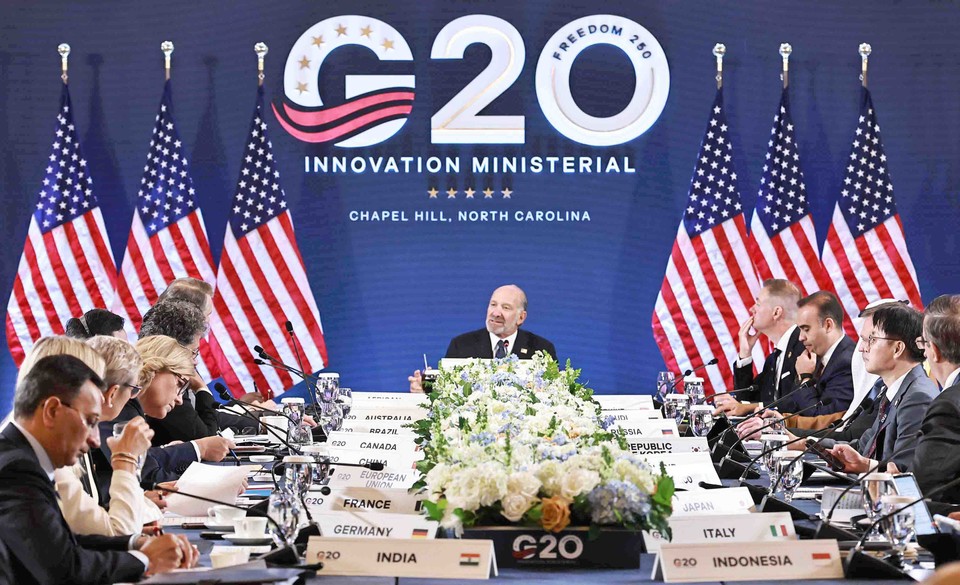
According to AI TIMES, the Group of 20 wrapped up the Innovation Ministers’ Meeting in Chapel Hill, the United States, on September 2 and defined AI as a key driver of economic growth and productivity, reaching agreement on six common principles covering intellectual property rights, standards, talent, and supply chains. The outcome included the Innovation Ministers’ Statement, as well as the AI Prosperity Goals, the AI Prosperity Compact, and the Carolina Principles. The agreement carried weight because it treated AI not as a subject for regulating individual technologies, but as a pillar of national competitiveness that requires coordinated planning for industrial competitiveness, manufacturing capacity, research and development, and commercialization, along with private-sector participation. In particular, it set up rights issues brought to the fore by the spread of generative AI and discussions on international standards as separate pillars, signaling an approach that advances technology while also improving institutions. By linking supply chain investment and the cultivation of technical talent, it also showed that the arena of AI competition is shifting beyond model performance to the ability to apply AI on the industrial front line. For South Korea, it can be read as a signal to reassess its AI strategy around the links among research, industry, talent, and institutions.
Perspective
The key point in this issue is that the center of the AI debate is moving away from whether to regulate and toward how to design industrial policy. In the end, competitiveness is likely to be decided less by the technology itself than by how tightly each country connects the ecosystem that supports it, and this suggests that policy in each country may be reorganized to link research and commercialization, talent and institutions, and industrial foundations into a single flow rather than relying on separate support measures.
This perspective is BizCrush's own commentary and is not part of the reporting by AI TIMES.
This article was produced with the help of an automated content generation algorithm.
Source: AI TIMES
View originalThis article was summarized and organized by BizCrush based on the original article from AI TIMES. For exact quotations and full details, please refer to the original article.