Federated Learning That Reduces Distance Error by Combining Each Robot’s Different View
AI TIMES ·
✦ AI Summary
According to AI TIMES, UNIST said on September 3 that it had developed a federated learning technology called FedDepth that improves distanc…
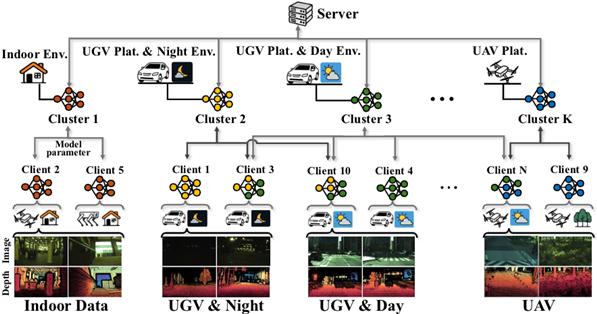
According to AI TIMES, UNIST said on September 3 that it had developed a federated learning technology called FedDepth that improves distance judgment accuracy even in unfamiliar places by jointly learning the different camera environments of heterogeneous robots. The key feature of the technology is that it cut relative distance estimation error by up to 32% compared with conventional federated learning. Existing methods averaged data from different fields of view and environments, such as drones and indoor robots, which hurt performance, but this technology is designed to separate and combine learning results around cases where visual characteristics are similar. In particular, it does not lock robots into a single group, but reflects them across multiple feature groups, reducing the loss that occurs when overly different data are mixed while preserving commonalities. The research team explained that joint learning is possible without sending original images outside, easing both communication burdens and concerns over personal information exposure. The achievement points to real-world applicability in fields such as autonomous driving, logistics, services, and disaster response, where different robots need to share the same decision-making capabilities.
Perspective
The significance of this research lies in weakening the assumption that data must be gathered in one place to improve robot performance. By shifting away from forcibly averaging learning outcomes from different devices and environments and toward managing differences, it opens an approach that can turn the varied conditions at each site into an asset. In the end, it can be read as a trend that addresses both the burden of data sharing and the challenge of environmental adaptation, which have been obstacles to the spread of robots.
This perspective is BizCrush's own commentary and is not part of the reporting by AI TIMES.
This article was produced with the help of an automated content generation algorithm.
Source: AI TIMES
View originalThis article was summarized and organized by BizCrush based on the original article from AI TIMES. For exact quotations and full details, please refer to the original article.