From 'Clicking' and 'Soft' to 'Melt-in-the-Mouth' Sounds, How Gen Z Relieves Stress Through the Senses
TECHWORLD ·
✦ AI Summary
Among Gen Z, sensory stress relief methods that focus on fingertip sensations and repetitive sounds are drawing attention.
Fidget toys include stress balls, malleable toys, slime, and wack-boo balls, and malleable-toy transaction volume and transaction value increased at Zigzag and ABLY.
Auditory content such as ASMR, singing bowls, and sound therapy is also being used as an easy-to-try daily mind-management method, and Professor Chae Jeong-ho said long-term anxiety, depression, and sleep problems require professional help.
Among Gen Z, sensory stress relief methods that can quickly shift tension without requiring much extra time are drawing attention. The approach focuses on briefly redirecting tension by concentrating on fingertip sensations and repetitive sounds.
Rather than setting aside separate time and space like travel or exercise, this kind of relief method is characterized by manipulating small tools or listening to sounds while focusing on present sensations. Fidget toys linked to this approach are also popular among Gen Z.
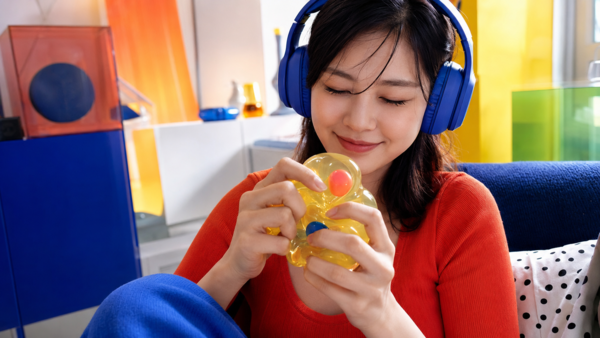
Fidget toys are designed to be touched by hand or enjoyed through repetitive movements, and representative examples include stress balls, malleable toys, slime, and wack-boo balls. Related spending is also rising quickly.
At Zigzag, malleable-toy transaction volume in May 2026 rose 235% from a year earlier. At ABLY, malleable-toy transaction value increased 514% year on year between January 1, 2026, and June 23, 2026.
This kind of sensory immersion based on fingertip sensations is also expanding into ways of managing the mind through sound. Methods that use repetitive or attention-guiding sounds, such as ASMR, singing bowls, and sound therapy, are also drawing attention.
Simple repetitive actions such as pressing, kneading, and popping surfaces are presented as having the effect of shifting attention from worries and thoughts to present sensations. The key point is that repetitive tactile stimulation redirects attention to the present sense of touch.
Against this backdrop, Changsin 1-dong in Jongno-gu, Seoul, is known as 'Malleabi Street.' Monthly average sales at stationery and art-supplies retailers in Changsin 1-dong rose from KRW 8.35 million in November 2025 to KRW 11.24 million in February 2026, with sales changes showing an increase of about 34%.
Recently popular products include keycaps and click stones. These products are characterized by letting users enjoy both touch and sound, and the factors considered include pressing strength, surface texture, and the sound produced through repetition. Selection criteria are framed as reflecting personal preference, and the expansion of sensory tools is extending beyond simple stress-relief products into taste-based consumption.
The expansion of sensory immersion for refreshing the mind is described as extending from fingertips to sound. Although tactile tools and auditory content differ in form, they are grouped together by their common effect of shifting attention stuck on worries and thoughts to present touch and sound.
ASMR is content that uses delicate and repetitive sounds such as soft whispers, the sound of turning pages, and rainfall, and it is widely used as relaxation and sleep content. Singing bowls and sound therapy share the common feature of focusing on repetitive resonance and vibration, and they can be seen as an auditory form of mindfulness that helps people briefly step away from complicated thoughts.
A feature of this kind of audio content is that it can be experienced even with the eyes closed. Because it does not require a separate space or complicated preparation, it is used as a form of mind management that can be easily tried in daily life.
Trost, a mental health platform, offers audio-focused mindfulness content called 'sound therapy.' The content can be used on a smartphone, making it available even before starting a separate specialized program.
Trost's sound therapy can be used without burden during short breaks, when sleeping, or when concentration is needed. It is composed of natural sounds, white noise, repetitive rhythms, and calming tones, and is used as a way to focus on sound.
Through this, it helps refresh complicated thoughts and supports comfortable rest. It is an example showing that audio content can be easily used in everyday life.
Everyday sensory stimuli such as fidget toys, ASMR, and sound therapy are being used as a way to refresh one's state, regulate tension, and provide light self-care. These sensory stimuli are cited as simple methods that can be practiced in daily life.
Chae Jeong-ho, a professor in the Department of Psychiatry at Seoul St. Mary's Hospital, said that focusing attention on repetitive tactile and auditory stimuli helps briefly step away from complicated thoughts and concentrate on present sensations. He added that this approach can refresh the mind in a short time and can be used as a method of managing everyday stress.
However, Chae Jeong-ho, a professor in the Department of Psychiatry at Seoul St. Mary's Hospital, said that if anxiety, depression, or sleep problems persist for a long time and affect daily life, it is necessary to seek help from a professional rather than relying on sensory content. He explained that the purpose of professional help is to identify the cause.
Source: TECHWORLD · Lee Gwang-jae
Original: https://www.epnc.co.kr/news/articleView.html?idxno=406252
References
This article was produced with the help of an automated content generation algorithm.
Source: TECHWORLD
View originalThis article was summarized and organized by BizCrush based on the original article from TECHWORLD. For exact quotations and full details, please refer to the original article.