Qualcomm Holds Dragonwing IoT Day, Expands Push to Bring Agentic AI to Industry and Robotics
TECHWORLD ·
✦ AI Summary
Qualcomm held the "Qualcomm Dragonwing IoT Day" on the 31st at The Grand InterContinental Seoul Parnas in Jung-gu, Seoul, for key domestic clients and partners.
At the event, Qualcomm unveiled its latest technologies and use cases that apply agentic AI to industrial automation, robotics, smart homes, and home appliances.
Qualcomm explained its strategy for targeting the IoT market based on an AI computing architecture connecting device, edge, and cloud, while strengthening cooperation with domestic clients and partners.
Qualcomm held the "Qualcomm Dragonwing IoT Day" on the 31st at The Grand InterContinental Seoul Parnas in Jung-gu, Seoul, for key domestic clients and partners. At the event, Qualcomm unveiled its latest technologies and real-world applications that apply agentic AI to industrial automation, robotics, smart homes, and home appliances, as it moved to expand Korea's IoT ecosystem.
The event was a follow-up to last year's "Qualcomm IoT Partner & Tech Day." This year as well, Qualcomm invited clients and partners to the event in order to share the latest industrial AI and IoT technologies and use cases and strengthen cooperation with domestic clients and partners.
More than 500 people attended the event. Representatives from Samsung Electronics, LG Electronics, Hyundai Motor, SK Telecom, KT, and LG Uplus also attended.
The event highlighted industrial automation, robotics, smart homes and smart appliances, and agentic AI as its core keywords.
Qualcomm said the direction of AI development is moving beyond simple inference toward environmental awareness, autonomous judgment, and action. It emphasized that, as a result, the importance of device intelligence and connectivity is growing in the IoT and robotics sectors.
As development tools and platforms supporting this, Qualcomm introduced "Qualcomm Linux 2.0," "Qualcomm Intelligent Robotics Product SDK (QIRP SDK)," and "Qualcomm AI Workflow" during the technical sessions. "Qualcomm Linux 2.0" is a software platform that supports IoT and robotics product development, and it is focused on making it easier for developers to use Qualcomm hardware and AI capabilities. QIRP SDK provides the functions needed for robot development and focuses on shortening the process from development to commercialization.
Presentations from partners continued. The participants were Hyundai Motor Robotics Lab, SST, Intelligrid, Ditek, Point Mobile, Access Lab, Advantech, Innodisk, Aetina, and WisePlus. These participants shared AI, robotics, and IoT applications using Qualcomm platforms, and also discussed their business strategies.
Based on this, Qualcomm explained its strategy for targeting the IoT market in the era of agentic AI, built on an AI computing architecture that connects device, edge, and cloud. Qualcomm outlined a direction for targeting the IoT market as agentic AI spreads, leveraging an AI computing structure that links devices, edge, and cloud.
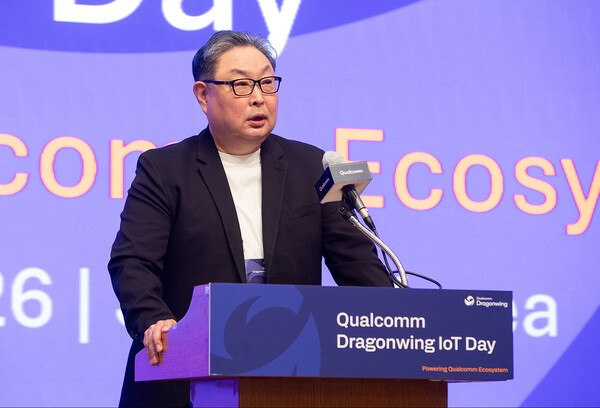
Kim Wo-hyung, president of Qualcomm APAC, said the conditions for realizing the potential of agentic AI are seamless connection and operation of intelligence across devices, edge, and cloud. He added that support is needed for platform-based AI workload optimization spanning device, edge, and cloud. Qualcomm also said it supports companies in achieving the optimal balance among performance, cost, and power efficiency.
The speaker also said Qualcomm will expand joint collaboration with domestic clients and partners based on its broad Dragonwing product portfolio and global ecosystem, and through this, create more IoT industry innovation cases and more robotics industry innovation cases.
Source: TECHWORLD · Park Kyu-chan
Original: https://www.epnc.co.kr/news/articleView.html?idxno=406280
References
This article was produced with the help of an automated content generation algorithm.
Source: TECHWORLD
View originalThis article was summarized and organized by BizCrush based on the original article from TECHWORLD. For exact quotations and full details, please refer to the original article.