Innogrid Launches 'OpenStackit 3.5,' Strengthening Virtualization Operations
IT DAILY ·
✦ AI Summary
Innogrid unveiled the private cloud solution 'OpenStackit 3.5' on the 3rd in response to demand for alternative platforms following VMware's licensing policy changes.
'OpenStackit 3.5' is refactored based on 'Gazpacho 2026.1' and provides maintenance mode, instance optimal relocation, instance HA, integrated monitoring and metering, provisioning automation, and multithreaded Parallel Live Migration.
GPU management features were also strengthened to support provisioning, allocation, real-time monitoring, and scheduling, making it usable for AI training and inference infrastructure development.
Since VMware's licensing policy changes, the domestic virtualization market has continued searching for alternative platforms. In the process, operational stability, resource efficiency, migration, and AI infrastructure support capabilities have emerged as key considerations.
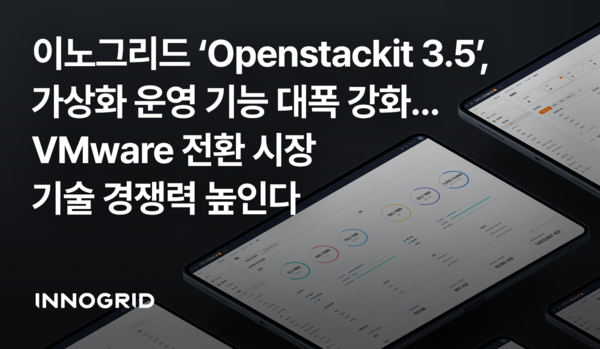
Innogrid unveiled the private cloud solution 'OpenStackit 3.5,' enhanced with related features to meet that demand. Innogrid announced the launch of 'OpenStackit 3.5' on the 3rd and also advanced its proprietary virtualization technology.
'OpenStackit 3.5' is based on the latest version, 'Gazpacho 2026.1,' and the platform was refactored across the board. Innogrid said it had strengthened operational features tailored to customer environment requirements in-house, securing stability and management efficiency in large-scale VM environments.
The advanced features include a 'maintenance mode.' 'Maintenance mode' allows VMs on a compute node under maintenance to be moved to another node and also supports VM restoration after the work is completed.
Innogrid offers 'instance optimal relocation' and 'instance HA' as features for infrastructure operation efficiency and fault response. The 'instance optimal relocation' function supports infrastructure resource utilization by balancing instances based on the resource usage status of each compute node. 'Instance HA' automatically migrates VMs running on a node to healthy nodes when a specific node failure is detected and is used to ensure service continuity in the event of an outage.
It also enables users to check the status of physical and virtual resources, as well as their usage, through integrated monitoring and metering functions. In addition, support for provisioning automation and automated resource lifecycle management helps reduce the burden of repetitive infrastructure operations. For large-scale VM movement, it has adopted multithreaded Parallel Live Migration, which Innogrid described as a method of processing multiple data transfer tasks in parallel. Parallel processing of multiple data transfer tasks contributes to improved workload migration efficiency during system maintenance and infrastructure relocation.
Innogrid said it has strengthened GPU management capabilities. According to Innogrid, the new features include GPU resource provisioning support, GPU resource allocation support, GPU resource real-time monitoring support, and GPU resource scheduling support. Through this, customers building AI training and inference infrastructure can use high-performance computing resources.
Based on these features, Innogrid plans to secure technological competitiveness that can compete with global virtualization solutions. It also intends to pursue future CMP integration, PaaS integration, DevOps integration, and AI infrastructure integration for OpenStackit, while expanding the scope of support. The expansion targets range from VM-centric virtualization environments to cloud native, GPU, and AI workloads.
Ban Il-gwon, head of the Cloud Infrastructure Center at Innogrid's R&D Division, said the hallmark of this version is that it actively applies maintenance, fault response, and resource optimization features that reflect the real needs of customer environments. He added that the company will continue advancing its proprietary virtualization technology for large-scale cloud operations and support stable infrastructure transitions and the expansion of AI environments.
Source: IT DAILY · Yang Seung-gap
Original: https://www.itdaily.kr/news/articleView.html?idxno=241395
References
This article was produced with the help of an automated content generation algorithm.
Source: IT DAILY
View originalThis article was summarized and organized by BizCrush based on the original article from IT DAILY. For exact quotations and full details, please refer to the original article.