“In the AI Era, Open Source Transformation Will Determine Competitiveness”: EDB Hosts 'Postgres AI Summit'
IT DAILY ·
✦ AI Summary
It was suggested that Open Source Transformation (OX) is needed to support AI transformation (AX).
It was said that reducing dependence on specific vendors, securing autonomy in costs and data utilization, and ensuring flexibility to respond to changes in AI workloads are necessary.
EDB held an event in Seoul on the 3rd to share the need for OX and introduced its data platform and WarehousePG 19.
To stably support AI transformation (AX), it was suggested that Open Source Transformation (OX), or a shift to an open source-based approach, is necessary. For this, a reduced dependence on specific vendors is needed, along with autonomy in costs and data utilization. It was also noted that flexibility to respond to future changes in AI workloads is required.
Based on this sense of urgency, EDB held 'EDB Postgres AI Summit Seoul 2026' on the 3rd at Sofitel Ambassador Seoul. The event shared the need for OX.
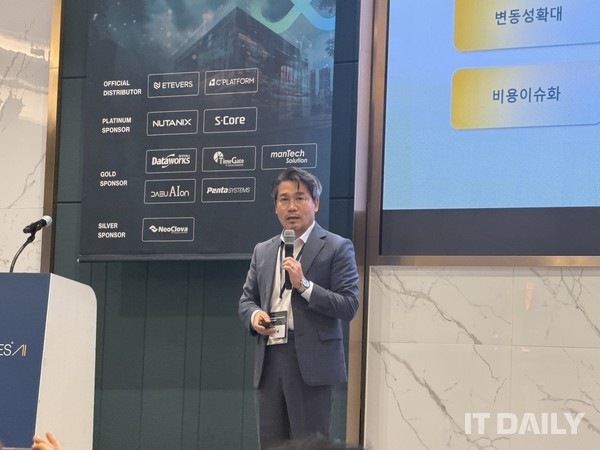
Kim Hee-bae, head of EDB Korea, spoke at 'EDB Postgres AI Summit Seoul 2026' on the 3rd. Photo credit: Yang Seung-gap.
Kim Hee-bae, head of EDB Korea, said enterprise data environments are changing rapidly as the AI adoption phase begins. He also explained that the application of open source DBs to core operations is expanding across various industries, including production, manufacturing, distribution, and healthcare.
He added that the use of open source DBs in AI and analytics has moved beyond simple adoption and is now producing real-world operational cases. The theme of this session was the expanded adoption of open source DBs and that 'OX' is the new game board.
EDB said it is expanding from providing DBs in specific areas into a data platform that encompasses operations, analytics, and AI.
Kim said the nature of DBs is changing and that this is becoming a Unified Data Platform. He also said it is evolving into a multimodel platform capable of performing future functions.
Kim said that, along with these changes, the open source transformation of corporate IT environments has emerged as a new issue. He added that a new game board called OX has appeared in open source.
Along with this, a theme was presented that open source across the entire SW stack is needed to prepare for the AI era.
Seo Seong-han, head of the business division at Escore, an EDB partner, explained that companies that preemptively pursued DX in the past prepared not only for service innovation but also for the open source transformation of their IT environments. He said companies that innovated through DX are strengthening their preparations by sufficiently shifting their underlying environments to an open source-based foundation.
The need for OX was emphasized. Its value was presented as easing dependence on specific vendors, reducing IT costs, and securing control over data. It was also suggested that a total cost of ownership (TCO) reduction of 60% to 80% is possible through open source transformation, though the actual reduction varies depending on the company's environment and situation.
It was also emphasized that OX should not be limited to replacing individual solutions with open source. The explanation was that a change across the overall software environment is needed, not a conversion centered on standalone products. The business division head said an open source-based transformation of the entire software stack, including OS, DB, middleware, cloud, and AI, is necessary.
At the same time, DB was identified as a key area of OX. The reason DB was selected is because it is tied to managing data, a core corporate asset. The business division head said a company's most important asset is data, and PostgreSQL was presented as a major option for open source DBMS. He then explained that PostgreSQL is leading in the open source DB field.
Frank Siedi, vice president of sales engineering at EDB, said the global analytics and AI platform market is expected to grow rapidly to USD 218 billion by 2028. However, he explained that more than 90% of AI projects are struggling due to fragmented and isolated data silo issues.
As a solution to this challenge, EDB presented the unified data platform architecture 'Agentic Lakehouse.' Agentic Lakehouse is characterized by integrating operational DBs (OLTP), ultra-high-speed real-time analytics (ClickHouse), petabyte (PB)-scale large DW (WarehousePG), an analytics acceleration engine (PGAA), and an AI agent framework (Agent Factory). The structure consists of a single SQL interface and a single security model.
EDB also unveiled key features of its next-generation data warehouse engine, 'WarehousePG 19.' WarehousePG 19 supports property graphs based on standard SQL/PGQ without the need for a separate graph DB, enabling anomaly detection and network analysis, and includes high-performance lakehouse write technology for storing large-scale streaming data. WarehousePG 19 is scheduled for official release in the first half of next year.
Source: IT DAILY · Yang Seung-gap
Original: https://www.itdaily.kr/news/articleView.html?idxno=241393
References
This article was produced with the help of an automated content generation algorithm.
Source: IT DAILY
View originalThis article was summarized and organized by BizCrush based on the original article from IT DAILY. For exact quotations and full details, please refer to the original article.