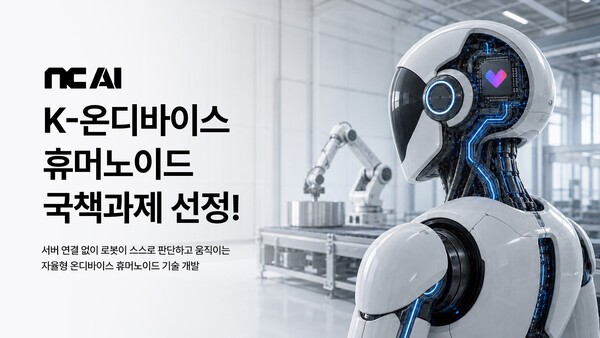
NC AI Selected for Government-Led 'K-On-Device AI' Project to Develop Autonomous Humanoids
TECHWORLD ·
✦ AI Summary
NC AI and LG Electronics were selected as implementing organizations in the humanoid sector of the Ministry of Trade, Industry and Energy and KEIT's 'K-On-Device AI Semiconductor Technology Development Project.'
The project aims to develop autonomous humanoids based on domestically produced on-device AI semiconductors and seeks task performance at a level comparable to humans.
NC AI will handle the initial training data and the 'human-robot retargeting' pipeline, while the consortium plans to start with object sorting, transport, serving and tool operation in homes and unstructured spaces.
NC AI has formed a consortium with LG Electronics and begun work on autonomous humanoid technology. NC AI and LG Electronics were selected as implementing organizations in the humanoid sector of the 'K-On-Device AI Semiconductor Technology Development Project' led by the Ministry of Trade, Industry and Energy and the Korea Evaluation Institute of Industrial Technology (KEIT), with the announcement made on the 3rd.
The goal of this project is to develop autonomous humanoids based on domestically produced on-device AI semiconductors. The target performance for the autonomous humanoids is to carry out tasks at a level comparable to humans in complex everyday spaces.
The consortium will pursue the project through a development framework that integrates robot hardware, training data, AI models and domestically produced AI semiconductors. Through this, it will develop autonomous humanoid technology using domestically produced on-device AI semiconductors.
In this process, NC AI will handle the initial training data for learning-based general motion tracking (GMT). It will also be responsible for building a 'human-robot retargeting' pipeline.
Retargeting is a technology that converts human movement to fit the humanoid's body structure. In this process, each robot's joint range of motion, body proportions, foot support status and balance conditions are reflected. This allows motions performed by a person to be converted into movements that a real robot can execute.
For a humanoid to make autonomous movements that respond to surrounding conditions rather than simply repeating tasks, it needs motion data for training and control technology that connects that data to actual robot actions. NC AI plans to leverage its accumulated motion data and animation production technology. It also plans to convert a variety of human task motions into data suitable for humanoid training.
NC AI plans to create multiple task scenarios in a digital twin environment and build a motion dataset for training. It then plans to combine motion control technology with its own world model technology. The aim is to advance the technology so that it can predict changes in the surrounding environment and enable the continuous execution of multi-step tasks.
The consortium including LG Electronics will set up a development framework that links robot hardware, data, AI models and domestically produced on-device AI semiconductors, and through this it will seek to reduce humanoids' dependence on external servers and establish a foundation for real-time motion control in everyday spaces based on high-performance, low-power computing.
The technology being developed will first be applied to object sorting, transport, serving and tool operation, with the target environments being homes and unstructured spaces. It will later be expanded to support work in manufacturing and logistics sites as well as disaster response, facility inspection and work in hazardous areas, while its scope of use will also be broadened to the industrial and public sectors.
NC AI is expanding its physical AI business centered on world models and robot foundation models, and in this project it aims to secure autonomous task execution capabilities for humanoids through a strategy that connects motion data, robot control technology and on-device AI semiconductors.
Lee Yeon-soo, CEO of NC AI, said the company's accumulated assets so far have been motion control technology and data-building capabilities, and that participation in this project is significant because those assets will be realized in autonomous humanoid motion through the project. He added that, based on close cooperation with partners including LG Electronics, the company aims to enhance the competitiveness of humanoids based on domestically produced on-device AI semiconductors and link that effort to securing national strategic technologies.
Source: TECHWORLD · Kim Seung-gi
Original: https://www.epnc.co.kr/news/articleView.html?idxno=406510
References
This article was produced with the help of an automated content generation algorithm.
Source: TECHWORLD
View originalThis article was summarized and organized by BizCrush based on the original article from TECHWORLD. For exact quotations and full details, please refer to the original article.