MegazoneCloud partners with Quandela on photonic quantum computing, linking GPUs and QPUs
TECHWORLD ·
✦ AI Summary
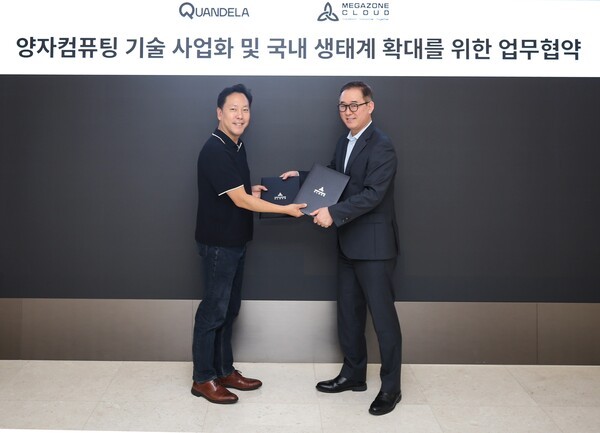
MegazoneCloud said it signed a strategic business agreement with Quandela on the 2nd to commercialize quantum computing technology and expand the domestic ecosystem.
The two companies will jointly build a cloud-based infrastructure for domestic companies, universities, and research institutions, and will pursue a hybrid computing environment linking GPUs and photonic-based QPUs.
They will also carry out joint technical validation, identify industry-specific use cases, and operate government R&D, demonstration projects, on-premises deployments, seminars, training, and developer programs.
MegazoneCloud announced on the 2nd that it had signed a strategic business agreement with Quandela, a French photonic quantum computing company. The agreement aims to jointly advance the commercialization of quantum computing technology and expand the domestic ecosystem.
The two companies will jointly build a cloud-based infrastructure for this purpose. The infrastructure will support domestic companies, universities, and research institutions.
The goal of the infrastructure is to help domestic companies, universities, and research institutions use and verify quantum computing in real-world environments. MegazoneCloud and Quandela plan to use this to lay the groundwork for the practical adoption of quantum computing technology.
Specifically, they will work to build a hybrid computing environment that connects GPUs and photonic-based QPUs so that existing AI and data environments can be used in parallel with quantum computing resources. The system slated for deployment is a hybrid computing setup.
Photonic quantum computing uses photons as units of information processing. This approach is easier to integrate with existing optical communications technology and places a relatively lower burden on maintaining ultralow temperatures across the entire system than superconducting methods do.
The two companies will carry out joint technical validation based on the built environment and identify quantum computing use cases by industry. Through this, they will support domestic companies and research institutions in reviewing the feasibility of applying actual QPU use cases, with the support model assuming that no separate large-scale infrastructure will be built.
The scope of cooperation will expand to government research and development (R&D), demonstration projects, and on-premises photonic quantum computer deployments. In addition, the two companies will jointly run seminars, technical workshops, hands-on training, developer programs, and hackathons.
The purpose of the joint programs is to expand opportunities for domestic developers and researchers to use quantum computing. In this process, MegazoneCloud will be responsible for finding domestic customers, business development, configuring cloud and GPU infrastructure, linking existing AI and data environments with quantum computing resources, and managing technical validation and projects.
Quandela will provide photonic-based QPUs as well as quantum computing development environments and algorithm technologies. It will also provide technical training, hands-on support, and developer support, and will participate in joint technical validation.
Following its agreement with Pascal in July, MegazoneCloud has moved to expand cooperation with quantum computing companies using different approaches. Pascal is a neutral-atom quantum computing company, while Quandela is a photonic quantum computing company. With its partnership with Quandela after the Pascal agreement, MegazoneCloud will broaden the range of quantum hardware it can support.
The latest collaboration is tied to its in-house quantum computing brand, "WAVE." Through this, MegazoneCloud plans to establish a utilization framework that spans support for access to quantum computing resources, education, technical validation, identification of industry-specific use cases, and ultimately commercialization.
Kim Dong-ho, CQO of MegazoneCloud, said that the growing computational complexity of AI and data analytics requires next-generation technologies to complement existing computing, and that opportunities in Korea to access and validate actual QPUs are limited. He said the agreement will support verification of customers' potential to use GPUs, cloud, and AI environments in an integrated way, while helping expand the domestic quantum computing base and increase the pool of specialized talent.
Source: TECHWORLD · Kim Seung-gi
Original: https://www.epnc.co.kr/news/articleView.html?idxno=406488
References
This article was produced with the help of an automated content generation algorithm.
Source: TECHWORLD
View originalThis article was summarized and organized by BizCrush based on the original article from TECHWORLD. For exact quotations and full details, please refer to the original article.