ElevenLabs Expands Korean Voice AI Push, Eyes Data Residency
IT DAILY ·
✦ AI Summary
ElevenLabs is moving to expand its business in the Korean voice AI market.
It cited rising contact center demand, declining response staff, a shrinking working-age population, and corporate AI projects not reaching production as background.
ElevenLabs said it is pursuing Korean data residency and a zero retention policy.
ElevenLabs, a generative AI-based voice technology company, is moving to expand its business in the Korean voice AI market. The company cited rising demand for contact centers, declining response staff, a shrinking working-age population, and the fact that many corporate AI projects have yet to reach production as reasons for the expansion. The plan also includes pursuing data residency.
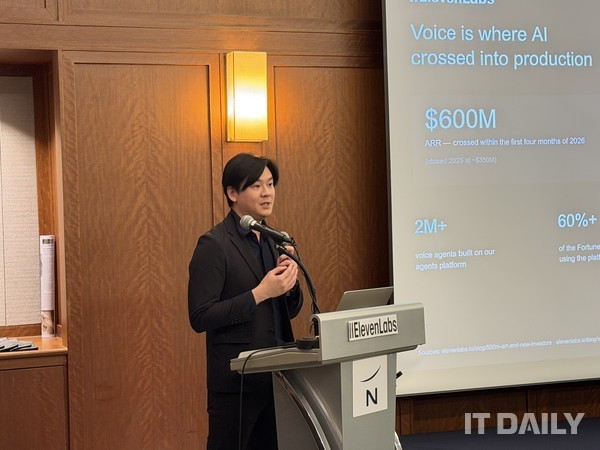
Eugene Liang, head of ElevenLabs' APAC operations, made the announcement on the 3rd at the 'ElevenLabs Executive Breakfast Session' held at Novotel Ambassador Seoul Gangnam. Liang shared the current state of voice AI adoption in global and APAC markets and discussed the company’s strategy for the Korean market.
ElevenLabs provides voice generation, voice agents, and content localization services. The photo in the article shows Liang speaking, and it was taken by Yang Seung-gap.
Liang said he believes voice AI has entered the stage of real-world service deployment, citing the company’s growth metrics as evidence. He said ElevenLabs' ARR exceeds USD 600 million, its valuation has topped USD 11 billion, more than 2 million voice agents have been built on the ElevenLabs platform, more than 1 billion end users have been reached via API, and its latest generative model supports more than 70 languages.
He added that ElevenLabs identified voice agents as a key growth area and said voice agents are growing faster than any new business. Liang also said that APAC has shown the strongest growth by region.
As examples from APAC, Liang highlighted the use of voice agents in customer support and sales. He said Australia’s Employment Hero used them for new product announcements to more than 350,000 customers and booked more than 1,000 demo calls, while Southeast Asia’s Funding Societies applied AI to outbound voice calls.
Liang said there are opportunities in the Korean market, but judged that it is still not the right time to enter, given changes in Korea’s population and labor market. He said the Korean market is promising, but that it is not yet time to move into it in earnest.
To support that view, Liang cited data showing that last year revenue in Korea’s outsourced contact center market reached KRW 10.6 trillion, up 9.75% from a year earlier. By contrast, outsourced contact center employment rose only 1.44%, while in-house contact center staff directly operated by companies fell 6.05% from 113,595 to 106,725.
He also pointed to a decline of 393,000 in the working-age population last year, saying the contact center market is growing while the labor force needed to support it is shrinking. He added that the gap between demographic change and technological progress can be bridged with AI.
In response, ElevenLabs plans to expand hiring in Korea, increase research, accelerate product launches, and strengthen engineering support for customers. It also plans to introduce Korean data residency, which refers to storing and processing data within a specific country or region. The current location for data residency in Asia is Singapore.
Until Korean data residency is in place, a zero retention policy will be used. Zero retention means deleting key data generated during API requests and responses immediately after the request is processed. Liang said the company is currently operating under a zero retention policy.
Liang said efforts to introduce Korean data residency are under way. He also said a roadmap for a Korea-only data residency is being prepared.
On how companies should adopt voice AI, he said they need to select specific, measurable use cases and validate them over a short period. Liang said it is preferable to prioritize some use cases that already have successful examples.
He went on to say that clear performance metrics must be established and measured, and that business goals beyond cost reduction should be set. He also said results should be evaluated over a short period such as 90 days.
Source: IT DAILY · Yang Seung-gap
Original: https://www.itdaily.kr/news/articleView.html?idxno=241384
References
This article was produced with the help of an automated content generation algorithm.
Source: IT DAILY
View originalThis article was summarized and organized by BizCrush based on the original article from IT DAILY. For exact quotations and full details, please refer to the original article.