ASUS: “We Will Accelerate Korean Companies’ AI Transformation and Become a Long-Term Infrastructure Partner”
TECHWORLD ·
✦ AI Summary
ASUS sees Korean companies’ AI transformation moving rapidly from the experimental stage to production and is stepping up its push into the Korean market.
ASUS presented an integrated AI infrastructure strategy and AI factory concept that go beyond GPU and server supply to include power, cooling, networking, software, deployment, and operations.
Vice President Paul Ju named cost per token, tokens per watt, GPU utilization, and time to business value creation as key metrics, and said ASUS will work with the ecosystem, including NVIDIA, to support design, deployment, and operations end to end.
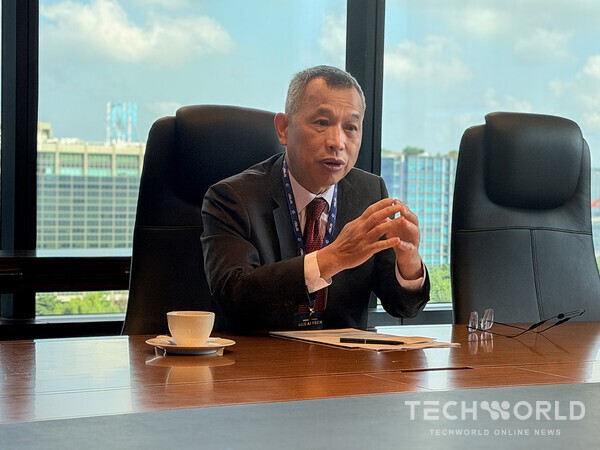
The use of AI by Korean companies is moving very quickly beyond the experimental stage and into “production,” where it is applied to actual services and businesses. Paul Ju, Executive Vice President and Head of the Infrastructure Solutions Business Group at ASUS, said in an interview before the start of the “ASUS AI Tech 2026” event on the 3rd that the pace of AI transformation among Korean companies is very fast.
In response, ASUS is stepping up its push into the Korean market. Beyond servers and storage, ASUS is responding with an integrated AI infrastructure strategy that encompasses power, cooling, networking, software, deployment, and operations. Paul Ju explained that moving to production requires more than introducing the latest computing platform.
He said that production transition requires taking into account system architecture, data requirements, power, cooling, deployment speed, operations, and future scalability together. He also emphasized that ASUS has capabilities in system design, server and storage architecture, deployment, and continuous infrastructure management, and that it can support Korean companies’ AI transformation on the back of those capabilities. He added that ASUS intends to become a long-term infrastructure partner for Korean companies.
ASUS said its Korea market strategy is not limited to GPU and server supply, and presented a direction of helping reduce the complexity of building AI infrastructure in Korea beyond product delivery, while helping connect AI investment to actual business value.
Vice President Paul Ju presented faster AI infrastructure deployment and greater predictability in AI infrastructure deployment as the differentiated value in the Korean market. He also said the company would pursue long-term partnerships with customers and ecosystem partners and work to accelerate AI transformation together.
Against this backdrop, ASUS forecast that AI will spread across companies and industries, and judged that infrastructure must also evolve as AI spreads. Accordingly, infrastructure must move beyond simple computing resources and develop in a way that encompasses design, deployment, operations, and optimization, and ASUS presented “AI factory” as the target form. It said the public message of “ASUS AI Tech 2026,” “All in on AI, AI in All,” is also connected to this Korea market strategy.
Vice President Paul Ju presented “AI factory” as the core concept of ASUS’s AI infrastructure strategy, describing it as the next stage of evolution for the data center. He said the definition of an AI factory lies in creating useful AI services and business value through the continuous transformation of infrastructure, data, and models.
He said the basis of competition in the AI infrastructure market is changing. If the previous benchmark was how many GPUs one had secured, the current benchmark has shifted to the efficient output of “useful tokens,” and the nature of competition is also changing into a yield competition, he explained.
Against this backdrop, ASUS emphasized that its definition of an AI factory is not simply a collection of high-performance servers. ASUS defined an AI factory as a new type of infrastructure in which a data center produces AI services and business value.
Vice President Paul Ju said the key point is that AI is now entering real production environments, and that it has become more important to turn the entire environment into one system than to simply add computing power. He cited deployability, scalability, efficiency, and manageability as the conditions needed for this.
ASUS is pursuing its AI factory construction strategy along two dimensions: platform and operations. The former is focused on infrastructure and resource support, while the latter is a concept centered on expanding management and governance.
Vice President Paul Ju explained that the platform layer’s role is to accelerate infrastructure design, validation, and deployment. He also said the platform layer should flexibly support computing, networking, storage, and software across various AI workloads.
Vice President Paul Ju said the role of the operations layer is to expand management and governance of AI Harness across AI services. He explained that the goal is to combine the two capabilities of platform and operations to help companies move AI use from the experimental stage to large-scale, stable operations.
From this perspective, Vice President Paul Ju outlined a forecast for changes in the competition criteria of the AI infrastructure market. He said the efficiency of generating real business value in AI data centers would become the core competitive edge.
As a comparison point, the importance of useful token output was presented as more significant than the number of GPUs owned. Accordingly, the view was presented that future market competition will center on how efficiently AI data centers can generate useful tokens and business value.
ASUS forecast that key metrics will emerge in the future AI infrastructure market. The key metrics ASUS presented are cost per token, tokens per watt, GPU utilization, and the time to business value creation. ASUS said AI infrastructure competitiveness would be evaluated by these metrics rather than by simple hardware performance.
Vice President Paul Ju said that AI factory optimization is not only a hardware issue. Accordingly, ASUS is closely aligning with NVIDIA’s technology roadmap, continuously improving its own system design, and continuously improving thermal management engineering and infrastructure efficiency, he explained.
ASUS is also pursuing partner collaboration across power, cooling, storage, networking, and the overall data center infrastructure. Vice President Paul Ju said it is working with Schneider Electric and others through initiatives such as the NVIDIA DSX ecosystem. ASUS explained that through this collaboration, it is anticipating constraints in advance, accelerating deployment, and improving design accuracy before physical implementation.
ASUS is working with AI ecosystem companies, including NVIDIA, to strengthen its AI factory construction capabilities. ASUS’s role is not to monopolize a specific technology, but to integrate technologies into a single system that works in the customer’s environment.
Vice President Paul Ju said the provider of an AI factory is not a single company but the entire ecosystem. He explained that NVIDIA’s role is to provide a leading accelerated computing architecture and technology foundation.
He then said ASUS’s role is to integrate computing, networking, storage, power, cooling, and system design tailored to customer needs. He added that the result of this integration is a complete, deployment-ready infrastructure.
ASUS’s differentiators were presented as system design capabilities, thermal and power architecture capabilities, signal integrity capabilities, and predictive design and validation capabilities.
He said deployment is not merely delivery, but is supported by key back-end elements such as system design, rack design, thermal architecture, power architecture, signal integrity, predictive design, and validation.
He explained that these technical capabilities help identify problems early, reduce integration complexity, and support customers in accelerating the transition from design to production.
Against this backdrop, as the AI factory market expands, ASUS’s business model is also shifting from a simple server and system supply focus to support across the full AI infrastructure lifecycle.
Vice President Paul Ju said the business model is evolving in the direction of AI infrastructure lifecycle support, and explained that customers need support across the entire process of architecture planning, validation, deployment, infrastructure management, AI operations, and continuous optimization.
ASUS is working to strengthen AIDC capabilities, ACC capabilities, and its own AI software stack capabilities. This is part of its broader expansion of AI-related capabilities.
Vice President Paul Ju said that as customer requirements change, speed alone is not enough and deployment predictability is needed. Accordingly, ASUS presented engineering validation, production automation, deployment tools, service capabilities, and ecosystem expertise as the combined elements.
Through this, ASUS aims to provide greater confidence in quality, lead time, and future scalability. It also seeks to avoid being merely a system supplier and instead aims to be a long-term AI infrastructure partner.
This direction also extends to its position on AI governance. ASUS said it does not limit AI governance to the software and service operations stage.
ASUS said power, performance, security, and reliability must be considered from the AI infrastructure design and deployment stages. Vice President Paul Ju explained that the scope of AI governance covers the entire AI lifecycle, and that it begins before the first token is generated.
He said that during the design and deployment stages, key decisions such as architecture, resource allocation, security, reliability, and infrastructure efficiency are finalized.
After deployment, infrastructure management capabilities and AI Harness are presented as expansion elements, and the scope broadens to visibility, control, and optimization from the base infrastructure to the AI services running on top of it.
In line with this approach, collaboration with NVIDIA is expanding. The nature of the collaboration is also extending beyond simple GPU-based server supply to the broader AI infrastructure.
Vice President Paul Ju said the scope of collaboration with NVIDIA has gone beyond the hardware platform. He explained that they are working together to bring the latest accelerated computing architecture to market, and that they are working closely with NVIDIA on a new solution framework that connects infrastructure design with a broad ecosystem including power, cooling, storage, networking, and software.
A strategy was presented to combine ASUS’s engineering capabilities based on the NVIDIA DSX blueprint. He explained that the NVIDIA DSX blueprint serves to provide a common technical framework.
He then said ASUS provides engineering intelligence, platform flexibility, and deployment experience for application in each customer environment. He added that the structure combines NVIDIA’s technological leadership with ASUS’s flexible modular design and customer-specific engineering.
He expressed the expectation that this combination will allow AI infrastructure to move into production more quickly. In other words, the expected effect is to accelerate the transition of AI infrastructure to the production stage.
Meanwhile, regarding the subheadline theme that even if the AI market overheats there is no exit strategy, the assessment of overheating competition in the AI hardware market was described as a natural phenomenon that appears during market maturation. The context is that it should be seen not as an abnormal crisis, but as part of the transition period and the process of market maturation.
Vice President Paul Ju explained that every major technological transition includes periods of rapid investment, and AI is no exception. He then predicted that as market maturation deepens, customer selection criteria will become stricter.
The speaker said that in the AI market, the basis for judging competitiveness will shift from securing computing resources to efficiency. He explained that the focus is moving away from whether one has computing power toward the ability to turn that computing power into useful and economically sustainable AI outputs efficiently.
From this perspective, he presented utilization, energy efficiency, cost per token, and tokens per watt as important metrics. He said this reflects the view that what matters more than the amount of resources owned is how efficiently those resources can be turned into results.
In the same context, he denied the possibility of ASUS withdrawing from the AI business. He explained that ASUS’s AI infrastructure is not a short-term hardware cycle and that no “exit strategy” is being considered at all. He added that the company is making long-term investments across system engineering, deployment, software, services, and ecosystem capabilities.
Source: TECHWORLD · Park Kyu-chan
Original: https://www.epnc.co.kr/news/articleView.html?idxno=406469
References
This article was produced with the help of an automated content generation algorithm.
Source: TECHWORLD
View originalThis article was summarized and organized by BizCrush based on the original article from TECHWORLD. For exact quotations and full details, please refer to the original article.