Equinix Automates Network Connectivity for the AI Era with 'Fabric One'
TECHWORLD ·
✦ AI Summary
Equinix unveiled a new managed connectivity service, "Equinix Fabric One," at Equinix Horizon, its customer and partner event.
The service is a managed any-to-any connectivity service designed to simplify enterprise AI, cloud, and network infrastructure connections, and customers only need to specify their connectivity targets and requirements.
Equinix Fabric One uses the OpenAPI 3.0 interconnect specification developed in collaboration with AWS and Google Cloud, and it is scheduled for beta release later this year before a general release in North America in 2027.
Equinix announced on the 3rd that it had unveiled a new managed connectivity service at Equinix Horizon, its first customer and partner event.
The newly announced product is called "Equinix Fabric One."
Equinix Fabric One is a managed any-to-any connectivity service designed to simplify how enterprises connect their AI, cloud, and network infrastructure. The service is designed to streamline connectivity across distributed cloud, network, and AI environments.
It also supports interoperability across distributed cloud, AI, and enterprise environments by leveraging an open connectivity specification co-developed with AWS and Google Cloud.
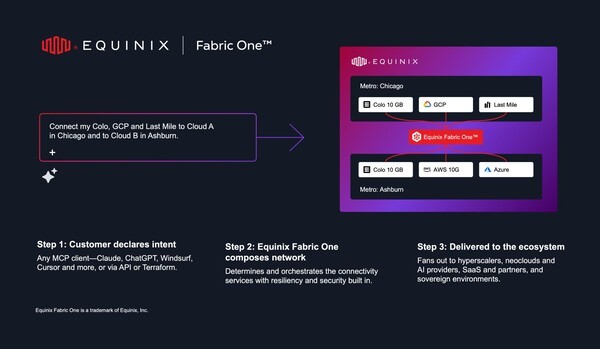
Equinix Fabric One is structured so that when customers specify their connectivity targets and requirements, it determines and provides the optimal connectivity needed for implementation. The only task for customers is to specify the connectivity targets and requirements.
Chris Audie, Equinix CPO, said that over the past dozens of years, enterprise networks have been built through business-specific operations, with separate connections established for each partner and provider. He said distributed AI environments require dynamic, flexible, real-time connectivity, but that the traditional approach of building individual connections has the limitation of reduced scalability.
He explained that Equinix Fabric One is a service that automatically manages connectivity based on customer intent. He said it manages connectivity across the entire architecture and expects it to significantly reduce the complexity of enterprise network operations.
Equinix said the endpoints enterprises connect to are expanding to include cloud and AI providers, partners, and business sites. It also said that adding a new network requires specialized technical capabilities, cross-functional collaboration, and ongoing management, and that such complexity can slow deployment and become an obstacle to timely infrastructure expansion in line with business requirements.
Andrew Buss, senior research director for cloud and data center and enterprise infrastructure at IDC, said networks are a core area of enterprise infrastructure. He also said that network design and operations still rely heavily on manual processes. He added that companies are looking for ways to further simplify and automate how they provision and manage connectivity across distributed cloud and AI environments, but that achieving such a transition remains a major challenge.
He went on to say that advances in technologies that support integrated automation and intent-based approaches can reduce operational complexity and risk. He also explained that such technological advances can support the flexibility required for modern AI and multi-cloud architectures.
Against this backdrop, Equinix Fabric One was presented as a means for specifying the connectivity needed without having to assemble or manage the components of network services individually. Customers can use the portal, API, automation workflows, agent-based requests, and natural-language prompts for this purpose.
Equinix Fabric One handles routing, cloud connectivity, encryption, system recovery, and automated orchestration and management of failover to deliver the result as a single managed service.
Equinix Fabric One is based on the Equinix platform, which includes more than 10,500 interconnected companies and about 3,000 cloud and IT providers. Its adoption has reached operation at 8 of the world's top 10 AI model providers and 9 of the top 10 neocloud companies.
Equinix provides a neutral platform and helps companies maintain architectural flexibility as they respond to changes in their business and technical environments. It also helps them connect freely with a range of service providers without vendor lock-in.
Equinix Fabric One uses the open-source OpenAPI 3.0 interconnect specification developed in collaboration with AWS and Google Cloud. This supports choice and interoperability across distributed AI, cloud, and enterprise environments.
Enterprise architecture is evolving toward agentic architecture, a direction in which applications and AI agents can discover, request, and provision connectivity. In this process, connectivity operations can be programmed without human manual intervention.
In this regard, Robert Kennedy, vice president of AWS network services, said that customers should be able to define only their requirements and have the system work immediately, without having to think through for themselves how to connect multiple cloud and AI environments. He added that Fabric One is based on an open interconnect standard established jointly by AWS and Google Cloud.
Vice President Robert Kennedy said Fabric One implements that kind of environment and takes on the management of complex connections. He added that customers can focus on the AI workloads themselves rather than on complex connectivity methods.
Rob Enns, vice president of engineering for cloud networking at Google Cloud, said interoperability between clouds is the foundation of the AI era. He also explained that Google Cloud contributed to establishing the open interconnect specification, with the aim of easing the burden on companies of directly managing multi-cloud networking complexity.
The combination of Google Cloud's cross-cloud network capabilities and Equinix Fabric One provides customers with an automated, intent-based network. As a result, distributed AI workloads can be deployed more quickly.
Equinix also announced Equinix Interface Exchange at this Equinix Horizon event. The product is intended to accelerate enterprise AI infrastructure deployment.
Paul Hager, CEO of Hyundai AutoEver America, said that as technology environments become more fragmented, AI workloads and multi-cloud architectures need connectivity with flexibility, scalability, and ease of management. He added that Equinix Fabric One has the potential to accelerate the company's efforts to meet those needs.
Equinix Fabric One is scheduled to launch in beta later this year, with a general release to begin in North America in 2027.
Source: TECHWORLD · Park Gyu-chan
Original: https://www.epnc.co.kr/news/articleView.html?idxno=406481
References
This article was produced with the help of an automated content generation algorithm.
Source: TECHWORLD
View originalThis article was summarized and organized by BizCrush based on the original article from TECHWORLD. For exact quotations and full details, please refer to the original article.