Kakao Expands AI Education to 13 Universities Nationwide, Tackles Local Social Problems
TECHWORLD ·
✦ AI Summary
Kakao, in partnership with the Ministry of Education, will expand AI education for university students nationwide and pursue projects that use technology to solve local social problems.
The Kakao Impact Foundation announced on the 3rd the start of the 2026 second-semester course for "Tech for Impact Campus," a regular class in which university students and social innovation organizations form teams to develop solutions to social problems using AI and digital technology.
In the second semester, 355 students from 13 universities nationwide will participate, and the total number of participating universities this year will expand to 18.
Kakao, in partnership with the Ministry of Education, will expand AI education for university students nationwide while also advancing projects that use technology to solve local social problems. The Kakao Impact Foundation announced on the 3rd the start of the 2026 second-semester course for "Tech for Impact Campus."
"Tech for Impact Campus" is a program in which university students and social innovation organizations form teams to develop ways to solve social problems using AI and digital technology. It is run as a regular class.
The program began in 2023 at the KAIST School of Computing. Cumulative participation through the first semester of this year reached 9 universities and 482 students. In April, the Kakao Impact Foundation signed an MOU with the Ministry of Education and the Korean Council for University Education.
Starting this semester, the number of participating universities will expand nationwide on the basis of cooperation with the Ministry of Education. In the second semester, additional classes will be operated with 13 universities nationwide and 355 students participating. As a result, the total number of participating universities this year will increase to 18.
The number of participating universities increased through linkage with the Ministry of Education's AI basic education curriculum project. The new participating universities are Kyungwoon University, Dongguk University, Busan University of Foreign Studies, Seoul Women's University, and Halla University. Classes will also be held at the four science and technology institutes — KAIST, DGIST, UNIST, and GIST — as well as Gachon University, Korea University's Sejong Campus, Seoul National University, and the University of Seoul.
Accordingly, the program will expand its educational focus from engineering to medicine, social sciences, marketing, and more. Students will combine AI and digital technology with their major knowledge and identify regional and social issues to develop solutions. The projects will be carried out in connection with actual local sites.
The 21 social innovation organizations selected through the national open call will be linked with universities by region. Over the course of a semester, students will visit the field and directly define the problems they will solve. They will then develop AI- and technology-based services that can be applied on site with support from social innovation organizations and current Kakao employees serving as mentors.
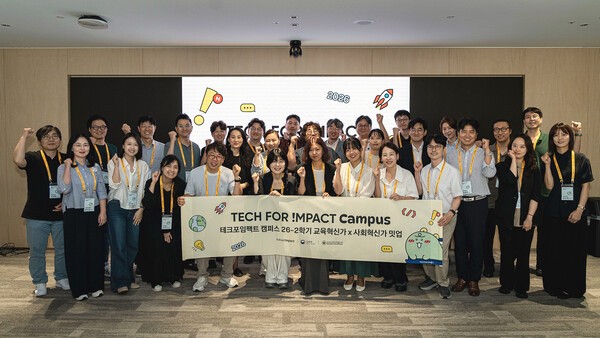
Before classes begin, the Kakao Impact Foundation held an opening meetup at Pangyo Agit on the 24th of last month to first establish a foundation for collaboration among participating institutions. More than 50 people, including university faculty members and representatives of social innovation organizations, attended the opening meetup.
On the 29th, the Kakao Impact Foundation will also hold an online workshop for more than 300 people, including faculty members, social innovation organizations, and current Kakao employee mentors. Through this, it has established a collaboration system among participating institutions before the full-fledged classes begin.
Meanwhile, apart from university education, Kakao is continuing programs to expand the local AI ecosystem. To that end, it launched Kakao AI Boat, a private partnership organization with the four science and technology institutes, and is supporting AI and data startups outside the Seoul metropolitan area based on a fund worth KRW 50 billion. It will also hold the Kakao AI Boat Summit 26 in Busan on the 29th, where AI company officials, startups, aspiring founders, and investors from Korea and abroad will share technology and business experience. An AI agent hackathon, Ralpthon, in which science and technology institute students and local talent will participate, will also be held alongside the summit.
Ryu Seok-young, chairperson of the Kakao Impact Foundation, said that the capabilities needed in the AI era should not be seen only as the ability to use technology, but also as the experience of identifying and solving problems around oneself. He said this was why the foundation intends to support opportunities for university students to use AI and their major knowledge to address the problems of the regions where they live.
Source: TECHWORLD · Kim Seung-gi
Original: https://www.epnc.co.kr/news/articleView.html?idxno=406473
References
This article was produced with the help of an automated content generation algorithm.
Source: TECHWORLD
View originalThis article was summarized and organized by BizCrush based on the original article from TECHWORLD. For exact quotations and full details, please refer to the original article.