MongoDB Expands Into Korea’s Manufacturing and Public Sectors With AI Data Platform Push
TECHWORLD ·
✦ AI Summary
MongoDB outlined legacy system modernization and AI innovation as its two main pillars for the Korean market.
Its key target markets are manufacturing and the public sector, and it emphasized a strategy of providing real-time operational data, search, and embeddings on a single platform.
It also highlighted cloud and on-premises deployment in the public and financial sectors, along with support for 'Run Anywhere.'
MongoDB outlined its strategy for the Korean market as enterprise AI adoption moves from PoC to real-world services. The company said it plans to expand its AI data platform business in Korea, with a focus on manufacturing and the public sector.
Accordingly, MongoDB presented a strategy aimed at capturing demand for legacy system modernization, offering the functions needed for AI applications, including real-time operational data, search, and embeddings, on a single platform. It said this would help expand its customer base by delivering a unified platform.
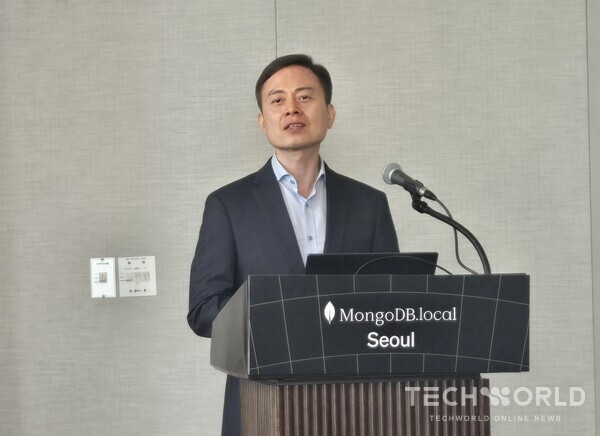
MongoDB held a media briefing for 'MongoDB.local Seoul 2026' on the 1st at the Grand InterContinental Seoul Parnas in Samsung-dong, Seoul. At the event, the company unveiled its domestic business strategy and intelligent data platform.
The presentations were delivered by Jang Jeong-wook, head of MongoDB Korea; Christopher Shem, MongoDB's director of product management; and Frank Liu, research manager at MongoDB Voyage AI.
Jang said the two core pillars of the company’s Korea business are modernization and the expansion of businesses built on AI innovation.
Jang said Korean companies are shifting their AI use from experimentation and PoC stages to actual service deployment. He also said AI is moving into production, not remaining at the experimental stage.
He said AI use is also becoming more concrete by industry, with applications emerging in services and search, financial anomaly detection, and manufacturing equipment and sensor data analysis.
He said that as AI enters the production stage, data architecture is becoming increasingly important for stable service expansion in operational environments. He also explained that existing data architectures need to change to enable AI applications to use real-time generated data.
However, he said the data environment challenges facing Korean companies include siloed structures distributed across multiple systems, the persistence of rigid legacy databases, and growing system complexity as AI-building components are introduced separately.
In AI operations, the data layer directly affects performance and cost. As AI services scale up, the importance of efficiently structuring model delivery data and context is also rising. Since the efficiency of data and context composition determines token usage and costs, the importance of token economics is growing.
In response to this demand, MongoDB set legacy modernization and AI innovation as the two pillars of its Korean business. Its strategy focuses on enabling flexible transitions from existing data environments and connecting that to AI service development.
MongoDB has set manufacturing as a key target market. As demand grows for linking AI with IoT and sensor data generated in equipment, processes, and logistics, MongoDB is expanding discussions with related companies. Jang said manufacturing data has great characteristics, complexity, and innovation potential, and that inquiries and strategic discussions from manufacturing customers considering AI are moving quickly.
The adoption of AI in manufacturing sites is still at an early stage, he said. Before AI can be fully applied, work is needed to modernize legacy systems and build security and data governance frameworks. Jang said manufacturing companies need changes and modernization in their existing legacy environments to secure an AI foundation, and that once security and governance frameworks are in place, an acceleration phase similar to the one seen during cloud migration could arrive.
Meanwhile, MongoDB is accelerating its push into the public sector. The company said it has completed the procedures required for registration on the Public Procurement Service’s KONEPS system with a local partner and is currently discussing business with several public institutions. Jang also said discussions are underway with multiple public agencies.
Jang said public-sector projects require a significant preparation period before they are reviewed, and that the company has continued the related process accordingly. He added that MongoDB’s public-sector business is now at the starting stage.
The discussion was presented as a framework for public and financial-sector deployments, with an emphasis on supporting both cloud and on-premises environments. In particular, the company highlighted support for responses to network separation and data sovereignty requirements, as well as the ability to choose data deployment methods according to regulations, workload characteristics, and operating environments.
MongoDB also emphasized that its approach supports the same technology regardless of the chosen deployment method. Jang described this internally as 'Run Anywhere,' and noted that on-premises environments are widely used in Korea.
Jang went on to say that the ability to use the same technology and platform across diverse environments is a major differentiator. He presented this as a way to maintain technical consistency while covering multiple environments in line with the regulations and operational constraints of the public and financial sectors.
The company is aiming beyond a database toward an 'intelligent data platform,' emphasizing integration and real-time capabilities. Director Christopher Shem introduced the intelligent data platform strategy, which integrates data functions for AI applications.
MongoDB provides transactions, full-text search, vector search, embeddings, and reranking within a single platform. This contrasts with the approach of separately building individual solutions such as databases and search systems and then connecting them, and is intended to reduce system complexity through integration.
Shem described the database as part of the overall stack and said the scope of expansion based on MongoDB covers the entire AI data layer. He said MongoDB is implementing this as a single intelligent data platform by integrating real-time data, search, analytics, embeddings, reranking, and vector search.
Building on that direction, MongoDB introduced the MongoDB Atlas Managed MCP Server. The server is designed to connect AI agents with data, and it is provided as a managed service. As a result, developers can connect AI tools to MongoDB Atlas without having to host an MCP server themselves.
Shem then pointed to MongoDB's differentiators as an integrated data environment, proven architecture, and real-time data processing. He also emphasized that functions needed for AI services, including transactions, search, and embeddings, can be handled in a single data environment.
He said transactions, full-text search, vector search, and embeddings can all be handled on one data platform. He also said these functions were not added individually, but that the integrated structure among them is the key.
He added real-time capability as another major competitive advantage. Data used by search and AI applications should be current operational data, not separate replicas or periodically migrated data, he said.
Shem said results based only on data from days or weeks ago are not sufficient. He also said accurate AI search using the latest data is needed if the results are to be reflected in decision-making.
MongoDB began in 2007 with a document data model. It later expanded its capabilities with the Atlas cloud database service, full-text search, and vector search, and more recently added embeddings, reranking, and MCP. On that basis, MongoDB is expanding its scope into an AI application data platform.
Research Manager Frank Liu introduced changes in AI search technology and the role of Voyage AI. Liu said the search technology trend is moving from keyword-centered search to AI search based on embeddings and vector search, then through retrieval-augmented generation (RAG) and on to agentic AI.
He said the scope of use is expanding toward agentic AI. In that process, he explained that the conditions for accurate AI agent output depend not only on model performance, but also on the accurate retrieval of needed information and the provision of context.
He presented Voyage AI's role as improving search performance through the use of embedding models and rerankers. Liu said search accuracy affects the judgments made by AI applications and agents, as well as operating costs.
Liu also said that if contextual data is outdated, incomplete, or inaccessible, even excellent models will produce inaccurate results. In this context, he said Voyage AI is positioned to improve search accuracy with embedding models and rerankers.
Integration of Voyage AI text and multimodal embedding models and rerankers is underway on the MongoDB platform. This makes it possible to test multiple embedding and search approaches according to each company's work characteristics. It is also possible to tune rerankers for specific areas and question types.
Liu said the company provides customers with tools to test various embeddings and verify search methods. He also said rerankers can be focused on the financial sector and adjusted toward specific question-answering directions.
Voyage AI is focusing on improving search performance and cost efficiency with its related model lineup. The models are 'Voyage-4,' 'Voyage-Multimodal-3.5,' and 'Rerank-2.5.'
Liu highlighted Voyage AI's technological competitiveness based on Hugging Face search embedding benchmark results. He also said the Voyage-4 family of models shows stronger search performance than competing embedding models.
As MongoDB pushes into the Korean market, it is targeting legacy system modernization and AI innovation as its two main axes, with manufacturing and the public sector as its key markets. As AI adoption shifts from experimentation to real services, MongoDB is positioned around an integrated data platform strategy, and the key questions are whether it can expand its domestic customer base and secure new demand, with attention on the link between that strategy and domestic customer growth and new demand creation.
Source: TECHWORLD · Kim Seung-gi
Original: https://www.epnc.co.kr/news/articleView.html?idxno=406364
References
This article was produced with the help of an automated content generation algorithm.
Source: TECHWORLD
View originalThis article was summarized and organized by BizCrush based on the original article from TECHWORLD. For exact quotations and full details, please refer to the original article.