ETRI Unveils 4E Innovation Strategy, Leads National Mission R&D Centered on AI and DX
TECHWORLD ·
✦ AI Summary
ETRI held the 'ETRI Conference 2026' on Sept. 1 to mark its 50th anniversary and unveiled a new vision and AI innovation strategy.
ETRI presented 'A Warm World Where We Live Together, Led by AI and DX Innovation' as its vision and set 'AI Scientist for Everyone' and 'AI's Heart - AIDC' as its central directions.
It also announced plans to concentrate on five key areas, develop an 'AI scientist at the level of a research institute director' by 2035, and build AIDC and a national science AI ecosystem.
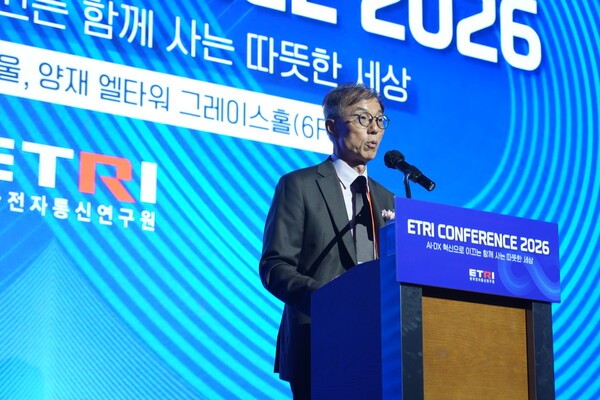
The Electronics and Telecommunications Research Institute (ETRI) unveiled a new vision and AI innovation strategy to mark its 50th anniversary and laid out its goal of leading the era of the AI transformation. As a forum to share the plan, ETRI held the 'ETRI Conference 2026' on Sept. 1.
More than 600 people from industry, academia, and research attended the event. The conference theme was 'A Warm World Where We Live Together, Led by AI and DX Innovation.'
At the event, ETRI presented its future vision and innovation strategy, with 'AI Scientist for Everyone' and 'AI's Heart - AIDC' set as its central directions. It also outlined the national missions to be carried out in the era of the AI transformation and future R&D directions.
This year's event was meaningful as it marked ETRI's 50th anniversary, but the focus was not limited to reviewing the achievements of the past half-century. ETRI presented directions for change and innovation to prepare for the next 50 years centered on AI and DX for the public, industry, academia, and research institutions.
ETRI President Park Se-wung delivered a presentation on the vision and innovation direction ETRI is pursuing in a new research environment and introduced ETRI's new vision and innovation strategy.
Park said that with the rapid advancement of AI technology, the technology level in some areas is approaching the Singularity, while the ultimate purpose of technological progress is to create a world that is more beneficial to people. Based on this, he presented ETRI's new vision as a warm world where people live together, led by AI and DX innovation.
He then presented the 4E Combination as the innovation strategy. He explained that Essential refers to essential innovation for national innovation growth engines and R&D system reform; Embracing means open embrace for an open R&D platform and sound win-win cooperation; Exciting means stimulating the research instinct and boosting research vitality; and Excellent means excellent growth for outstanding quality outcomes and expanded global influence. Park said ETRI plans to pursue both technological innovation and management innovation through the combination of the 4E elements.
ETRI established a policy of strategically concentrating its R&D capabilities to secure national innovation growth engines and decided to channel its research and development capacity into five key areas. The five priority areas are AI-native 6G, satellite communications, safe AGI, spatial media, physical AI, and public/industrial AI and DX.
ETRI also decided to consolidate and integrate non-strategic areas, a measure aimed at concentrating research capabilities. Along with this, ETRI plans to push forward AI R&D focusing, mission-type flagship R&D, and the securing of differentiated core technologies by field, with a focus on developing national strategic technologies that only ETRI can do.
Under this direction, the first strategic technology session, 'AI Scientist for Everyone,' presented the vision of the AI for Science era. The session outlined a role shift in which AI goes beyond a simple research assistant tool and participates in the entire research process, including hypothesis formulation, experimentation, analysis, and verification.
Kwon Oh-wook, head of the Intelligent Information Research Division at ETRI's Artificial Intelligence Research Laboratory, gave a presentation titled 'ETRI's Technology Vision for Realizing an AI Scientist.' Kwon explained that the scientific and technology R&D paradigm is changing rapidly as general-purpose AI intelligence advances and science-specific AI emerges.
AI for science is expanding its status beyond research assistance. It is showing effects in shortening research periods and improving research productivity, and is emerging as a key competitive field that determines national research leadership.
Against this backdrop, ETRI will begin developing an 'AI scientist at the level of a research institute director' by 2035 with the goal of solving national strategic scientific challenges. The 'AI scientist at the level of a research institute director' is intended to autonomously carry out the entire research cycle.
ETRI presented a step-by-step roadmap to support this plan. The first stage is the human-AI collaborative 'AI research colleague,' in which researchers and AI jointly formulate hypotheses and conduct experiments together. The second stage is a 'human-supervised autonomous science system,' in which AI operates scientific agents and runs the laboratory under the condition that the researcher provides direction. The final stage is a full-cycle autonomous research system, in which AI handles the entire research process and runs multiple research tasks in parallel.
To back this plan, ETRI is pushing to secure core technologies such as a science-specific foundation model, specialized AI agents, hypothesis generation and prioritization, sophisticated experimental design, agent orchestration, a science AI-OS, and autonomous laboratories. Agent orchestration will connect specialized agents with research tools and experimental environments. ETRI also plans to develop a Korean-style AI scientist platform that integrates these core technologies.
As part of its response to dependence on overseas general-purpose AI models, ETRI presented a strategy to address the possible leakage of national scientific data and research assets. The strategy aims to secure independent science-specific AI technology capable of understanding scientific claims and evidence, as well as equations and charts.
ETRI also set as a goal securing science-specific AI technology capable of handling the entire research process. The article presented a strategy to secure an independent science-specific AI that can understand scientific content and forms of expression and carry out the full research cycle.
ETRI plans to link this initiative with the national K-moonshot AI scientist mission. ETRI set a challenge of achieving Nobel Prize-level research results and presented the advancement of AI technology into an 'AI scientist for everyone' as its vision. The goal of the 'AI scientist for everyone' is to solve humanity's and society's toughest challenges.
Yoo Yong-gyun, head of the National Science and Technology Research Council's National Science AI Research Center, gave a presentation on 'The Development of AI and the Changing Role of Human Scientists.' Yoo explained how AI is changing the way science and technology research is conducted and the role of scientists, and introduced the national AI scientist promotion strategy centered on the National Science AI Research Center (NAIS). He then said that AI is evolving beyond accelerating scientific discovery to a stage where it changes the time and method of research itself.
While emphasizing the use of AI scientists, the target was presented as solving national science and technology challenges, including the 12 K-moonshot missions, and the role was set as a common acceleration engine. The four key tasks for NAIS promotion were presented as a science AI research acceleration platform, an autonomous science system, a science AI convergence demonstration hub, and K-moonshot support.
The function of the science AI research acceleration platform was summarized as providing researchers with the full cycle of AI-ready data, GPU, models, and expertise. The goal of the autonomous science system was presented as building a foundation for AI to carry out the entire research process, including hypothesis setting, experimentation, and analysis.
ETRI plans to support joint research and demonstration between domain researchers and AI researchers. ETRI also plans to provide platforms and personnel for K-moonshot projects.
As an operating model, NAIS was presented as taking on the role of a hub that provides the national common infrastructure, while government-funded research institutes, including ETRI, serve as spokes responsible for research in specialized fields. The proposed linkage structure is a strong hub + strong spoke model.
In the role-sharing structure for building a national science AI ecosystem, the shared goal of NAIS and each government-funded research institute was presented as building that ecosystem. Among them, NAIS will provide common infrastructure such as FAIR and AI-ready data standards, common foundation models, evaluation benchmarks, a GPU pool, and integrated scheduling.
Each government-funded research institute is responsible for securing data in its specialty field and developing domain-specific models. The roles are divided in a way in which NAIS provides the common infrastructure and each institution accumulates capabilities by field based on it.
Following this trend, the 'AI's Heart - AIDC' section diagnosed a shift in the center of AI competition. It said the focus of competition is moving from individual AI chips to infrastructure that encompasses the entire AI data center, and in the same section it presented ETRI's AIDC technology strategy.
ETRI has technology capabilities across the entire ICT field, including AI models, agents, computing, and networks, and is expected to play a key role in realizing a national AI scientist ecosystem. In a presentation titled 'ETRI's Technology Vision for Completing AIDC,' Koh Kwang-won, head of ETRI's AIDC Research Division, defined AIDC as a 'Token Factory' that produces 'tokens and AI computing power' by inputting power and data.
Koh explained AIDC by comparing it to the power plants of the industrial age, saying it is an infrastructure that combines power and data with AI semiconductors, high-speed interconnects, and computing software to produce AI computing power. He then defined AIDC as the heart of the AI era.
Koh said the battleground for AI competition is shifting from chip to infrastructure (AIDC). He also explained that AIDC and ultra-high-speed connectivity are key to building a national expressway.
ETRI plans to develop AIDC technologies centered on AI semiconductors, optical interconnects, optical networks, and AI computing SW. It also plans to advance optical interconnect and optical network technologies that provide light-based ultra-high-speed connectivity for large-scale AI computing resources inside data centers.
ETRI plans to secure optimization and abstraction technologies for heterogeneous AI semiconductor clusters, large-scale AI model serving technologies, resource integration management technologies, scheduling and orchestration technologies, management-intervention-minimizing AIOps-based operational automation technologies, and HW-SW-inclusive E2E integrated infrastructure technologies.
ETRI presented a plan to sequentially secure 12.8Tbps-class optical I/O chipset technology by 2031, and to sequentially secure 3.2Tbps-class optical transceiver technology and core optical device technology by 2031. Based on this, it presented a blueprint for eliminating communication bottlenecks between computing resources inside AI data centers.
ETRI also presented a vision for all-optical-switching-based RDMA technology and a vision for in-network computing technology. These technology visions were presented in line with efforts to improve communication efficiency inside AI data centers.
The AIDC architecture was presented as a plan to expand from a single-site data center to a wide-area distributed AIDC. Then, after 2032, a plan was also presented to evolve into a collaborative AIDC that links ground and space computing resources.
The goals of this plan were presented as concentrating optical semiconductor design, foundry, and packaging capabilities, concentrating AI semiconductor and optical network capabilities, and concentrating computing resource management and scheduling SW capabilities. These concentration goals were summarized as completing the 'AI heart.'
Along with this trend, Lee Il-jun, director of NHN Cloud, gave a presentation on 'AI Infrastructure and Data Centers.' Lee introduced changes in data centers driven by AI expansion and also introduced directions for responding at industrial sites.
Lee explained that the function of data centers is changing as AI spreads. He said traditional data centers were computers centered on CPU, data storage, and processing, but in the AI era, their role is changing into AI factories that produce large-scale GPU-based AI computing.
The spread of high-performance GPUs was presented as the background for this change. Accordingly, surging power consumption and heat generation are appearing, and Lee stressed that securing power, cooling, land, and load capacity are emerging as key elements of a data center's physical infrastructure. He also said that data center physical infrastructure determines AI competitiveness.
Lee noted that even in cooling methods, a transition is under way from the existing air-cooling-centered system to direct chip cooling and immersion cooling. He also said that to secure AI competitiveness, it is necessary to encompass power, cooling, and networks beyond GPUs, and mentioned the need for expansion of national AIDC infrastructure and strategic investment.
Through this conference, ETRI presented a comprehensive AI innovation strategy. ETRI judged that the future of the AI transformation era cannot be seen through competition in AI model performance alone, and it presented AI research innovation, AI scientists, AI computing infrastructure, AIDC, and a national mission-centered R&D system as the scope of its strategy.
ETRI presented 'AI Scientist for Everyone' and 'AI's Heart - AIDC' and defined them as key strategies symbolizing intelligence and infrastructure in the AI era. ETRI said it aims to support national AI competitiveness by bringing together research capabilities across the full ICT spectrum, from AI models, AI semiconductors, computing, networks, and data centers to application services.
ETRI then announced a policy to expand open research collaboration with universities, companies, government-funded research institutes, and global research institutions, broadening cooperation beyond the boundaries of research organizations. It also said it would strengthen its role in creating strategic technologies needed by the nation and producing world-class research results, while pursuing its identity as a national AI and ICT research institution.
Park said that over the past 50 years, ETRI has developed the technologies needed by the nation and its people at every major moment in the Republic of Korea's rise as an ICT powerhouse. He also said that at the inflection point of the AI transformation, ETRI's accumulated ICT capabilities over half a century must be combined with AI, and that the country needs to create a new growth engine.
The speaker said that in the AI era, it is difficult to secure a global technological competitive edge with the capabilities of individual organizations or researchers alone, and announced ETRI's plan to open up and cooperate across the boundaries of research institutes, universities, and companies. Through this, ETRI set out its goal of leading national missions such as AI scientists and AIDC, and driving the development of core technologies needed for the Republic of Korea to rise into the top three AI powers.
The speaker then said that as technology surpasses human abilities, the direction of technology must be made clear, and presented a vision of a warm world where people live together, led by AI and DX innovation. ETRI expressed its determination to connect technological progress with human happiness and national growth, and to pioneer the next 50 years for the Republic of Korea.
Source: TECHWORLD · Lee Kwang-jae
Original: https://www.epnc.co.kr/news/articleView.html?idxno=406347
References
This article was produced with the help of an automated content generation algorithm.
Source: TECHWORLD
View originalThis article was summarized and organized by BizCrush based on the original article from TECHWORLD. For exact quotations and full details, please refer to the original article.