Ericsson Holds 'Innovation Day 2026 Korea,' Outlines Network Evolution in the AI Era
TECHWORLD ·
✦ AI Summary
Ericsson Korea held a media briefing as part of 'Ericsson Innovation Day 2026 Korea,' introducing key technologies from 'MWC 2026' and the direction of evolution in the Korean market for 5G SA, 5G Advanced, AI and 6G to domestic telecom operators, industry players and ecosystem partners.
Ericsson said AI is changing network performance, operations, services and business models, presented 'network for AI' and 'AI for network,' and described AI-RAN, ISAC, 5G SA, network slicing, QoS, QoD API and dynamic AI offloading as key measures.
Ericsson said it sees 6G as the result of evolution based on 5G SA, 5G Advanced, AI-based capabilities, open and programmable networks, and automation, and head of Ericsson Korea Sibel Tombaz said the starting point for competitiveness in the AI era is the network.
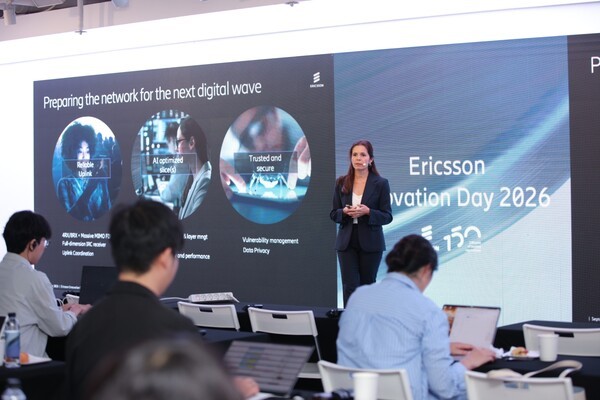
Ericsson Korea held a media briefing as part of 'Ericsson Innovation Day 2026 Korea.' The event was aimed at domestic telecom operators, industry players and ecosystem partners, and was organized to share Ericsson's key technologies for 'MWC 2026' and introduce the direction of evolution in the Korean market for 5G SA, 5G Advanced, AI and 6G.
The media briefing focused on how AI is transforming network performance, operations, services and business models. At the event, Ericsson presented two perspectives — 'network for AI' and 'AI for network' — and explained the network's new role in the AI era.
Ericsson cited AI glasses, autonomous driving and robots as new applications, saying these services require high uplink capacity, consistent low latency, reliability and mobility. It accordingly presented an intelligent platform as the next stage of network evolution to support new demand.
Ericsson outlined improving performance, enhancing energy efficiency and automating operations as directions for the use of AI in networks, and said related requirements can be supported based on 5G SA and 5G Advanced. It added that this evolution path leads to AI-native 6G.
Ericsson described AI-RAN as the core of this evolution. It said AI-RAN is not limited to a single product or a specific accelerator, but is an architecture that delivers the performance needed by AI applications while enabling self-improvement in network performance and self-improvement in operational efficiency through AI across all RAN layers.
It also said ISAC (Integrated Sensing and Communication) expands mobile network capabilities beyond data transmission, carrying out functions such as sensing the surrounding environment and objects, as well as location awareness and motion tracking. Ericsson added that it can be applied to critical infrastructure, transportation, industrial sites and the low-altitude economy, offering differentiated possibilities across sectors.
Ericsson presented 5G SA, network slicing, QoS and QoD API-based network quality assurance technologies, and dynamic AI offloading as implementation measures. It said these would make it possible to deliver the speed each service needs and the reliability each service requires, thereby enabling differentiated connectivity.
The company presented industry and field operation scenarios such as drone-based site monitoring. Through these scenarios, it suggested the potential to support stable and predictable network performance.
Ericsson said it sees 6G not as a disruptive generational shift. It also defined 6G as the result of evolution based on 5G SA, 5G Advanced, AI-based capabilities, open and programmable networks, and automation.
Ericsson emphasized the possibility of a natural connection from current network investment to AI-native 6G. It also stressed that current network investment serves as the foundation for future services, citing immersive experiences, autonomous driving and industrial automation as examples of future services.
Sibel Tombaz, head of Ericsson Korea, said the starting point for competitiveness in the AI era is the network. She also pointed to high uplink capacity, predictable performance and stable connectivity as requirements for AI services, and mentioned the need to make networks more intelligent and efficient through AI.
Based on its telecommunications technology capabilities and technical leadership in AI-RAN, ISAC, differentiated connectivity and 6G, Ericsson outlined its direction for supporting the Korean market, and said it will help Korean customers and partners realize new service and business opportunities.
Source: TECHWORLD · Lee Kwang-jae
Original: https://www.epnc.co.kr/news/articleView.html?idxno=406343
References
This article was produced with the help of an automated content generation algorithm.
Source: TECHWORLD
View originalThis article was summarized and organized by BizCrush based on the original article from TECHWORLD. For exact quotations and full details, please refer to the original article.