From Deoksugung Patrols to Downtown Tokyo Deliveries: Neubility Accelerates 'Spatial RFM' Strategy for Commercial Robot Services
TECHWORLD ·
✦ AI Summary
Neubility said it will expand the scope of its autonomous robot services based on spatial intelligence and service operation experience accumulated in real commercial settings.
Spatial RFM is designed to interpret spatial structures, people, vehicles, facility movement, access, operating conditions and assigned tasks within a single context so it can determine mobility methods and how services should be carried out.
Neubility is broadening its applications to patrols at Deoksugung, patrols at Seoul Forest, logistics at Chungnam National University Hospital and deliveries in Shibuya, Tokyo, while recording more than 150 sites of domestic and overseas operations and more than 146,721 km of cumulative driving distance by the first half of 2026, as well as 44,638 service operations in 2025.
Based on the spatial intelligence and service operation experience it has accumulated in real commercial settings, Neubility outlined a direction to expand the scope of its autonomous robot services to fit each site environment and task. The company said it has validated spatial intelligence and service operation capabilities in commercial deployments and is linking those proven capabilities to applications tailored to each site environment and mission.
Neubility announced that it is fully rolling out its service expansion strategy based on the "spatial robot foundation model" (hereinafter "spatial RFM"). Spatial RFM is defined as a spatial intelligence model that interprets spatial structures, people, vehicles, facility movement, access, operating conditions and assigned tasks within a single context. Through this, it is designed to determine the necessary mobility method and how the service should be carried out.
On this basis, Neubility is expanding the scope of its autonomous robot services to include patrols at Deoksugung, patrols at Seoul Forest, interbuilding logistics at Chungnam National University Hospital, and deliveries in Shibuya, Tokyo, Japan. The company is broadening its service areas into patrols, hospital logistics and urban delivery.
Neubility has been operating its autonomous robot Neubi in actual service environments since 2023. By the first half of 2026, it had operated in more than 150 sites in South Korea and overseas and logged more than 146,721 km of cumulative driving distance.
While driving, the robot collects RGB images through five-direction cameras and uses an RGB-image-based method of capturing the surrounding environment. It generates visual and spatial perception data based on the collected footage, and the generated data falls into 6 categories. The categories include depth information, road surface segmentation, object recognition, distance estimation and location estimation. This information is used for on-site driving and situation awareness.
Neubility has accumulated commercial operating data, recording 44,638 robot service operations in 2025. The company also has on-site operating experience. Based on this, Neubility has built development and operation capabilities for "site-based physical AI."
These capabilities support both on-site application of spatial RFM and service expansion. Neubility said it is linking the capabilities built through cumulative commercial operating data and on-site experience to broader deployment of spatial RFM.
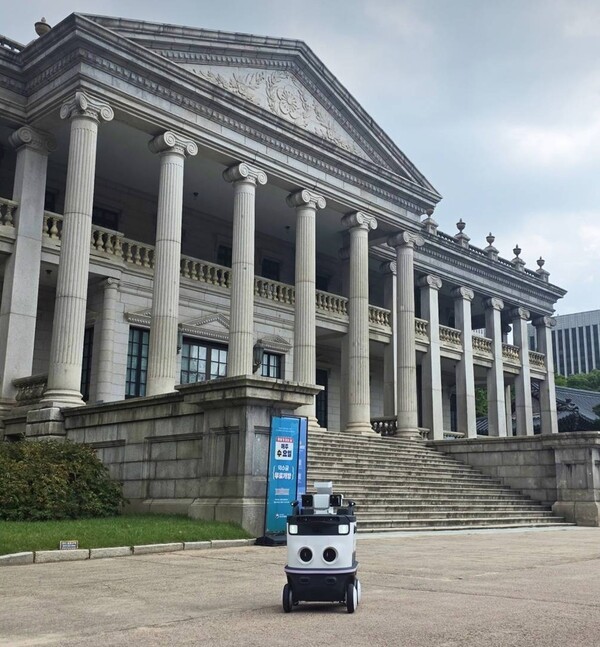
The Royal Palaces and Tombs Center under the National Heritage Administration is operating the autonomous patrol robot "Sunrabot" at Deoksugung. Neubility supports daytime and nighttime patrols for "Sunrabot" and also supports detection of abnormal situations such as fire and falls. The Deoksugung environment requires consideration of both cultural heritage preservation and visitor movement. Neubility said it has validated autonomous driving and situational awareness technologies in existing patrol services and applied those verified technologies to the Deoksugung environment.
Based on its advanced route judgment and pedestrian avoidance capabilities in urban outdoor environments, Neubility is preparing to introduce a robot patrol service at Seoul Forest in the second half of the year. The service aims to support safety management work, and Neubility plans to provide patrols tailored to the operating environment characteristics of Seoul Forest, including high pedestrian density, the presence of temporary facilities and changes in driving conditions by weather and time of day.
In the same flow, Neubility is also moving to introduce indoor-outdoor robot services at Chungnam National University Hospital. The autonomous robot will be deployed on the route between the main building and the Daejeon Chungcheong Regional Rehabilitation Center, which is about 400 m from the main building.
The robot will handle two-way logistics transport. Neubility plans to expand the scope of hospital logistics automation to outdoor sections by applying the spatial recognition and driving capabilities needed for indoor-outdoor transitions as well as those needed for interbuilding movement.
At the same time, Neubility is also conducting a proof of concept for autonomous robot delivery in Japan. The demonstration began on Aug. 24 in Sasazuka, Shibuya Ward, Tokyo, and the partner platform is Demae-can.
Drawing on its experience with urban delivery services in South Korea, Neubility has begun operating in downtown Tokyo. The company said it is applying its experience in pedestrian response, route judgment and delivery service operations to Japan's transportation system and delivery procedures, and using that to move into downtown Tokyo operations.
Neubility CEO Kang Ki-hyuk said the city is not the final testbed for technology, but the starting point of robot intelligence. He said the company has accumulated operational experience in unpredictable urban environments and is turning existing field challenges into next-site intelligence. He added that the new sites are examples of expanding spatial intelligence proven in one site to different spaces and tasks, and said that through Billi, which will be unveiled soon, the company plans to pursue a single-task connection between indoor-outdoor mobility and on-site work while broadening the scope of spatial RFM to a wider range of industrial sites.
Source: TECHWORLD · Lee Gwang-jae
Original: https://www.epnc.co.kr/news/articleView.html?idxno=406324
References
This article was produced with the help of an automated content generation algorithm.
Source: TECHWORLD
View originalThis article was summarized and organized by BizCrush based on the original article from TECHWORLD. For exact quotations and full details, please refer to the original article.