KT, Seoul National University and KAIST Launch Joint AI Research on Agents and Reasoning Efficiency
TECHWORLD ·
✦ AI Summary
KT said on the 30th that it will pursue joint research into core AI technologies with Seoul National University and KAIST.
The areas of collaboration are autonomous AI agents, responsible AI (RAI), and prompt compression, with the goal of internalizing technologies for application to actual models and platforms.
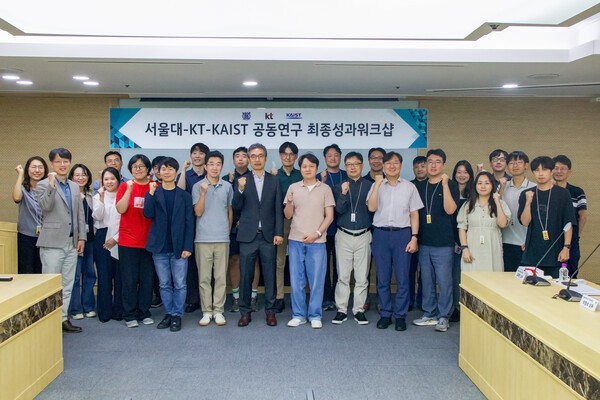
KT held a final results workshop at KT Uam Research Center in Seocho-gu, Seoul, and discussed sharing the past year's achievements and ways to apply them to KT AI models, platforms, and services.
KT announced on the 30th that it will pursue joint research into core AI technologies with Seoul National University and KAIST. The areas of collaboration are autonomous AI agents, responsible AI (RAI), and prompt compression, with the goal of internalizing technologies for application to actual models and platforms.
To that end, KT held the 'Seoul National University-KT-KAIST Industry-Academia Joint Research Final Results Workshop' at KT Uam Research Center in Seocho-gu, Seoul. About 50 researchers from KT, Seoul National University, and KAIST attended the event, shared the results of their joint research over the past year, and discussed ways to apply them to KT's AI models, platforms, and services.
The joint research with Seoul National University focused on autonomous agents' context understanding and reasoning technologies, RAI evaluation criteria and reliability improvements, securing Korean datasets and developing behavior prediction models, and a reinforcement learning framework based on user feedback.
The research is presented as a stream of work that simultaneously strengthens context understanding and reasoning capabilities for autonomous agents while also advancing research on AI reliability evaluation and improvement. The aim is to support appropriate action decisions based on user requests and surrounding context.
With KAIST, KT will conduct research on LLM prompt compression and optimization technologies. Through this, it aims to reduce the burden of prompt processing and improve inference efficiency for AI models and agent services.
KT will carry out verification and internalization of the technologies secured through the joint research for application to its own AI models, platforms, and services. This reflects a plan to move research outcomes beyond the paper and technology development stages and connect them to real-world AI service competitiveness.
KT also plans to identify new research topics with Seoul National University and KAIST centered on agentic AI, RAI, physical AI, and token efficiency, in line with business and technology demand and a policy of expanding the scope of follow-up joint research.
The three representatives each explained the significance and expected effects of the joint research. Lee Jae-wook, head of the AI Research Institute at Seoul National University, said the significance of the joint research lies in connecting university research capabilities with practical technical challenges from the industrial field and jointly verifying the applicability of research results. He also said that through cooperation with KT, he hopes to advance the industry-academia cooperation model and link academic achievements to innovation in AI technology and stronger industrial competitiveness.
Professor Kim Gi-eung of KAIST's Kim Jaechul Graduate School of AI said that when judging AI technological competitiveness, efficiency and applicability in real-world environments matter in addition to model performance. He added that he hopes the technologies secured through this joint research will improve the processing efficiency of large language models and serve as a foundation for broader AI adoption in industry.
Park Jae-hyung, executive vice president and head of KT AX Future Technology Institute, said KT has jointly completed core AI technologies needed by the company through its partnership with Seoul National University and KAIST. He also said KT will pursue ways to connect the research results to its AI competitiveness and continue developing the R&D cooperation model.
Source: TECHWORLD · Kim Seung-gi
Original: https://www.epnc.co.kr/news/articleView.html?idxno=406234
References
This article was produced with the help of an automated content generation algorithm.
Source: TECHWORLD
View originalThis article was summarized and organized by BizCrush based on the original article from TECHWORLD. For exact quotations and full details, please refer to the original article.