Seoul AI Hub Accelerates Training of Specialists in Physical AI as Advanced Robot-AI Fusion Program Concludes
TECHWORLD ·
✦ AI Summary
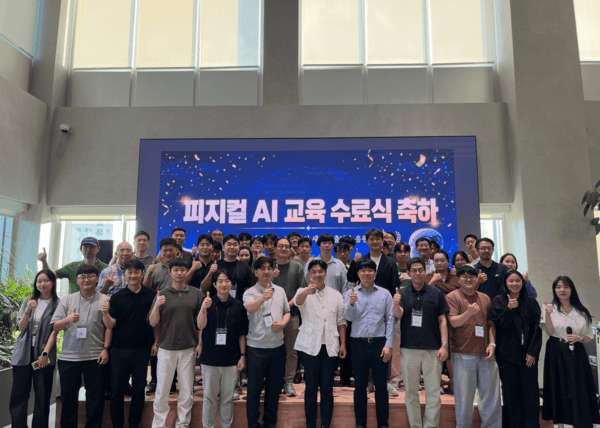
Seoul AI Hub, together with the Seoul Metropolitan Government, Korea AI, and the Korea Robot Industry Association, operated the "Physical AI Specialist Training Program," which ended after running through the 18th of last month.
A total of 188 people applied for the program, and 75 were selected, with the curriculum including robotics, computer vision, VLM, VLA, reinforcement learning, humanoids, and robot system security.
Seoul AI Hub has expanded its training to match industrial demand and has been operating advanced AI+X convergence education since 2023.
Seoul AI Hub is accelerating the cultivation of advanced specialists to meet the needs of the Physical AI era. Physical AI goes beyond generative AI and refers to a field that perceives, judges, and acts in the real world.
In step with the spread of Physical AI, Seoul AI Hub moved to secure related specialists and, together with the Seoul Metropolitan Government, Korea AI, and the Korea Robot Industry Association, operated the "Physical AI Specialist Training Program." The program ended after running through the 18th of last month.
The program was structured as an advanced specialized curriculum for implementing Physical AI. The training covered robotics, computer vision, VLM, VLA, reinforcement learning, humanoids, and robot system security.
A total of 188 people applied for the program, and 75 were selected. Applicants included Ph.D. holders, doctoral students, and people with at least 5 years of industry experience, while those selected had expertise in research and industrial settings.
Participants included Samsung Electronics, LG Electronics, LG Chem, Hyundai Mobis, Hyundai Glovis, Hyundai Engineering, Hyundai AutoEver, KT, and Lotte Innovate, among the supporting companies in the AI and robotics sectors, as well as Intelivix, HyperExcel, Aerobotics Innovation, DooGo Robotics, LPK Robotics, and SOSLAB, among supporting startups and technology companies.
Participating organizations in the defense sector included the Ministry of National Defense, the Republic of Korea Air Force, the Defense Acquisition Program Administration, the Defense Intelligence Command, and the National Defense Computer and Information Agency. Public and research institutions included Seoul Metro, the Korea Automotive Technology Institute, the Science and Technology Policy Institute, the Korea Institute of Industrial Technology, and the Korea Testing Laboratory.
The instructors were drawn from leading universities in South Korea, including Seoul National University professors Cho Gyu-jin, Lim Jong-woo, Choi Jong-hyun, Ju Han-byeol, Yoon Seong-ro, Kim Hyun-jin, and Cheon Hyun-deuk, as well as Yonsei University professor Lee Young-woon, Korea University professor Lee Hee-jo, and Kyung Hee University professor Lee Dong-jae. Among them, Professor Cho Gyu-jin has a background in Physical AI and robotics research.
The training opened with a lecture by Seoul National University professor Cho Gyu-jin, who served as the opening speaker. Under the theme "The Era of the Great Robot Voyage in Physical AI," he explained the development of Physical AI technology and discussed how robots will change future industries as they take over humans' physical tasks.
Next, Seoul National University professor Lim Jong-woo gave a lecture on sensor fusion and spatial cognition (SLAM) as key themes. He explained technologies for robots to perceive real-world environments, localize themselves, and understand surrounding spaces.
After that, Seoul National University professors Ju Han-byeol and Choi Jong-hyun delivered lectures. The two professors introduced the use of visual information such as cameras, 3D spatial perception technology, and technologies for perceiving and learning about surrounding environments, focusing on 3D vision and world models.
The curriculum also included VLM (Vision-Language Model), VLA (Vision-Language-Action), LLM-based robot intelligence, and robotics foundation models. These VLM-, VLA-, LLM-based robot intelligence, and robotics foundation models have emerged as core technologies of Physical AI.
Seoul National University professor Yoon Seong-ro also participated in the program, and the session focused on AI models that simultaneously understand visual and language inputs. It also introduced the latest technical trends connecting those models to robot judgment and action, and discussed the direction of development for robot intelligence.
The training then moved on to instruction on the process from robots' environmental perception to judgment and movement. In this stage, participants conducted theory and hands-on training in robot motion planning and learned how to plan robot movements according to goals. This was followed by theory and practical training in reinforcement learning, along with instruction on learning behavioral strategies through interaction with the environment.
The program then offered hands-on reinforcement learning training using actual robots and supported participants in experiencing the process of implementing AI algorithms as physical robot movements. In the latter part of the training, intensive instruction was provided on humanoid robot manipulation techniques and humanoid robot walking techniques.
Industry experts such as Robytiz executive Pyu Yun-seok also took part. They shared technologies and field cases from actual robot development and application processes, and their participation strengthened the program's practical relevance.
Seoul National University professor Cheon Hyun-deuk gave a presentation on the theme of "Ethics and Social Impact of Physical AI," addressing ethical and social issues that arise as humans, AI, and robots coexist. Korea University professor Lee Hee-jo presented on the theme of "Physical AI and Robot System Security," introducing cyber security threats to robot systems and response directions.
Seoul AI Hub said it is continuously expanding specialized education by industry and technology to cultivate AI convergence talent that can respond to demand from industrial sites. It also emphasized that this year in particular, it upgraded its existing "AI+robot" program around Physical AI, which has emerged as a key topic in the AI industry.
In the first half of the year, Seoul AI Hub operated an "AI+Manufacturing Specialist Training Program," which covered manufacturing data analysis, quality prediction, predictive maintenance for equipment, machine vision, process optimization, and manufacturing AI agents. It said this was intended to train key technologies needed for manufacturing AX, and that based on this, Seoul AI Hub expanded its education scope to Physical AI to encompass everything from industrial AI applications to next-generation AI technologies that interact with the physical world, strengthening its specialist training system.
Together with the Seoul Metropolitan Government, it has been operating advanced AI+X convergence training centered on industrial sites since 2023. The training field was AI+bio in 2023, AI+healthcare and AI+robot in 2024, and AI+manufacturing and robot in 2025. The program has continuously expanded its fields to reflect industrial changes and on-site demand, with the goal of cultivating specialists who can actually use AI technologies in industry.
Against this backdrop, Seoul AI Hub Director Byun Woo-seok described Physical AI as artificial intelligence that goes beyond digital environments to perceive and judge the real world and act directly. He also said Physical AI is a core technology for innovation across various industries, including manufacturing, robotics, mobility, and defense, and noted that the broad participation of specialists from companies, research institutions, defense, and public sectors in this training shows strong industrial interest in Physical AI.
Seoul AI Hub Director Byun Woo-seok stressed the organization's policy of operating curricula that actively reflect changes in AI technology. He also mentioned plans for cooperation with universities and industry specialized institutions, and expressed the will to continue nurturing advanced AI talent that can be used in actual industrial settings.
Source: TECHWORLD · Lee Gwang-jae
Original: https://www.epnc.co.kr/news/articleView.html?idxno=406250
References
This article was produced with the help of an automated content generation algorithm.
Source: TECHWORLD
View originalThis article was summarized and organized by BizCrush based on the original article from TECHWORLD. For exact quotations and full details, please refer to the original article.