[DigiKey TechForum] A 9-Step Guide to Selecting TVS
TECHWORLD ·
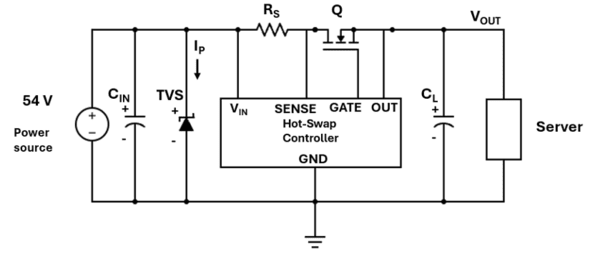
✦ AI Summary
A 9-step guide has been presented for selecting a TVS for hot-swap circuits.
First, VR, IP, VC, pulse duration, and PPP are calculated step by step to review the suitability of candidate TVS devices.
In the example, the allowable power after 8-step derating must exceed the TVS peak power calculated in Step 5 by at least 50%, but the power condition is not met, so reselection is needed.
A 9-step guide has been presented for selecting a TVS for hot-swap circuits. Using this step-by-step guide can improve the speed and efficiency of device selection reviews.
This procedure introduces the process of choosing a TVS for a hot-swap circuit step by step. It starts by setting the basic electrical conditions, then narrowing down candidates that fit those conditions, and then reviewing suitability under transient conditions.
Step 1 is to select the minimum reverse standoff voltage (VR). A tolerance of 5% is reflected in the VR selection criteria.
In Step 2, the expected maximum pulse current (IP) is calculated based on the circuit's worst-case conditions. As an example setting, a peak current of 480 A was presented.
The candidate selection criterion is the reverse standoff voltage set in Step 1. Accordingly, MCC's SMC 5kW series was presented as a candidate group.
Some products in the SMC 5kW series were summarized as meeting the reverse standoff voltage conditions set earlier. These candidate products are the targets of evaluation.
In the next step, the clamping voltage (VC) during a transient voltage event is calculated. The VC calculation then continues with a procedure that reviews suitability using an equation.
The power calculation in this step is based on the clamping voltage (VC) and the estimated pulse current (IP), which are values obtained from earlier steps. Here, the required TVS power handling during the transient pulse is calculated, and the purpose of this step and the next is to confirm the power handling capability of a single TVS.
The pulse duration (⧍td) is estimated based on an equation and the application of input-side parasitic inductance. Following the power calculation, how long the pulse lasts is handled by estimating it using the parasitic inductance at the input.
In this example, the pulse duration for the example is calculated from the values obtained in the previous steps. Based on the pulse duration (⧍td) calculated in Step 6, the value is checked in [Figure 3], where the allowable peak pulse power (PPP) is shown.
Based on [Figure 3], the TVS power handling capability confirmed for the device slightly exceeds 80 kW. Accordingly, the process continues with checking the PPP of a single TVS.
Finally, as part of reflecting real-world operating conditions, allowable peak pulse power (PPP) derating is performed with the maximum ambient temperature taken into account. In this derating process, the effects of heat from surrounding components are also considered as an additional factor, and the allowable power is lowered.
Using the maximum ambient temperature condition of 125°C shown in [Figure 4], the maximum allowable power of the example device after derating is calculated.
The TVS requirement is that the allowable power after derating in Step 8 must exceed the TVS peak power calculated in Step 5 by at least 50%.
The purpose of this 50% criterion is to secure a reliability margin for the TVS and the circuit.
The example calculation results indicate that the power condition is not met.
Accordingly, the follow-up action is to reselect the TVS and repeat the 9-step process.
Alternatives include reviewing another TVS with higher power handling capability or sharing the power by connecting multiple identical TVS devices in parallel.
The [table] summarizes the calculation results for three pulse current (IP) cases: 120 A, 160 A, and 480 A.
In the table, green indicates that the 9-step power requirement is satisfied with a single TVS.
The original reference is DigiKey's TechForum/Article.
Source: TECHWORLD · Lee Gwang-jae
Original: https://www.epnc.co.kr/news/articleView.html?idxno=406157
References
This article was produced with the help of an automated content generation algorithm.
Source: TECHWORLD
View originalThis article was summarized and organized by BizCrush based on the original article from TECHWORLD. For exact quotations and full details, please refer to the original article.