PMI: People in Their 20s Discover Trends via YouTube and SNS, While Those in Their 50s Rely on TV and Portals
TECHWORLD ·
✦ AI Summary
PMI conducted its "2026 Trend Awareness Survey" among 1,000 adult men and women aged 20 to 59 nationwide.
People in their 20s were more likely to first encounter new trends through SNS and YouTube, while those in their 50s had a higher share for TV, broadcasting, and portals.
Interest in trends and direct experience declined with age, and judgment criteria showed generational differences in SNS exposure, news and broadcast exposure, and mentions by people around them.
PMI released the results of its "2026 Trend Awareness Survey." The survey was conducted among 1,000 adult men and women aged 20 to 59 nationwide.
The survey found that the media people first encounter new trends through differs by generation. Among respondents who said they first encounter new trends, SNS accounted for 58.8% in their 20s, while TV and broadcasting accounted for 10.8%.
By contrast, among people in their 50s, SNS accounted for 26.4% and TV and broadcasting for 42.4% among those who said they first encounter new trends. PMI said the survey confirmed differences by age group in trend interest and experience, contact channels, and signals used to judge trends.
The share of respondents who said they are interested in new fads and trends was 51.2% for those in their 20s, 47.2% for those in their 30s, 41.6% for those in their 40s, and 34.8% for those in their 50s. The survey found a pattern in which interest in trends declines as age increases.
The share of respondents who said they had directly used or experienced new trends was 41.2% for those in their 20s, 34.8% for those in their 30s, 29.6% for those in their 40s, and 18.8% for those in their 50s, showing a downward trend in direct use and experience as age increased. The gap between interest and actual experience also varied by age group: among people in their 20s, the gap was 10.0 percentage points, with interest at 51.2% and actual experience at 41.2%, while among people in their 50s, the gap was 16.0 percentage points, with interest at 34.8% and actual experience at 18.8%.
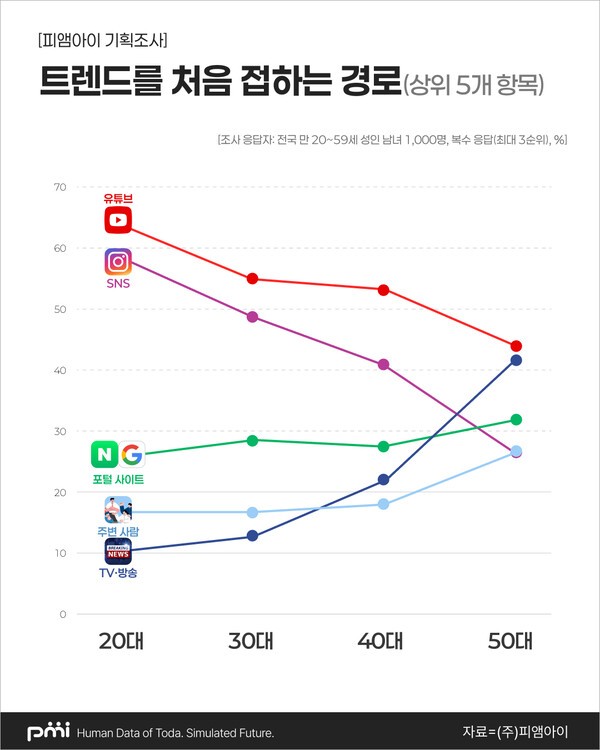
Differences by generation were also seen in the first point of contact with new fads and trends. Among people in their 20s, the main first points of contact were YouTube at 64.0% and SNS at 58.8%, indicating a high share for digital platforms among younger consumers.
The share of respondents naming SNS as their first point of contact was 48.8% in their 30s, 41.2% in their 40s, and 26.4% in their 50s, showing a downward trend as age increased. By contrast, the share naming TV and broadcasting as their first point of contact rose with age, at 10.8% for those in their 20s, 12.8% for those in their 30s, 22.0% for those in their 40s, and 42.4% for those in their 50s. Portals were a relatively major first point of contact among people in their 50s, at 32.0%.
The share naming YouTube as their first point of contact was 64.0% in their 20s, 55.2% in their 30s, 53.2% in their 40s, and 44.0% in their 50s. In this survey, YouTube was the only channel that ranked in the top tier across all age groups.
The analysis found that the criteria used to judge trends differed by age. There were differences by age group not only in where trends are encountered, but also in the standards used to determine whether something is a trend.
Younger consumers placed more emphasis on frequent exposure on SNS. Among people in their 20s, the main trend signal was "when it appears frequently on SNS," at 53.6%; the same response rate was 45.6% in their 30s, 42.8% in their 40s, and 28.0% in their 50s. The perception that something is a trend when it appears frequently on SNS declined as age increased.
By contrast, older respondents relied more on repeated exposure in traditional media. The share of respondents who saw "when it is covered often in news and broadcasts" as a trend signal was 21.2% in their 20s, 24.0% in their 30s, 32.8% in their 40s, and 46.4% in their 50s. The perception that something is a trend when it is covered often in news and broadcasts increased as age increased.
Mentions by people around them and actual use also emerged as more important criteria with age. The share of respondents who saw "when people around me talk about it a lot or use it" as a trend signal rose from 21.2% in their 20s to 42.8% in their 50s. Among people in their 20s, repeated exposure on SNS served as the main trend signal, while among older age groups, the share who viewed exposure in news and broadcasts and conversations and use by people around them as trend signals expanded.
The survey found that interest in trends and actual experience tend to decline with age. However, differences by age group were confirmed in the actual product and service selection stage.
Among all respondents, 46.9% said that the fact that something is "popular these days" affects their choice of products and services. By age group, those in their 20s were highest at 52.0%, followed by 48.4% in their 30s, 42.8% in their 40s, and 44.4% in their 50s.
In actual selection, the impact of trends did not follow the same age pattern seen in trend interest and experience. Regarding this, PMI CEO Jo Min-hee explained that generational differences were clearly visible not in which generation is more sensitive to trends, but in the channels through which trends are discovered and the signals used to judge them.
Jo Min-hee, CEO of PMI, also said that it is difficult to reach all age groups with only a single message posted on a single channel.
Source: TECHWORLD · Lee Gwang-jae
Original: https://www.epnc.co.kr/news/articleView.html?idxno=406274
References
This article was produced with the help of an automated content generation algorithm.
Source: TECHWORLD
View originalThis article was summarized and organized by BizCrush based on the original article from TECHWORLD. For exact quotations and full details, please refer to the original article.