K-FDE: Turning Skilled Workers’ Tacit Know-How Into AI Assets, as Institutionalization Kicks Off
IT DAILY ·
✦ AI Summary
At a roundtable hosted by Rep. Lim Moon-young, discussions were held on institutionalizing a Korean-style field-deployed engineer (K-FDE) system to turn skilled workers' tacit knowledge into AI assets.
The amendment includes support for placing young industrial AI workers on site at small and mid-sized companies, collaborating with skilled workers, and identifying and solving on-site problems.
Speakers said education alone is not enough, and that on-site experience, long-term development, sustained operation after deployment, incentives, and the conversion of tacit knowledge into explicit knowledge and data are needed.
One of the foundations of the competitiveness of South Korea's manufacturing sector is the experience and know-how of skilled workers, and discussions have begun in earnest on building a
On the 1st, a policy roundtable titled "Building a System for the Digital Transformation of Manufacturing Tacit Knowledge (K-FDE)" was held at the National Assembly Members’ Office Building in Yeouido, hosted by Rep. Im Moon-young of the Democratic Party of Korea. The roundtable discussed the need to introduce K-FDE, ways to apply it on the ground, talent development measures, and proposals for building a government support system, with the goal of discussing specific institutional directions for the revision bill to the "Act on Promoting Industrial Digital Transformation and the Use of Artificial Intelligence," introduced by Rep. Im Moon-young.
The revision bill, modeled on Palantir’s FDE framework, includes support for placing young specialized workers on-site at small and mid-sized companies and mid-tier companies, support for collaboration between young specialized workers and skilled workers, support for identifying real-world manufacturing problems, and support for solving real-world manufacturing problems.
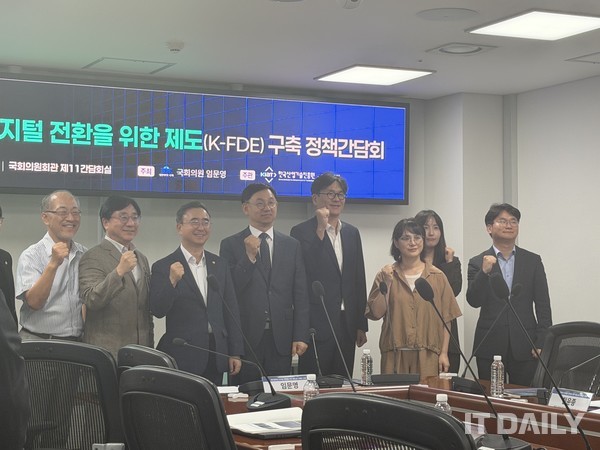
On the 1st, the policy roundtable "Building a System for the Digital Transformation of Manufacturing Tacit Knowledge (K-FDE)" was held. Participants posed for a commemorative photo, and the person third from the left in the photo is Rep. Im Moon-young of the Democratic Party of Korea. The roundtable focused on connecting skilled workers’ manufacturing tacit knowledge with young AI talent, under the theme of "K-FDE."
The roundtable focused on how to connect the tacit knowledge of skilled workers, which has supported the competitiveness of manufacturing, with digital transformation and AI use. Rep. Im Moon-young identified skilled workers’ manufacturing tacit knowledge as a key asset for manufacturing competitiveness.
Rep. Im Moon-young pointed to skilled workers in their 50s and 60s as the ones who form manufacturing tacit knowledge. He said this manufacturing tacit knowledge has been built through the accumulation of long years of on-site experience and know-how.
Rep. Im Moon-young said that accumulated on-site experience and know-how must be turned into assets and combined with new AI, but that capabilities for using AI transformation are lacking. He explained that manufacturing-site tacit knowledge is knowledge embedded in skilled workers’ experience and judgment rather than in company databases or manuals.
This tacit knowledge was presented as on-site judgment ability that is distinct from simple work manuals. Examples cited included judging whether equipment was abnormal by sound or vibration, or identifying the likelihood of defects by subtle differences in a product’s color, shape, or texture.
The concern was raised that when skilled workers retire, a company’s losses are not limited to the reduction of one person, but can also include the possible loss of decades of accumulated manufacturing knowledge.
To address this, Rep. Im said that since there are skilled workers who understand the site and young workers who can use AI and digital technologies, there needs to be a structure in which the two sides meet and solve problems together.
Rep. Im said he took note of the FDE model and referred to it. FDE refers to engineers responsible for on-site deployment, identifying customer problems, and implementing technology in real work, and the spread of this model was driven by Palantir’s adoption of it.
The related revision bill reflecting this concept includes support for deploying young industrial AI workers to small and mid-sized companies and mid-tier companies, as well as support for enabling young industrial AI workers and skilled workers to jointly identify and solve on-site problems.
Rep. Im Moon-young said the bill’s goal is to drive digital and AI transformation in manufacturing, not just youth employment.
These remarks were made at the policy roundtable "Building a System for the Digital Transformation of Manufacturing Tacit Knowledge (K-FDE)," held on the 1st. The photo credit for the roundtable is Yang Seung-gap.
At the roundtable, it was suggested that fostering FDEs requires more than education alone and that on-site experience and long-term development are necessary.
As a presenter, Prof. Lee Min-seok of the College of Software Convergence at Kookmin University said the reason FDEs are needed lies in the gap between AI models and real industrial sites. He assessed that even if a company secures an excellent AI model, meaningful AI transformation (AX) is difficult unless on-site application is supported.
The professor said that, just as important as AI model performance, is the personnel that will handle on-site application and connect it to results. He also stressed the need for personnel who can be deployed across all areas where AI is needed and lead the transformation to success.
It was pointed out that in manufacturing sites, much of the key knowledge for AI application remains unorganized as data, and that the knowledge itself is mostly held in the experience and judgment of skilled workers. There have been cases of system construction by SI companies through government support programs, but it was noted that problems of staff leaving after project completion follow, and that after staff leave, there is also a lack of parties to keep operating and advancing the system.
The professor described digital transformation in manufacturing as a "generational transition." He said the work of transferring artisans’ experience and tacit knowledge to computers is necessary, and that only when a generational transition takes place can a transformation be established in which a business can operate normally.
He went on to explain that what is needed is not the solution itself, but personnel who can stay at the site and continue solving problems and driving further development. On talent development, he proposed moving away from the existing supply-oriented structure and pointed out that simply training students at universities and other educational institutions and sending them into industry is not enough. He said this is because it is difficult to sufficiently secure the capabilities required for FDEs.
To develop the workforce needed in the AI transformation era, education alone is not enough, he said, and a growth path linking education and on-site deployment is necessary. The goal is to build understanding of AI and software technologies as well as specific industrial processes and data, and he said hands-on experience solving real problems is also needed. He also said that an on-site-centered operating approach is necessary in responding to AI transformation.
If FDEs are on-site deployment-based personnel, the professor said, then the entire approach to training personnel and entering the workplace must change. He also said gaining FDE expertise will take considerable time, explaining that it would take 5 to 10 years to grow into an FDE.
The professor emphasized the need for continued support to help accumulate on-site experience during the growth process. He then said the policy is a compound policy that encompasses youth talent development, jobs, and industrial protection.
As various opinions were raised for helping FDEs take root on site, Prof. Yoon Dae-kyun of the Department of Software at Ajou University said the cost of code production has fallen and the spread of AI has changed the capabilities needed by software talent. He said that while the core skill in the past was the ability to write code quickly and accurately, the core skills in the AI era are the ability to define problems accurately and the ability to verify the real-world validity of AI outputs.
This shift was also presented as an example of changes reflected in university education. While the focus of existing project-based classes had been on producing deliverables, the current emphasis is expanding on education about user interviews, problem definition, documentation of the development process, and verification.
Prof. Yoon suggested that FDEs should be viewed in the same context as this change. He said education and on-site deployment for FDEs should not be approached as separate stages.
Accordingly, Prof. Yoon Dae-kyun of Ajou University’s Department of Software proposed designing a single pipeline for FDE training and deployment. His argument was that education and deployment for FDEs should not be viewed separately, but designed as one continuous flow.
On the performance evaluation method and key tasks of the K-FDE project, it was pointed out that if the number of deployed personnel and employment rate are set as KPIs, the on-site dispatch itself could become the project’s goal. The concern was that if the project is evaluated only on personnel deployment or employment outcomes, its purpose could be narrowed to simply placing people on site.
In this regard, Prof. Yoon said it is necessary to check whether the system continues operating after deployment. He also stressed the need to confirm the size and extent of the assets that remain on site.
It was also proposed that incentives are needed to encourage skilled workers to participate so that such operational sustainability and on-site asset accumulation are possible. Skilled workers are said to provide tacit knowledge accumulated over long periods and to play a role in collaborating with FDE talent.
Prof. Yoon said participation by many skilled workers who possess tacit knowledge is necessary. However, he said active participation is difficult without sufficient compensation for skilled workers and that active participation is hard without clear incentives.
There was also mention of the need for a management system in preparation for the possibility that FDEs will become a promising profession in the future. Since there is a possibility that educational institutions, training programs, and certification projects related to this field could proliferate, a proposal was made to establish institutional mechanisms for verifying educational quality and expertise.
Prof. Yoon said a legal and institutional filtering mechanism should be designed so that the relevant content can be screened at the legal and institutional level.
He then presented tacit knowledge -> explicit knowledge -> data as what K-FDE should leave behind.
Lee Hyun-dong, vice president of Superb AI, explained that concerns are rising in industrial sites recently about workforce gaps caused by the retirement of the baby boomer generation, and that the number of companies demanding AI solutions is increasing.
Lee Hyun-dong, vice president of Superb AI, diagnosed that in such a situation, a one-off solution delivery alone cannot resolve workforce gaps. He also stressed the need to convert skilled workers’ tacit knowledge into explicit knowledge and to build a data system in which the converted explicit knowledge can be used with AI.
Lee Hyun-dong, vice president of Superb AI, also said that if the introduced AI solution does not work properly, there is a risk of losing on-site expertise and industrial competitiveness, and proposed building a structure that turns skilled workers’ know-how from tacit knowledge into explicit knowledge and then into data.
In manufacturing sites, there is a growing recognition of the need to turn the process of selecting meaningful information from among numerous signals and making judgments into reproducible knowledge. In particular, the need to codify the judgment process of skilled workers is becoming more widely recognized. Since apprenticeship-style transfer that depends on individual experience has limits in spreading knowledge, the trend is toward systematization based on certain standards and methodologies as a response.
The vice president said that in SI projects, the system may remain but the foundation does not, and that they are highly likely to become one-off projects. He then explained that tacit knowledge needs to be converted into explicit knowledge, and explicit knowledge needs to be converted into a data system. He also stressed that the entire process, from tacit knowledge to explicit knowledge and then to a data system, must be kept in mind.
Within this framework, the data system requirements that K-FDE should contain were presented as expertise, consistency, learnability, freshness, and sustainability. The point was that a system meeting these requirements is needed to organize skilled workers’ judgment in manufacturing sites as reproducible knowledge and transfer it into a data system.
The vice president said there is a strong concern in industry about the retirement of experts. He then explained that the K-FDE bill is a way to address the retirement of experts and a way to secure sustainable industrial competitiveness.
Jang Hee-young, senior researcher at the National Root Industry Promotion Center of the Korea Institute of Industrial Technology, diagnosed the severity of the loss of manufacturing tacit knowledge in the root industry. The root industry handles basic manufacturing processes such as casting, molds, and welding.
This industry relies heavily on the experience and judgment of skilled workers. For this reason, the aging of skilled workers and labor shortages are factors that increase the risk of technological discontinuity.
Researcher Jang Hee-young explained that there is a shortage of follow-up personnel who can learn the technology on site. Accordingly, she diagnosed the root industry as having a structure in which the risk of losing manufacturing tacit knowledge and of technological discontinuity is growing.
An additional problem identified was the gap between the field and digital technology. Skilled workers are strong in process understanding, but are not familiar with AI, data, or robotics technologies, while SI companies have digital technologies but lack understanding of the detailed processes of the root industry. Researcher Jang Hee-young stressed the need for a role to bridge the gap between the field and technology.
As a solution, building a university-company connection infrastructure centered on regional hubs was proposed. The infrastructure is envisioned to handle links with regional strategic industries, provide a foundation for converting skilled workers’ tacit knowledge into explicit knowledge and data, and connect university-trained talent with actual corporate demand.
As labor shortages have worsened recently and companies' demand for automation and intelligence has continued to grow, Researcher Jang said that talent development needs to be systematized. She also stressed the need to build infrastructure for a middle-manager role, that the infrastructure must be connected all the way to the field, and that these elements need to be balanced.
Source: IT DAILY · Yang Seung-gap
Original: https://www.itdaily.kr/news/articleView.html?idxno=241361
References
This article was produced with the help of an automated content generation algorithm.
Source: IT DAILY
View originalThis article was summarized and organized by BizCrush based on the original article from IT DAILY. For exact quotations and full details, please refer to the original article.