IAS Leadership Forum Marks Its First Anniversary, Looking Beyond Technology to People and Value
IT DAILY ·
✦ AI Summary
The 6th IAS Leadership Forum was held on the 2nd at the Kensington Hotel in Seoul's Yeouido district, and also marked the first anniversary of the IAS Leadership Forum's launch.
Chairperson Ko Jeong-hyeon said that in the AI era, not only the speed of technology adoption but also the scope of what to entrust and who should bear responsibility, as well as human judgment and accountability, are important.
Seoul National University professor emeritus Lee Yu-jae and BiMatrix CEO Bae Young-geun each delivered presentations on service marketing and DB data analysis AI Agentic, respectively.
The 6th IAS Leadership Forum, under the banner of "Looking Beyond Technology to People and Value," was held on the 2nd at the Kensington Hotel in Seoul's Yeouido district. The event, hosted by Computerworld/IT DAILY, also marked the first anniversary of the launch of the IAS Leadership Forum. With this, the IAS Leadership Forum has reached its first anniversary.
The IAS Leadership Forum was launched in June last year, led by Chairperson Ko Jeong-hyeon of the IAS Leadership Forum. The forum began against the backdrop of an alliance of CIOs, CDOs, and CISOs in the financial sector, and 16 people from the financial sector, industry, and academia took part in the launch.
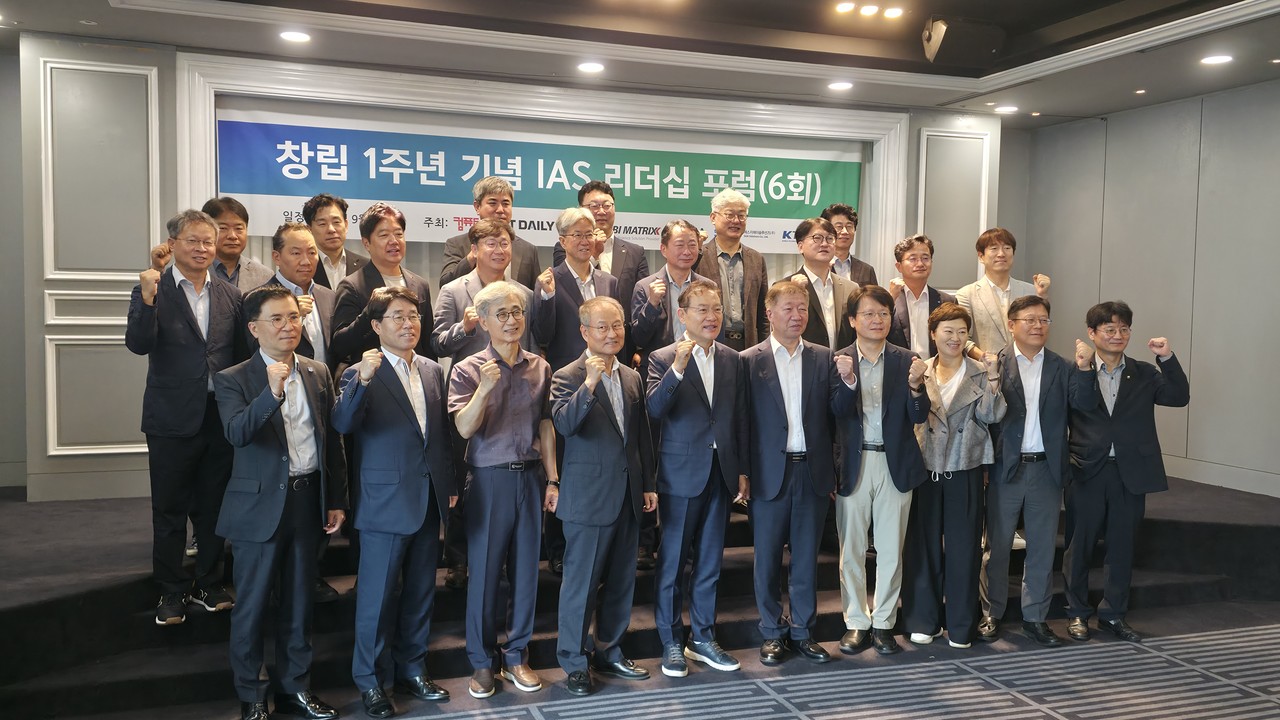
This event's program included a presentation by Lee Yu-jae, professor emeritus at Seoul National University's College of Business, and a presentation by Bae Young-geun, CEO of BiMatrix. Attendees also took part in a commemorative photo session to mark the first anniversary.
IAS refers to the convergence of information technology (IT), AI, and Security, and each element symbolizes the Three Digital Pillars that will drive the future competitiveness of industry.
The 6th IAS Leadership Forum was held on the 2nd at the Kensington Hotel in Seoul's Yeouido district, where Chairperson Ko Jeong-hyeon of the IAS Leadership Forum delivered remarks marking the forum's first anniversary. The photo was taken by reporter Seong Won-young.
Chairperson Ko Jeong-hyeon said that over the past year, many people from the financial sector, academia, the legal profession, and industry had participated, and that their involvement was the background for the forum reaching its first anniversary. He also compared the meaning of a first birthday to the point when a child begins to walk.
Ko said the forum's next step would be to begin a second step of examining the value between technology and people, and stressed that vigilance is needed against potential risks in the AI innovation process.
In his anniversary remarks, Ko opened with the recently discussed film "Odyssey." Christopher Nolan's "Odyssey" will be released on August 5 and follows the journey of Odysseus, the hero of the Trojan War, as he returns to Ithaca. Ko said the film's "Trojan Horse" scene brings to mind the AI era, where opportunity and risk coexist.
The Trojan Horse is said to be a wooden horse used by the Greeks to win the Trojan War. The Greek allied forces feigned retreat and built a wooden horse that could hold 30 people. The Trojan allied forces believed it to be a symbolic offering to the goddess of war, Athena, and brought it inside the city walls; taking advantage of the opening, the Greeks captured Troy. Ko pointed out that while people are paying attention to the potential and value of AI, they are overlooking the risks hidden within it.
He noted that AI is an opportunity that changes productivity and customer experience, but that as technological power expands, so do the risks. In particular, he said, "Agentic AI," which performs tasks in place of people, intensifies this problem.
Ko said that in the AI era, the issue is not just competing over adoption speed, but also determining the scope of what to entrust to AI and who should bear responsibility. He said that as technology advances faster, the importance of human judgment and accountability grows, and explained that the reason the IAS Leadership Forum has addressed IT, AI, and Security together is rooted in this awareness.
He then brought up the story of Odysseus while speaking about the forum's first anniversary. Odysseus wandered the seas for 10 years, but even amid many crises he never forgot where he needed to return, and in the end reached his homeland of Ithaca.
Ko said Odysseus' attitude of never losing sight of direction offers major lessons for companies and leaders in the AI era. He noted that Odysseus is praised not only for victory, but also for not forgetting where he had to return amid temptation and crisis, and said today's leaders must embrace technology quickly while never forgetting their duty to create value for whom and for what purpose.
The 6th IAS Leadership Forum was held on the 2nd at the Kensington Hotel in Seoul's Yeouido district, and Lee Yu-jae, professor emeritus at Seoul National University's College of Business, attended as a speaker and gave a presentation. The topic of Lee's presentation was "Service Marketing for Securing Competitiveness."
In his presentation, Lee said customer value should be placed ahead of products and that service determines competitiveness. He also explained that if companies continue to think product-first amid rapid changes in technology and the market, they risk falling behind in competition. He further stressed the need to focus on service, which concerns interaction with customers and solving problems they actually feel, rather than on the product itself.
Lee is the first Korean to earn a Ph.D. in business administration from Stanford University, and at 33 he was appointed to an endowed professorship at the University of Michigan's business school. He later returned to Korea in 1993 and joined Seoul National University's College of Business as a professor.
Lee has won numerous paper awards from organizations including the American Marketing Association and the Korean Marketing Association, and received the Korea Academy of Sciences Award in 2021. The photo from the event was taken by reporter Seong Won-young.
The cases of Netflix and Blockbuster show that the ability to respond to change, rather than initial scale, determined their direction. Blockbuster, a video rental chain that opened in 1985, grew to more than 9,000 stores in the United States. Netflix, founded in 1997, was initially a latecomer and smaller than Blockbuster. But Netflix is now a leading global OTT company, while Blockbuster went bankrupt and disappeared. Lee assessed that agility in responding to change determined the futures of the two companies.
After internet streaming services emerged in the early 2000s, the market was reorganized into OTT services. In that process, Netflix quickly shifted its business model. Blockbuster, by contrast, became complacent with its past glory and collapsed as a result.
Lee explained that video rental stores like Blockbuster had return deadlines and late fees, and that they were inconvenient because customers had to visit the store to return the videos after watching them. He said Netflix resolved this inconvenience of video returns by shifting to an online service. Lee said Netflix's success lay in its ability to listen to customers and respond quickly to change.
As a criterion for judging corporate competitiveness, Lee cited the ability to perceive and solve customer problems, saying companies need to value what they provide to customers more than the products they sell. He pointed to Netflix and Amazon as companies focused on customer value.
Lee explained that Amazon began in 1995 as an online bookstore, but its focus was aligned with customer needs. Amazon expanded choices, lowered price ranges, and strengthened the speed and convenience of delivery services, and Lee said its success stemmed from focusing on customers' unchanging needs.
Lee said competitiveness cannot be secured through products alone and proposed the need for "Provice (Provice, Product+Service)." He said "Provice (Provice, Product+Service)" means Product + Service, and stressed that thinking about and approaching things from a service perspective helps organizational development and individual growth as well.
The 6th IAS Leadership Forum was held on the 2nd at the Kensington Hotel in Seoul's Yeouido district. That day, Bae Young-geun, CEO of BiMatrix, gave a presentation on "DB data analysis AI Agentic." The photo credit is to reporter Kim Ho-jun.
At the forum, Bae introduced AI Agentic for DB data analysis and stressed foundational elements such as Security, resource, and performance management, as well as operational usability, as essential conditions for enterprise AI. He said enterprise AI should prioritize "clear rules" over flashiness, and noted that he has about 3 years of experience promoting AI business.
Bae presented mainframe, cloud, and AI as the axes of rapid change in the IT environment. At the same time, he said that core business functions within companies, such as HR, labor, general affairs, sales, and production, remain unchanged.
He also explained that the level, scope, and demands of decision-making differ by decision-maker, such as staff members, team leaders, and executives. He defined the function that responds to these differences as business intelligence (BI), and said BiMatrix applies AI as a means of strengthening the performance of BI's essence. He explained that BiMatrix's focus in applying AI is supporting business decision-making.
Bae identified hallucination as the biggest concern in the AI adoption process. Despite the emergence of various techniques such as harness engineering and loop engineering, he said LLMs that mimic human thought inherently carry the possibility of structural errors. Accordingly, he emphasized the need to control AI in enterprise environments and said it is important to verify forms specialized to a company's specific tasks and data.
In that context, Bae pointed to the ERP database a company holds as the starting point for AI tasks. He explained that unstructured data such as documents, videos, and images is relatively difficult to make accurate. By contrast, data accumulated in ERP is the key material for AI-based decision-making.
A demonstration of BiMatrix's "TRINITY" solution was also held that day. TRINITY is an Agentic AI development platform for analyzing internal corporate data and supporting reasoning and decision-making. On-site, it was introduced as a system in which when a user enters a natural-language question such as "sales status by product," the AI internally generates SQL and presents the analysis results in dashboard form.
Jeon Gyu-hwa, vice president at BiMatrix and the demonstrator, said AI can generate queries arbitrarily and that results may differ even when the same question is repeated. He added that if AI is to be operated in a real enterprise environment, clear rules and a management system are necessary, while also mentioning the counterargument over whether AI needs to learn all rules.
Jeon said that even people need clear standards and examples to perform their work stably, arguing that enterprise AI needs functions beyond simply generating answers. He then stressed the need for controllability over the data used, controllability over what is computed, and controllability over the rules to be followed.
Source: IT DAILY · Kim Ho-jun, Seong Won-young
Original: https://www.itdaily.kr/news/articleView.html?idxno=241359
References
This article was produced with the help of an automated content generation algorithm.
Source: IT DAILY
View originalThis article was summarized and organized by BizCrush based on the original article from IT DAILY. For exact quotations and full details, please refer to the original article.