MSIT Sets Next Year's Budget at KRW 29.6476 Trillion, the Largest Ever; KRW 9.4 Trillion to Be Invested in AI
IT DAILY ·
✦ AI Summary
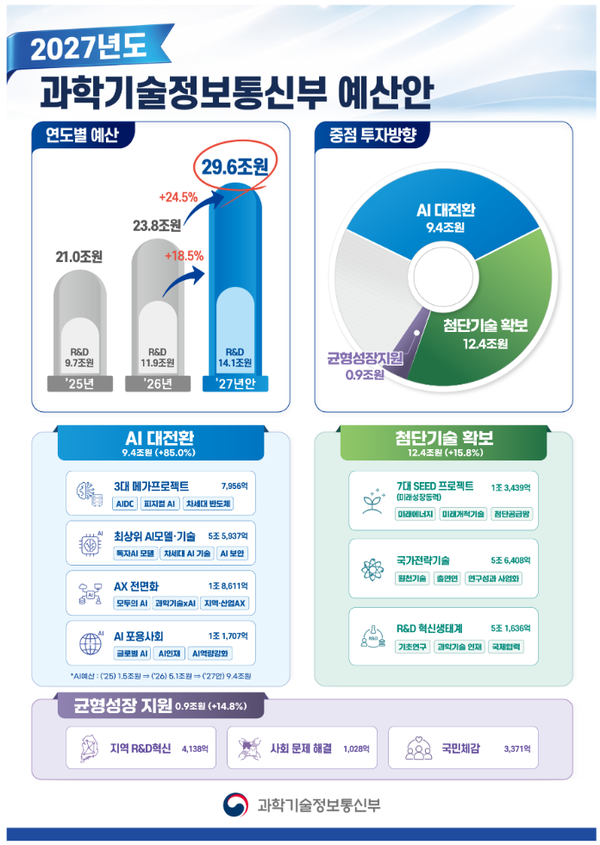
The government set next year’s budget for the Ministry of Science and ICT at KRW 29.6476 trillion in the 2027 budget proposal.
The R&D budget was raised to KRW 14.1 trillion and the AI budget to KRW 9.4 trillion.
The Ministry of Science and ICT identified accelerating the AI transformation, securing next-generation AI and advanced technologies, and promoting balanced growth based on science, technology and digital capabilities as next year’s key investment areas.
The government approved the 2027 budget proposal at a Cabinet meeting on the 1st and set next year’s budget for the Ministry of Science and ICT at KRW 29.6476 trillion. This is the largest budget ever for the ministry, up KRW 5.8272 trillion from this year’s supplementary budget. The increase rate is 24.5%.
Under its policy of concentrating investment in AI and R&D, the government set goals of accelerating the AI transformation and strengthening competitiveness in advanced technologies. Accordingly, the R&D budget was set at KRW 14.1 trillion, up 18.5% from this year, and the AI budget was set at KRW 9.4 trillion, up 84.3%.
The Ministry of Science and ICT identified three key investment areas for next year: accelerating the AI transformation, securing next-generation AI and advanced technologies, and supporting balanced growth based on science, technology and digital capabilities. As investment priorities, it put forward support for the '3 major mega projects' and the '7 SEED projects,' along with the spread of policy outcomes across all generations, all regions and all social groups.
According to the Ministry of Science and ICT, the government set next year’s budget for accelerating the AI transformation at KRW 9.4211 trillion. That is about an 85% increase from this year’s KRW 5.0938 trillion.
Of that amount, the government expanded the budget for the '3 major mega projects' centered on AIDC, physical AI and next-generation semiconductors from KRW 298.1 billion to KRW 795.6 billion. The government said it would accelerate the AI transformation by focusing on the three core projects.
The AIDC sector includes building a 10 MW AIDC testbed, supporting demonstrations of domestic solutions, and supporting the industrialization of exports of domestic solutions. It also reflected KRW 87.8 billion for the creation and industrial development of AIDC clusters, and newly allocated KRW 115.5 billion for the development of related materials, parts, equipment and cloud technologies.
In the physical AI sector, the government will promote the localization of physical AI foundation models and demonstrations of physical AI foundation models. To this end, it newly allocated KRW 40 billion for building a training center and another KRW 55 billion for core technology development.
In addition, the government will work with the Korea Post to demonstrate domestic physical AI in the logistics sector. The budget for demonstrating domestic physical AI in logistics is KRW 26 billion.
The government plans to directly embed domestic AI semiconductors into the products and services of local companies in order to verify the early commercialization potential of domestic AI semiconductors. To this end, it newly allocated KRW 90 billion for securing a full-stack reference for K-AI semiconductors linked to market demand, KRW 25 billion for the development of ultra-fine and stacked semiconductor technologies, and KRW 20 billion for the development of next-generation core source technologies for K-AI semiconductors.
At the same time, the government is pushing for joint public-private participation in the development of its own AI models and has set the goal of catching up with top-tier performance. Related funding was increased from KRW 2.6146 trillion to KRW 5.5937 trillion, and the government also unveiled plans to secure 10,000 GPUs, data, and talent. In addition, the budget for expanding GPUs was raised from KRW 2.0841 trillion to KRW 3.85 trillion.
The budget for strengthening data competitiveness for frontier AI development was expanded from KRW 30 billion to KRW 800 billion. KRW 25 billion in new funding was allocated for cultivating frontier talent.
Investment in AI safety and security was also strengthened. KRW 55 billion was allocated for development of the 'AI Cyber Shield Dome' technology, which is aimed at developing AI hacking detection and autonomous defense systems. KRW 70 billion was allocated to support AI threat response services for small and medium-sized enterprises.
The government broadly increased budgets for the foundation for AI use by bundling together public access to AI services, regional expansion and talent cultivation. As a result, the total budget for AI services and utilization rose from KRW 1.2067 trillion to KRW 1.8611 trillion. The government newly launched the 'Universal Support for Nationwide AI Services' project and allocated KRW 250 billion, with the aim of supporting public use of domestic AI model-based general-purpose AI chatbots and public AI agents.
The regional AX budget for regional expansion was organized around the four major regions of Daegyeong, Southwest, Jeonbuk and Southeast. The regional AX budget was expanded from KRW 177 billion to KRW 334.5 billion.
The government also set out a policy to broaden the base of AI talent. Accordingly, AI-focused universities will be expanded from 18 to 67, and the related budget will rise from KRW 118 billion to KRW 185 billion. The budget for an inclusive AI society also rose from KRW 974.4 billion to KRW 1.1707 trillion.
Separately, KRW 12.377 trillion was allocated next year for securing next-generation AI and advanced technologies. Of that amount, the '7 SEED projects' cover areas including future energy, future frontier technologies and advanced supply-chain ecosystems, and their budget was expanded from KRW 861.6 billion to KRW 1.3439 trillion.
To respond to surging electricity demand from AI and to support carbon neutrality, the energy sector will see budget allocations for technology development along with efforts to secure small modular reactors (SMR) early, secure fusion power early, and secure renewable energy technologies early. KRW 160.1 billion was newly allocated for building a foundation for core fusion technology development and demonstration, KRW 45.7 billion was newly allocated for marine molten salt reactor technology development, and KRW 18 billion was newly allocated for i-SMR commercialization technology development.
At the same time, in preparation for the post-semiconductor and AI era, new budgets were also assigned to efforts to secure quantum technologies and advanced biotechnology. Along with efforts to develop a full-stack quantum computer led by domestic companies, KRW 17.5 billion was newly allocated for the 'Korean Quantum Computer Grand Manufacturing Challenge,' and KRW 26 billion was newly allocated for supporting quantum transformation (QX) technology innovation based on regional clusters. In addition, KRW 16 billion was newly allocated for building a next-generation drug autonomous laboratory for AI and robotics operations, and KRW 19.5 billion was newly allocated for the 'BrainLink Initiative' for core brain-computer interface (BCI) technology development.
As the government is shifting the research system of government-funded research institutes to a mission-oriented model, it will expand research operating expenses for such institutes from KRW 2.5613 trillion to KRW 3.1476 trillion, increase strategic research projects from 77 to 119, and raise the share of government grants in personnel expenses from 60.3% to 70.2%. At the same time, it will introduce investment-type R&D, based on equity acquisition, recovery and reinvestment, for the first time in three projects, and the budget for national strategic technology development and commercialization, including investment-type R&D, will rise from KRW 4.8668 trillion to KRW 5.6408 trillion.
The government will also expand investment in basic research to broaden opportunities for researchers, increasing the budget for individual basic research from KRW 2.2657 trillion to KRW 2.4421 trillion, expanding the budget for general basic research from KRW 125.6 billion to KRW 226.1 billion, and injecting KRW 30 billion into long-term regional research. As a result, the budget for strengthening the R&D innovation ecosystem, including basic research, will rise from KRW 4.7117 trillion to KRW 5.1636 trillion.
The budget was expanded along two pillars: nurturing science and technology talent and supporting balanced growth based on science, technology and digital capabilities. The government is pushing to strengthen the development of science and technology talent, and the budget for supporting balanced growth based on science, technology and digital capabilities increased by KRW 110.3 billion from this year’s KRW 743.4 billion to KRW 853.7 billion.
To expand the talent base, research operating expenses for the four science and technology institutes will rise from KRW 660.3 billion to KRW 818.1 billion. The target schools for AI colleges will also be expanded from KAIST to all four science and technology institutes. A joint industry-academia AX research institute will also be newly established, with KRW 24 billion reflected in the budget. The number of recipients of scholarships in science and engineering fields will expand from 2,920 to 5,140.
Separate balanced growth funding will be directed to regional R&D and the fostering of research hubs. KRW 151.2 billion will be newly invested in the '4 poles, 3 special zones science and technology innovation support' project. The budget for fostering research and development special zones will also increase from KRW 167.3 billion to KRW 178.2 billion.
Investment in technologies to solve issues closely tied to people’s daily lives will also expand. Target areas include disasters, drugs, deepfakes and public safety. Of this, the budget for core technology development to respond to digital deepfake crimes will be increased from KRW 3 billion to KRW 7 billion, and support for field implementation of disaster response technologies using specialized technicians will be increased from KRW 2.5 billion to KRW 5.1 billion.
Projects supporting science culture and information access will also continue. Efforts to expand science culture services using national and public science museums will continue, and the project to distribute information and communications assistive devices for vulnerable groups will also continue.
The Ministry of Science and ICT said it will pursue both the AI transformation and the securing of advanced technologies while ensuring that the results spread across regions and into everyday life for the public.
Source: IT DAILY · Yang Seung-gap
Original: https://www.itdaily.kr/news/articleView.html?idxno=241354
References
This article was produced with the help of an automated content generation algorithm.
Source: IT DAILY
View originalThis article was summarized and organized by BizCrush based on the original article from IT DAILY. For exact quotations and full details, please refer to the original article.