SKT CEO Jeong Jae-hyun Says AI Productivity Will Surge After Clearing the “Valley of Discomfort”
IT DAILY ·
✦ AI Summary
SK Telecom CEO Jeong Jae-hyun delivered a lecture for more than 300 Seoul National University graduate and undergraduate students on choices and opportunities in the AI era.
He compared the spread of automobiles, mobile phones, and ChatGPT to explain the scale of AI-driven change, and said global AI investment is overwhelmingly large compared with the Industrial Revolution era.
He also presented the J-curve of AX and three attitudes — seeing things in a strange way, confronting extremes, and getting uncomfortable — explaining that productivity may fall at the start of AI adoption but can rise sharply afterward.
SK Telecom CEO Jeong Jae-hyun said, in effect, that AI productivity will surge once it gets over the valley of discomfort, adding that as AI emerges, each person’s time-use intensity is changing rapidly, to the point that for some, a day feels like 240 hours or 2,400 hours, and existing principles are also changing.
Based on that sense of urgency, Jeong delivered a special lecture on the 1st to more than 300 graduate and undergraduate students at Seoul National University. The lecture was organized as the first class of the 10th year of SK Telecom and Seoul National University’s joint AI course, and the theme was “Choices and Opportunities in the AI Era.”
Explaining the scale of AI-driven change, Jeong compared the speed at which technologies spread. He said it took more than 60 years for automobiles to become widely adopted, and more than 10 years for mobile phones to do the same, but ChatGPT surpassed 50 million users in just 1 month.
He also said that global AI investment is overwhelmingly large compared with the Industrial Revolution era.
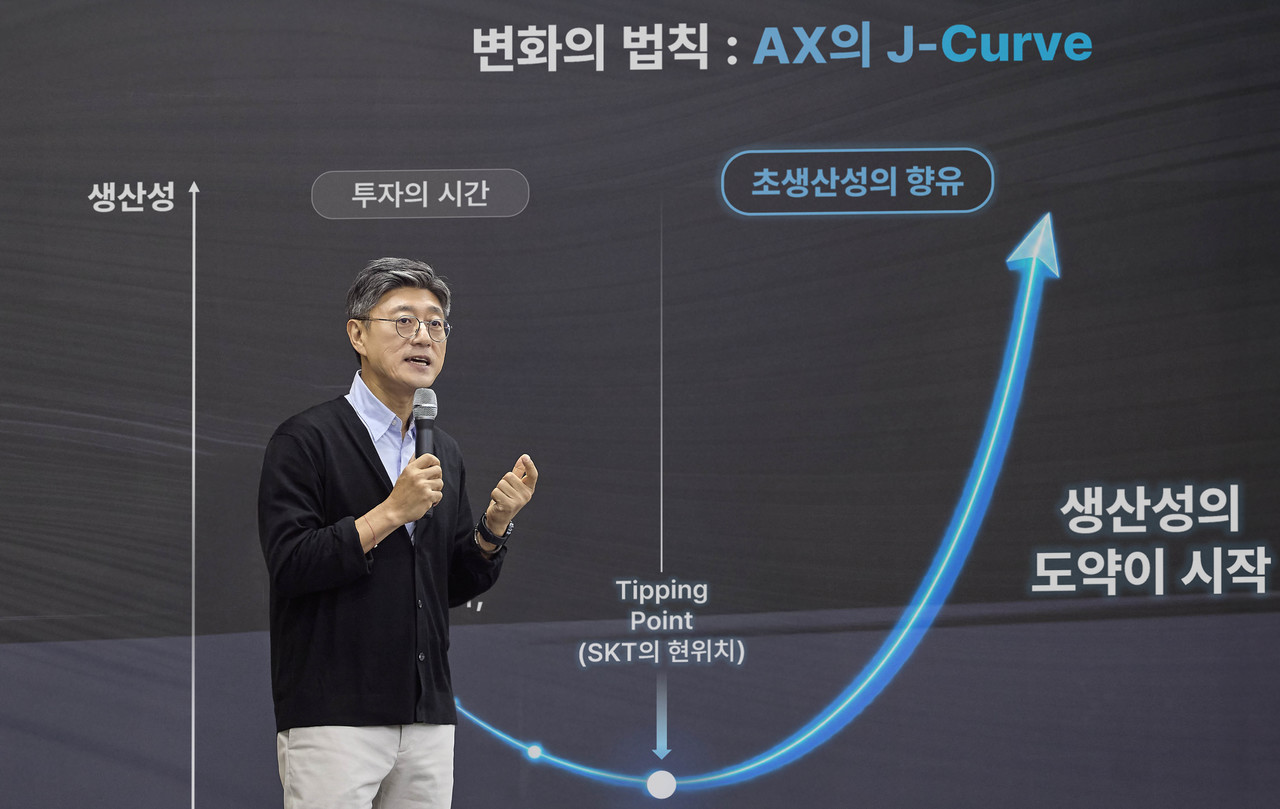
At the lecture, Jeong, who has led SK Telecom’s AI transformation over the past year, presented a pattern he derived himself: the “J-curve of AX.” Jeong explained three ways of working in the AX era: seeing things in a strange way, confronting extremes, and getting uncomfortable.
The J-curve is an economic theory that explains the relationship between exchange rates and the trade balance. Right after an exchange rate rises, the trade balance does not improve immediately because there is a time lag before export and import volumes are adjusted. During that process, the trade balance initially worsens, and because the shape resembles the letter J, it came to be called that.
Jeong applied this J-curve concept to AX. He said efficiency is not easy to raise immediately after AI adoption, citing retraining, work redesign, data, organizational restructuring, and the time lag between technological innovation and productivity. Accordingly, his view is that productivity actually declines at first.
Jeong explained that organizations that endure this stagnation period will see a sharp rise in productivity at some point. (Photo: SK Telecom)
The first attitude for AI transformation is presented as seeing things in a strange way. This means questioning assumptions that have been taken for granted and exploring new possibilities. Example questions include, “Does this task really have to be done by a person?” and “Is this sequence the best one?” Jeong said that before every task, an approach is needed that asks, “If we assume AI, how should we redesign this work?”
The second attitude is confronting extremes. This means challenging oneself by placing oneself in an extreme situation. It is explained that motivation arises when goals are set that are difficult to reach through conventional methods. Jeong cited SK Telecom’s development of the 688 billion-parameter AI model “A.X K2” with limited GPUs.
The final attitude is getting uncomfortable. This means enduring the discomfort that comes with the early stages of AI transformation. In the process of handling system modification work based on customer requests, one SK Telecom developer used to spend 50 hours on the task, and at the beginning of AI adoption, it took more than 500 hours. After a verification process, the same work is now being completed in just 1 hour.
Jeong said that the starting point for competitiveness is securing one’s own domain expertise and maximizing productivity through the use of AI. He added that it is also necessary not to remain within a single area of expertise but to transcend boundaries between domains, explaining that connecting technology, industry, and people can create new opportunities.
Source: IT DAILY · Seong Won-young
Original: https://www.itdaily.kr/news/articleView.html?idxno=241347
References
This article was produced with the help of an automated content generation algorithm.
Source: IT DAILY
View originalThis article was summarized and organized by BizCrush based on the original article from IT DAILY. For exact quotations and full details, please refer to the original article.