Apple's Future on Display 8 Days After John Ternus Takes the Helm — and the Foldable iPhone He Must Prove
IT DAILY ·
✦ AI Summary
Apple will hold its product event at 10 a.m. on the 9th at Apple Park in Cupertino.
The event will be John Ternus's first public appearance 8 days after taking office as CEO.
Possibilities have been raised that Apple's first foldable iPhone, the iPhone 18 Pro, and a new Apple Watch will be unveiled.
According to ITDaily, Apple's September product event has typically been about confirming the performance and sales outlook of new iPhones, but it said the meaning of the event on the 9th is different. This will be John Ternus's first public appearance 8 days after he took office as Apple CEO on the 1st. Ternus is the successor to Tim Cook.
It said the event is widely expected to include the unveiling of Apple's first foldable iPhone. The foldable iPhone was developed while Ternus oversaw the hardware division, meaning he would be launching the product himself as CEO.
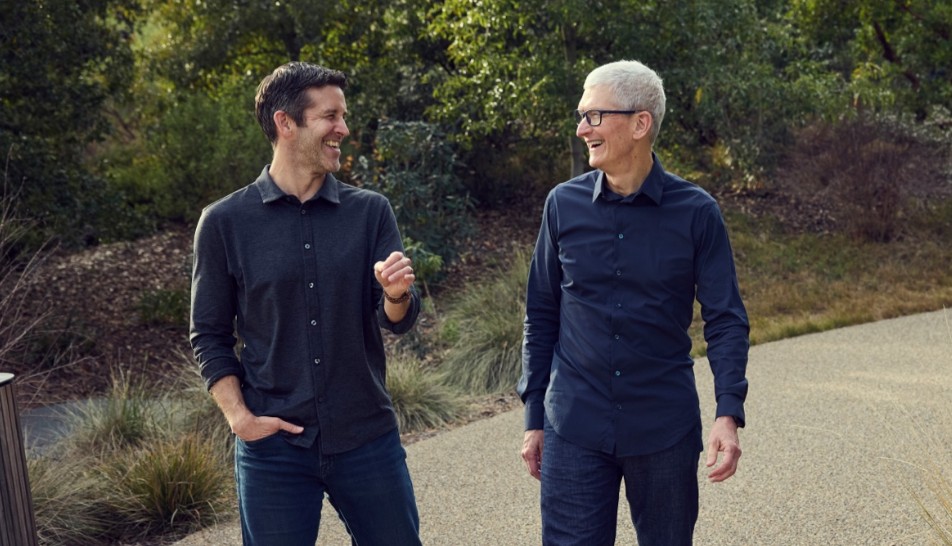
As a result, the success or failure of the new product will be both Ternus's first report card and a test of Apple's product innovation and market leadership in the AI era, it noted. The photo shows John Ternus and Tim Cook in conversation, and the source is Apple.
Apple will hold its product event at 10 a.m. on the 9th. In Korea time, that is 2 a.m. on the 10th. The venue is Apple Park in Cupertino, California.
Apple has not disclosed details of the products to be announced. However, the iPhone 18 Pro lineup, Apple's first foldable iPhone, and a new Apple Watch are expected to appear. The source is a screenshot from Apple's website.
The event will be a place to unveil products. At the same time, it is expected to serve as a stage for explaining the meaning of the CEO change to the market.
The new CEO is set to face his first test through a hardware product before presenting his management strategy. The significance of the event is also heightened by the fact that it will showcase Ternus's Apple at his first product launch event.
Ternus joined Apple's product design team in 2001. He was promoted to vice president of hardware engineering in 2013. Since 2021, as senior vice president of hardware engineering, he has overseen development of major products including the iPhone, iPad, Mac, Apple Watch, and AirPods.
Ternus is a figure deeply involved in Apple's transition from Intel processors to Apple Silicon-based Macs. More recently, he co-led work on thickness, durability, repairability, and materials innovation across Apple products including the iPhone Air, and the iPhone Air is a signature product he personally introduced on stage. He is regarded as the person most familiar with the iPhone.
Apple chose Ternus as CEO rather than an AI researcher or a services executive. This is being interpreted as a decision that places more weight on consumer-facing AI devices that combine Apple's own semiconductors, operating systems, and hardware, amid a race among Big Tech companies to compete on the scale and performance of large language models (LLM). Apple's choice of Ternus as CEO is seen as a refocusing of its next-generation competitiveness on products.
However, the event on the 9th brings both upside and burden for Ternus. Most of the products to be unveiled at the event were developed before he became CEO. If the products succeed, it could reinforce the judgment to appoint a hardware expert as CEO, but if they fall short of expectations, questions about innovation at the start of the new management system could arise.
As Apple's first foldable iPhone draws intense attention, foreign media have raised the possibility that the product will be called the 'iPhone Ultra.' Its expected specifications are said to include a display size when unfolded that approaches that of the iPad mini, while its anticipated features include multitasking support for running multiple applications simultaneously. However, some say that simply releasing a folding-screen iPhone would not be enough to prove innovation.
Market assessments are likely to depend on reduced creasing, improved thickness, greater durability, and app optimization. In the end, the criteria will likely be how much the product reduces the existing inconveniences of foldable phones. It is also being noted that Apple's entry into the foldable smartphone market comes significantly later than competitors such as Samsung Electronics.
However, a 'late entry' could also become an opportunity for Ternus to prove his management philosophy. Apple has repeatedly pursued a strategy of releasing products only after technology and user experience reach a certain level, rather than trying to gain early market share. Accordingly, if Ternus describes the foldable iPhone not as a mere screen-expansion product but as a device that combines the user experiences of the iPhone and iPad, it could help highlight the strengths of a CEO with a hardware engineering background.
Amid slowing growth in the global smartphone market, Apple's challenge is to expand replacement demand among existing users and increase the share of premium products. In this context, the role of the foldable iPhone is being discussed not only as a way to boost sales volume but also as a card to raise the iPhone ASP.
A Reuters analysis said the foldable iPhone is important for improving Apple's selling prices and profitability. The foldable iPhone is presented as a means of increasing both sales volume and ASP while also helping profitability.
At the same time, attention at the product event is shifting from specifications to how AI will be implemented. Apple has been seen as lagging behind OpenAI, Google, and Microsoft in responding to the generative AI race, and even after the announcements of Apple Intelligence and Siri changes, the user experience gains were not as significant as expected at the time.
Ternus's task is not simply to develop larger AI models than competitors. Possible changes include AI agents handling search, shopping, reservations, and payments on users' behalf.
In that case, the importance of the traditional smartphone interface, in which users find and launch individual apps, could decline. Apple has used the App Store and the iPhone as gateways to digital life, but such a shift could also raise the possibility of weakening Apple's platform dominance.
The background to Apple's decision to choose a hardware chief as CEO lies in the view that Apple's core asset is not a single in-house AI model. Apple's core asset is its broad device ecosystem, including the iPhone, Mac, and Apple Watch, as well as its ability to control both its own semiconductors and operating systems. Apple's competitiveness is said to rest on a structure that commands the device ecosystem, semiconductors, and operating systems together, rather than on any individual AI model.
Accordingly, Ternus's task is centered on combining cloud-based AI with on-device AI. The goal of that combination is to deliver a single product experience that brings together performance, battery efficiency, and privacy protection. The point of the Ternus era is also not the best AI model, but creating devices that use AI most naturally.
The foldable iPhone, too, is not enough with foldable-screen hardware alone. Its differentiation will depend on how AI arranges app and content screens and how well it supports users' ongoing tasks. The 9th event will be watched for whether AI remains merely an added feature of new products or rises to the center of how the product is used.
This CEO change does not mean a dramatic strategic shift for Apple. Cook is not leaving the company but moving to executive chair of the board, while current board chair Arthur Levinson will serve as lead independent director. Ternus will join the board when he becomes CEO.
According to Apple's announcement, Cook will continue supporting some company operations as executive chair, including communication with policymakers in various countries. Ternus will be in charge of products and technology, while Cook will handle external issues such as supply chains, trade, and regulations. Under this structure, Ternus can focus on product development and organizational management with Cook's support on external relations, which also aligns with Ternus's strengths.
Apple faces challenges including restructuring its China-centered production network, responding to U.S. government demands for domestic investment, and dealing with tariff burdens. In addition, regulatory pressure continues in the European Union (EU) and elsewhere over how the App Store is operated. The division of roles between the two is expected to help Apple respond simultaneously to these internal and external issues.
At the 9th event, which is Apple's new product launch, the roles of the two men on stage will draw attention. The focus of the article is on how Cook and Ternus divide responsibilities, and the key points are whether Cook fully hands over event proceedings and whether he appears alongside Ternus in his capacity as executive chair. In particular, if Cook appears together with Ternus to emphasize the management succession, it is expected to provide a clue for assessing the distribution of authority in the new system.
This event is expected to be Ternus's first public unveiling of 'Ternus's Apple' and his management debut. The first iPhone to be unveiled by Ternus was not developed after he became CEO, but it will be up to the new CEO to decide which front-and-center product to choose and how to explain the AI and foldable changes. What is placed at the forefront, and how the AI and foldable transitions are explained, will shape the first impression of the new CEO era.
Source: IT DAILY · Lee Jae-young
Original: https://www.itdaily.kr/news/articleView.html?idxno=241348
References
This article was produced with the help of an automated content generation algorithm.
Source: IT DAILY
View originalThis article was summarized and organized by BizCrush based on the original article from IT DAILY. For exact quotations and full details, please refer to the original article.