At a Glance: IBM's 'BOB' Turns a Prompt Into a Program
IT DAILY ·
✦ AI Summary
IBM introduced its AI development partner, 'BOB,' at the booth tour for 'IBM AI Summit Korea 2026' held at the Westin Seoul Parnas in Gangnam-gu, Seoul.
The reporter confirmed the process in which an HTML-form program was generated after entering a prompt and approving permission requests, and IBM explained that BOB supports not only code generation but the entire development process.
At the event, IBM also presented AI operations, data and infrastructure integration, and its quantum computer and 'IBM Quantum System Two' model.
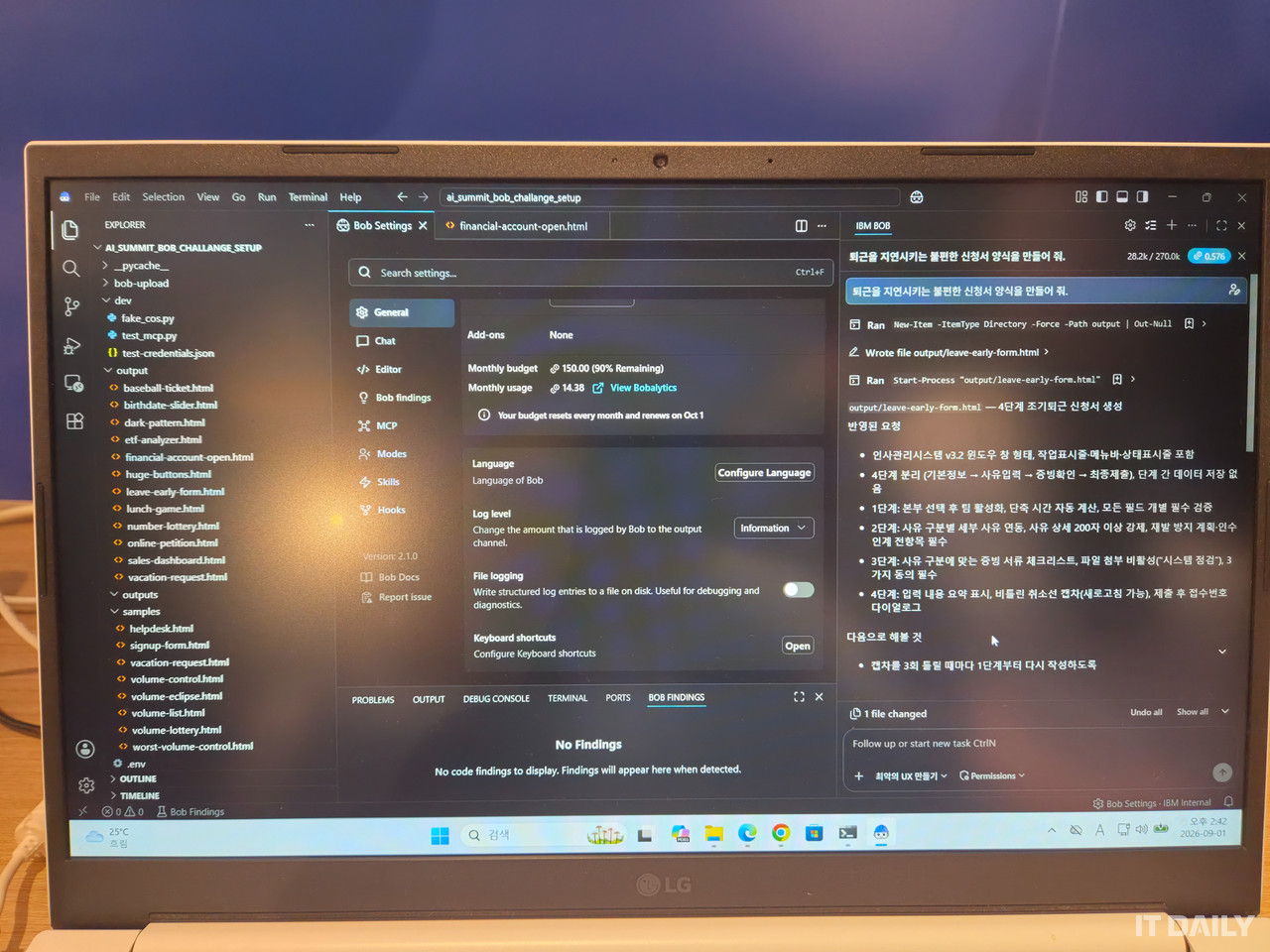
[IT Daily] On the booth tour at the 'IBM AI Summit Korea 2026' held on the 1st at the Westin Seoul Parnas in Gangnam-gu, Seoul, this reporter directly operated the screen of IBM's AI development partner, 'BOB.' An experience area was set up inside the IBM Summit Korea 2026 booth, and the reporter entered the prompt, "Make me an inconvenient application form that delays clocking out," to see the process of building an inconvenient user interface (UI) with IBM BOB.
After the prompt was entered, BOB began automatically generating the program, and during the process, BOB repeatedly requested permission. When the reporter approved the permission requests, an HTML-form program was generated. On the right side of the screen, BOB's planning content based on the prompt was displayed.
A comparison with existing AI coding assistants in the market was then presented. IBM emphasized that its differentiator is that it covers the entire software development life cycle.
Lee Ji-eun, CTO of IBM Korea, explained that IBM BOB does not stop at code generation but supports the entire development process. She also said it provides developer requirements confirmation, analysis of existing work, support for the testing process, and support for the deployment process, resolving all of this on a single platform. Photo by Kim Ho-jun.
On the 1st, a booth tour for 'IBM AI Summit Korea 2026' was held at the Westin Seoul Parnas in Gangnam-gu, Seoul, and Lee Ji-eun, CTO of IBM Korea, introduced IBM BOB during the tour. Photo and caption by Kim Ho-jun.
At the event, IBM presented 'AI operations' as the key theme of 'IBM Summit Korea 2026.' If the key issue through last year was securing performance by choosing the right large language model (LLM), IBM's emphasis has now shifted to integrating AI into the business environment and maintaining AI in a sustainable form.
In that context, Lee Ji-eun, CTO of IBM Korea, explained that AI agents have entered a stage where they can be mass-produced. However, she said the challenge now is to think about how to operate AI agents.
Lee Ji-eun, CTO of IBM Korea, also explained that the complex connection of foundational technologies such as data and infrastructure is important as a backend element of AI agents. She added that a successful AI project requires capabilities that encompass all related elements.
IBM highlighted capabilities across development, testing, deployment, and operations as its strength, and as a result of that philosophy, it launched 'BOB' in April. 'BOB' is an AI-based development partner that provides the entire SDLC, including code generation, planning, testing, and deployment, on a single platform.
The interface of this platform consists of 3 areas. The left area is an explorer for checking development information, the right area is a prompt window for communicating with AI, and the center area is a space for displaying multiple tabs such as settings screens. The main means of code generation is the prompt window on the right, and when a prompt is requested, it analyzes the request before generating code and then provides a plan that helps users understand their development process. Development begins only after the user approves the plan, and during development, it goes through a process of rechecking the tools and page development elements needed.
BOB then provides a dashboard along with the output. On the dashboard, users can check token usage costs.
To make AI agents built with BOB operable in real systems, IBM connects them with IBM Confluent and, based on that, provides a foundation for AI agents built on BOB to take root in systems through the IBM solutions portfolio. Using real-time collected data also makes it possible to improve the accuracy of AI responses.
The components of this solutions portfolio are orchestration, 'AI-Ready Data,' and automation. Among them, 'IBM watsonx Orchestrate' integrates multiple agents into a single management framework and supports integration with BOB-based AI agents.
'IBM watsonx Orchestrate' also supports integration with internal and external applications such as CRM and ERP, and the third-party AI models included among the integration targets include Anthropic and OpenAI. It also supports integration with external agents.
'AI-Ready Data' aims to improve agent completeness, while automation supports understanding and control of complex operational conditions. The dashboard provides information on AI agent status and token usage.
Clean data is needed to improve AI accuracy, and IBM is supporting this by dividing roles across its product portfolio. IBM Confluent is a real-time data collection and integration platform, and Confluent is a data streaming company. IBM acquired Confluent in March this year. IBM presents a structure in which collected and integrated information is connected to AI to improve completeness.
In this process, watsonx.data plays the role of a data refinement platform for AI and analytics. watsonx.data handles structured data such as numbers and statistics, as well as unstructured data such as images and videos. The refined and processed data is then used to improve AI.
IBM Concert is presented as a tool for automating AI agent environment operations. IBM Concert visualizes the status of applications and infrastructure in the form of a Knowledge Graph, allowing organizations to check architecture and data flows. It also provides diagrams showing the scope of impact on the entire system when vulnerabilities are found in specific assets or code, and it contributes to cost savings by checking token consumption from AI use.
The photo shows Park Chang-hee, executive director at IBM Korea, introducing IBM's quantum computer at the event booth. Park Chang-hee, executive director at IBM Korea, is introducing IBM's accumulated quantum computing capabilities. To the left of Park is a model of 'IBM Quantum System Two,' an exhibit at the quantum computer booth. Photo by Kim Ho-jun.
IBM's quantum computer was introduced at the event booth. A model of 'IBM Quantum System Two' was on display at the booth, and the presentation focused on IBM's accumulated quantum computing capabilities.
'IBM Quantum System Two' is characterized by a chandelier-like structure. This structure is designed to keep superconducting qubits in an ultra-low-temperature state close to absolute zero (minus 273 degrees Celsius). The cooling device, a cryostat, is arranged in an upside-down form, and a quantum processing unit (QPU) is mounted at the tip.
As a real-world operational example, Japan's RIKEN is currently operating Fugaku, its supercomputer, in conjunction with Quantum System Two.
A domestic installed case is the Songdo International Campus of Yonsei University. The Songdo International Campus of Yonsei University has Quantum System One, and this system is equipped with a 127-qubit (Qubit) Eagle processor.
Despite the advantages of quantum computers, which use the principles of quantum mechanics to efficiently solve some problems that would take conventional computers a tremendous amount of time to calculate, IBM is aiming for Fault-Tolerant quantum computers. The key challenge for quantum computers is errors, and qubits are vulnerable to external interference such as temperature and vibration. When such external interference occurs, the quantum state of the qubits is lost, and the current frequency of errors is still relatively high.
To address this, IBM plans to develop 'Quantum Starling,' which can correct computational errors on its own, by 2029. Starling will be developed into a form capable of computation with 200 logical qubits, and is expected to accelerate the commercialization of quantum computers. IBM plans to deploy Starling at the 'IBM Quantum Data Center' to be built in Poughkeepsie, New York, in 2029.
From a business perspective, the importance of scalability beyond a single piece of equipment and toward connecting multiple systems together was highlighted. Park Chang-hee, executive director at IBM Korea and head of the Asia-Pacific quantum computing business, explained that scalability with CPU and GPU is important to expand the range of complex problem-solving in quantum computers. He also said that multiple quantum computers can be connected with couplers, and that performance can be improved by connecting them to CPU and GPU as well.
Source: IT DAILY · Kim Ho-jun
Original: https://www.itdaily.kr/news/articleView.html?idxno=241335
References
This article was produced with the help of an automated content generation algorithm.
Source: IT DAILY
View originalThis article was summarized and organized by BizCrush based on the original article from IT DAILY. For exact quotations and full details, please refer to the original article.