MongoDB: In the AI Era, Data-Centric Architecture Is Gaining Importance
IT DAILY ·
✦ AI Summary
Jang Jeong-wook, head of MongoDB Korea, focused on architecture and data as the core of the AI era.
He explained that data use must expand from storage and retrieval to embedding, indexing, and reranking.
He also said that individually adding AI to an existing stack increases complexity and cost, making architecture reconfiguration necessary.
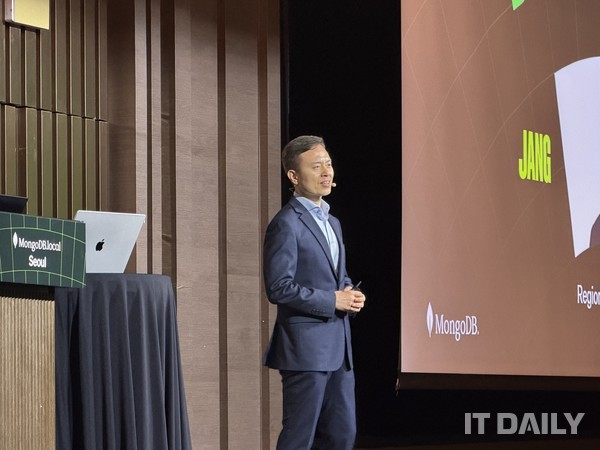
At the 'MongoDB.local Seoul 2026' presentation held on the 1st at the Grand InterContinental Seoul Parnas, Jang Jeong-wook, head of MongoDB Korea, focused on architecture and data as the core of AI adoption under the theme of the growing importance of data-centric architecture in the AI era. The photo was taken by reporter Yang Seung-gap.
Jang said architecture is the most important factor in AI, and explained that data plays the top role in the AI stack. He pointed out that the scope of data use is expanding beyond storage and retrieval.
He went on to say that data processing is insufficient if it stops at storage and retrieval, and that embedding, indexing, and reranking are required functions. He said the goal is to use accurate context information at the right time.
He also analyzed the recent AI transition as similar to the earlier cloud expansion process, but said the pace of change in AI is much faster than it was for cloud adoption. As a response, he said architecture must be reconfigured rather than simply introducing new technologies.
In the early cloud market, the mainstream approach was 'lift and shift,' which moved only the infrastructure to the cloud while keeping existing applications and processes in place. However, many companies that applied 'lift and shift' failed to achieve the level of results they expected.
Jang explained that even in the AI era, many companies are sequentially adding AI components to their existing technology stacks while expecting high productivity. However, he said that from various materials and customer conversations, it is clear that this approach quickly increases costs and makes it difficult to achieve the expected results.
Amid these concerns, companies leading AI transformation are reexamining their organizations, processes, and technology stacks as a whole. These companies are redesigning architectures suited to AI around the data layer.
Jang said AI applications are not complete with data storage and retrieval alone. He said information must be usable in the proper context, and cited vector search, embedding models, and reranking as necessary elements for that purpose.
Jang noted that the approach of adding AI-related functions individually to an existing technology stack increases system complexity. He said the reason is a rise in data movement, pipelines, and management points, which in turn leads to higher costs and greater operational risk.
As an alternative in this situation, Jang pointed to MongoDB. He cited the widespread use of JSON-based structures in how AI applications and agents represent and exchange data, and presented MongoDB's strength as being based on a document model similar to JSON.
Jang emphasized MongoDB's flexible data structure and integrated platform. He said these characteristics mean it can respond flexibly to rapidly changing data structures, and explained that MongoDB provides core AI application data functions, including vector search, on a single platform, increasing the potential for more efficient use of multiple technical elements.
Jang explained that AI agents function by reading and understanding data, reasoning, and then generating new forms of data. Because of this characteristic, he identified flexible data structures as a core element in the AI era.
Jang then mentioned the importance of security, and clearly pointed to the importance of governance along with the importance of infrastructure flexibility. He explained that in discussing the AI era, it is necessary to look not only at data structures but also at security, infrastructure, and governance together.
On security, Jang predicted that future changes will be similar to the early days of cloud adoption. In the past, security concerns were a factor delaying cloud adoption, but after security-related technologies such as IAM, encryption, and audit logs advanced, he said they instead became one of the reasons to adopt cloud.
He said core security capabilities are not limited to preventing vulnerabilities from occurring at all, but also include quickly detecting and responding when problems arise. In that context, Jang viewed the essence of security as a matter of speed.
From an infrastructure perspective, Jang emphasized the autonomy to choose without being tied to a specific provider. He explained that while infrastructure in the early cloud era tended to be concentrated around a single cloud provider, companies are now moving toward using a variety of environments amid data residency and geopolitical factors.
The existence of data residency rules, limited supply of high-performance AI infrastructure, and the spread of open models and open weight models are all seen as factors increasing the importance of companies' autonomy in placing data and AI workloads. An assessment was presented that the combination of these factors is increasing the importance of such autonomy.
Regarding this, Jang said infrastructure flexibility is an essential element for an accurate AI strategy. He then emphasized the importance of development, operations, and management based on the same technology and platform anywhere.
At the same time, the need to proactively build governance systems as AI use expands was also emphasized. Areas cited as needing improvement included agent-level access control, usage policies, observability, and traceability, and it was argued that improving the level of governance system building can speed up AI adoption.
Jang explained that AI change shows a pattern similar to the cloud era, but pointed out that the pace is much faster. He then said MongoDB's role in this environment is to help customers develop faster and operate safely, and to be a partner that helps customers achieve their target business results.
Source: IT DAILY · Yang Seung-gap
Original: https://www.itdaily.kr/news/articleView.html?idxno=241334
References
This article was produced with the help of an automated content generation algorithm.
Source: IT DAILY
View originalThis article was summarized and organized by BizCrush based on the original article from IT DAILY. For exact quotations and full details, please refer to the original article.