[SI AX②] Combining Domain Expertise with AI... Mid-Sized SI Firms Accelerate AX on the Industrial Front Lines
IT DAILY ·
✦ AI Summary
AI use is spreading across industrial sites, and major domestic mid-sized SI companies are also expanding AI integration in retail, aviation, logistics, manufacturing, and the public sector.
Shinsegae I&C is promoting offline store automation, error and loss reduction, and customer experience improvement through the AI vision-based retail solutions Sparrows Scanfree and ScanCare.
Asiana IDT, Hanjin Information Communication, Kolon Benit, GS ITM, and NDS are also strengthening vertical AI, workflow automation, development support, and public-network-compatible AI services tailored to their respective industries and tasks.
AI use is spreading across industrial sites. The goal is to improve task processing speed and accuracy, as well as operational efficiency. In response, major domestic mid-sized SI companies are also expanding AI integration. The application areas include retail, aviation, logistics, manufacturing, and the public sector.
These companies are working to improve operational efficiency and service competitiveness in their respective areas of accumulated expertise. In particular, the trend is to combine AI with industries where they already have strengths, focusing on delivering AX results.
Among them, Shinsegae I&C is pushing to strengthen AI services that optimize both online and offline retail environments. The effort is based on hundreds of thousands of data points from actual retail sites and experience in advancing technology.
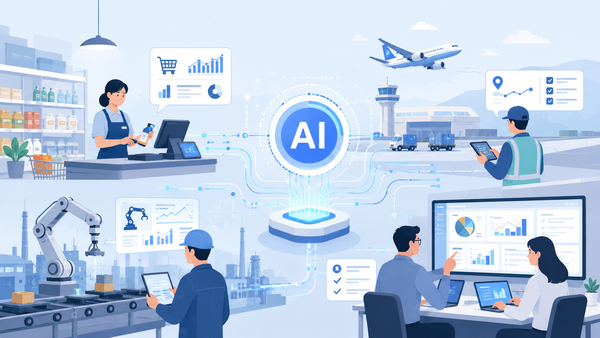
Using AI vision technology, Shinsegae I&C is seeking to automate tasks in offline stores, improve store operations, and enhance customer experience. The image was created with AI.
As an example of how AI vision is used in retail settings, the company cited the AI vision-based retail solution 'Sparrows Scanfree.' Shinsegae I&C said that when products are placed on the checkout counter, multiple items can be identified at once. It added that 'Sparrows Scanfree' can recognize items in 0.4 seconds, achieve 99.9% accuracy, and identify about 5,000 product types while distinguishing multiple items.
'Sparrows Scanfree' has reduced checkout wait times to about one-ninth of those at a typical self-checkout counter. The solution is currently operating at a smart store inside the SK hynix Icheon campus. Discussions are also under way for its introduction at other retail stores.
AI vision is also being applied to reduce errors and losses during checkout. 'Sparrows ScanCare' analyzes self-checkout usage to detect missed scans and barcode recognition errors. As a result, it has cut the frequency of staff calls to about one-fifth of the level seen with the existing weight-comparison method, and at some stores where it has been introduced, it has reduced annual losses from missed scans by up to several billion KRW.
A Shinsegae I&C official explained that while online e-commerce easily accumulates customer behavior data, offline retail has been slower in AX adoption than online retail because it is difficult to datafy on-site conditions such as customer movement, checkout flow, and product recognition.
The official said AI vision technology is the focus for overcoming these limitations. The official also said Sparrows Scanfree and ScanCare are AI vision-based solutions and that their upgrade was completed in the first half of the year.
The official added that the company plans to pursue customer verification and commercialization across a variety of retail environments, while also securing application references. Based on those references, it also plans to expand its business in domestic and overseas retail markets.
Asiana IDT has domain knowledge and IT implementation experience in aviation, logistics, finance, and manufacturing, and is pursuing an AI-integrated 'vertical AI' strategy. The company is reflecting the different regulations and work processes of each industry while focusing on connecting AI with existing systems.
Asiana IDT's main technology areas are document data analysis, image data analysis, and AI model performance management. Its representative technologies include AI optical character recognition (OCR) for extracting unstructured document data, 'AI Vision Assistant' for risk detection based on recognition of objects, places, and actions in images, and 'ModelOps.AI' for managing AI model performance during operation. The company's use of AI technology stands out in aviation, backed by long-term experience in systems implementation.
AI OCR can be linked with ERP and CRM systems. Asiana IDT said using AI OCR can cut data input and verification labor by more than 80%.
These technologies have already been applied in aviation. Asiana Airlines applied an AI solution in 2024 to a weather and NOTAM data analysis system, improving the accuracy of data analysis related to flight safety. Last year, it conducted a PoC for AI analysis of ground handling safety and turnaround management using CCTV footage, which was used to inspect on-site work safety and verify compliance with procedures and operational efficiency.
As a real-world implementation case for managing the performance of AI models in operation, the company cited the intelligent AI performance management system built this year for ABL Life by applying ModelOps.AI. The target system includes multiple applied AI models, such as the FDS.
The system includes AI model lifecycle monitoring, detection of signs of performance deterioration, and alerting functions.
An Asiana IDT official said the company is seeking to maximize development productivity not only through simple chatbots but also by using agentic AX and AI coding tools, and that the key is a shift in the development paradigm. The official added that the company is upgrading its business consulting capabilities, working to secure DSLM responsiveness through strategic partnerships, and promoting the provision of workplace infrastructure based on the agentic AI platform ModelWave as well as innovation in SI implementation through EasyVibe.
Hanjin Information Communication is moving to advance logistics and mobility services by combining AI with its aviation and logistics know-how.
Based on its domain expertise in aviation and logistics, Hanjin Information Communication is developing and advancing AI services specialized for logistics and mobility. To this end, it is pursuing a strategy that combines various cloud and data platforms such as AWS, GCP, and Databricks, with the strategic goal of building a multi-cloud environment that meets customer cost and performance requirements.
Under this direction, its in-house solutions are divided into corporate common tasks and aviation and logistics sites. The common-purpose 'HAI solution' includes AI-based talent recruitment and task assignment 'HAI-FIT,' cloud failure analysis and handling 'HAI-OPS,' and intelligent document processing 'HAI-OCR.' Operational solutions for aviation and logistics include aircraft loading management 'Opti-LOADs,' ground handling system 'TOSS,' and air cargo management 'CMS.'
Hanjin Information Communication is trying to support operational decision-making at logistics sites. According to the company, existing dispatch work can vary depending on the individual capabilities of the person in charge, so it is working on automating dispatch operations to reduce that variation.
In this process, it predicts the appropriate dispatch allocation based on cargo volume changes by terminal and provides the prediction results as guidance for workers. Hanjin Information Communication is preparing to apply an operations model-based approach to about 8,200 out of every 10,000 cases, with the goal of supporting workers' dispatch decisions, reducing individual variation, and eventually expanding to automatic dispatching.
A Hanjin Information Communication official said the company is preparing a strategy to develop new solutions and services based on best practices identified through executed projects, while also advancing existing solutions. The official added that rather than trend-chasing AI, the company aims to provide practical AI services with references that can deliver immediate value at customer sites.
Kolon Benit is pursuing both AX and DX in parallel. To that end, it is not relying on a single technology but applying customized combinations of technology and infrastructure for each customer challenge, while also leveraging in-house solutions, AI alliances, and global partnerships at the same time.
In manufacturing, the company is focusing on integrating dispersed on-site data. Kolon Benit is pursuing this through its manufacturing DX platform 'ALKOKOANA,' which combines CDP and MOM and has functions for integrating equipment and production data. It is also applying analysis technologies such as vision AI.
This platform construction is being carried out at SeAH Besteel's Wonju plant. Kolon Benit is in the process of building an integrated manufacturing operations platform based on ALKOKOANA, and the platform is designed to connect equipment, energy, and production data.
In factory safety management, the company verified the potential of combining generative AI with video analysis. At Kolon Industries' Gimcheon Plant 2, a PoC using 'PromptON Pak.Vision' was completed, including verification of whether workers were wearing protective gear and of video detection of abnormal behavior. The PoC was conducted to verify the potential for use in actual safety management work.
Kolon Benit is applying AI to management planning work. The company has 'Alplana,' an SAP-based management planning and profit-and-loss simulation solution, and 'Alplana' supports planning that reflects variables such as exchange rates and costs. According to Kolon Benit, verification was conducted for some customers, and the results showed that the predicted cost was 99% close to the actual cost.
A Kolon Benit official said that the initial interest was in whether to adopt AI at all. The official added that the focus has recently shifted to projects where returns on investment can be demonstrated. Accordingly, Kolon Benit is shifting its business structure beyond simple technology supply to an end-to-end model covering consulting, implementation, and operations.
Kolon Benit was selected as the lead organization for the Korea Institute of Startup & Entrepreneurship Development's '2026 Mutual Growth AX Leading Model Construction Support Project.' The selected project is planned to spread major manufacturing innovation capabilities from large enterprises to small and mid-sized manufacturing companies. Kolon Benit already has in-house solutions such as management planning, financial disclosure, and manufacturing DX, and it plans to gradually integrate AI functions into those solutions. The purpose of the AI integration is to increase the level of task automation.
GS ITM has adopted 'execution-oriented AX' as its core AI strategy. Rather than competing on research and development of AI models themselves, the company focuses first on defining customer work problems, then selecting the necessary technologies, and finally linking them with existing work systems and data to build services that can be used in actual operations.
This approach has recently been expanded into a stage of upgrading 'execution-oriented AX' into 'knowledge-based AX.' The company divides a single job into multiple detailed tasks and applies AI technologies suited to the characteristics of each task.
Examples of sales duties broken down into finer tasks include customer research, meeting preparation, proposal strategy development, quotation calculation, and contract review. The method of dividing work into such detailed task units and applying different AI systems to each is the concrete form of 'knowledge-based AX.'
GS ITM sees the structuring of elements dispersed inside the company as necessary to make this possible. The targets for structuring are business terminology, internal rules, decision criteria, relationships between data, and approval procedures, and the company views building an 'enterprise-specific knowledge infrastructure' based on these as a core capability.
The data and work structuring described above, along with the division of AI roles, were reflected in GS ITM's own brand, 'U.STRA.' GS ITM explained that 'U.STRA AI Management Analysis' targets dispersed information from ERP, CRM, project management systems (PMS), HR, and other systems, and that its analysis standards conform to each company's management guidelines and work ontology. In this structure, the system receives natural-language questions from executives and provides related information, while accurate numerical calculations are handled by the system logic. Generative AI analyzes causes and risk factors based on verified data and suggests response directions.
This approach has also been implemented in an actual project. GS ITM won the Korea Airports Corporation's 'SKY-POS' project, which connects airport commercial-facility point-of-sale (POS), sales, settlement systems, ERP, and AI. The project included linking store and item transaction data with ERP and settlement systems, structuring complex business rules and data relationships into a form that AI can understand, integrating anomaly detection functions with existing systems, and integrating work support functions with existing systems.
GS ITM is directly building and operating AI assistants across its internal operations. The target tasks are proposals and sales, quotations, contract review, design, and quality management. The AI assistant was built by combining work knowledge and ontology. A GS ITM official said the company is using its internal organization as an AI verification testbed and prioritizing proof of effectiveness in-house, and that based on the practical know-how accumulated in that process, it plans to bring to market a customized AI work innovation service, 'U.STRA Knowledge AX.'
NDS is focusing on improving SI business productivity through AI-based development support. It is also establishing a development support framework that takes into account restricted network environments such as those in the public sector.
NDS plans to improve project execution productivity by introducing AI into the development stage, while also pursuing support for closed-network environments. Based on this, it is expanding its push into public SI applications.
NDS has independently developed and is operating 'nairo,' an AI support service for developers, so that AI can be used in development even in restrictive environments such as network separation or closed networks. 'nairo' is a name derived from AI Refine and Oversee, and it was designed to enable AI-based development support for closed-network environments. As a result, it can support AI use in the development process for public projects subject to network separation constraints.
The service was designed with public projects in mind, and NDS is in discussions to introduce 'nairo' for a Korea Hydro & Nuclear Power project that is building a project office. The project plan includes providing more than 80 AI support services across the full process of analysis, design, development, testing, and stabilization.
An NDS official said that as government interest in AI adoption rises, cases in which AI-related items are included in project orders are increasing. The official added that the company expects related business to expand and is preparing accordingly in terms of both personnel and technology.
The speaker said the company would continue preparing services that are not limited to AI support for group affiliates but also help across external SI and SM as a whole, and explained plans to simultaneously pursue the building of a collaborative platform with AI functions to respond to market changes.
Source: IT DAILY · Yang Seung-gap
Original: https://www.itdaily.kr/news/articleView.html?idxno=241327
References
This article was produced with the help of an automated content generation algorithm.
Source: IT DAILY
View originalThis article was summarized and organized by BizCrush based on the original article from IT DAILY. For exact quotations and full details, please refer to the original article.