[AI Brief] Infinic and AsianaIDT Pursue Joint Industrial Safety Solution Business Based on AI Video Analysis
IT DAILY ·
✦ AI Summary
Infinic and AsianaIDT signed a memorandum of understanding (MOU) to expand their AI-based industrial safety solution business.
The two companies will integrate the response flow from on-site risk detection to follow-up safety management by linking Infinic's 'Oron-I' and AsianaIDT's 'Plan to Do,' and will pursue joint business model development.
Salesforce also announced Hanssem's adoption of Sales Cloud, while EDB unveiled 'Disaster Recovery for WarehousePG.'
Artificial intelligence is rapidly changing industry and everyday life.
IT Daily brings together a range of updates through its "AI Brief" to help readers quickly grasp key industry issues at a glance.
Infinic and AsianaIDT are pushing to expand their AI-based industrial safety solution business. The partnership aims to broaden industrial safety offerings by linking Infinic's AI video analysis capabilities with AsianaIDT's safety management platform.
The two companies aim to provide integrated support from detecting risks at industrial sites to taking follow-up action. To that end, they plan to explore business models based on linking AI video analysis with the safety management platform.
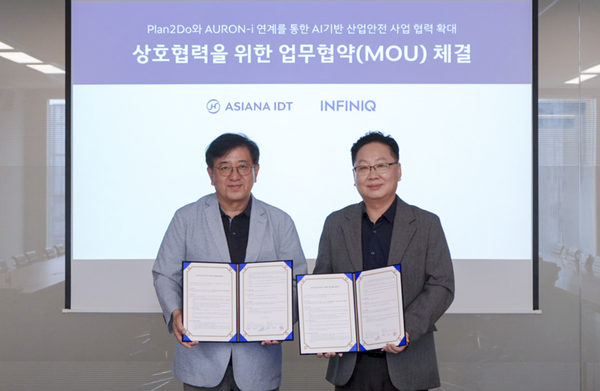
Infinic and AsianaIDT signed a memorandum of understanding (MOU) on the 28th for cooperation on an "industrial safety AI solution business." The photo shows Park Kyung-seo, director at Infinic, and Jeon Hae-don, managing director at AsianaIDT.
Infinic and AsianaIDT said the purpose of the MOU is to link Infinic's "Oron-I" with AsianaIDT's "Plan to Do" to unify the response flow from detecting risks at industrial sites to follow-up safety management tasks. Finding a joint business model is also included among the goals of the agreement.
As the importance of building and implementing occupational safety and health management systems to prevent serious accidents grows, the two companies plan to develop an AI-based solution that organically connects on-site risk detection with follow-up safety management tasks. To this end, they will review linking "Oron-I" AI video analysis functions with "Plan to Do" safety management functions. They also plan to examine a method in which "Oron-I" detects hazardous gas leaks, water leaks, fires, and workers not wearing safety helmets at industrial sites, after which the AI safety manager in "Plan to Do" analyzes risk factors and mitigation measures and records and manages the results on a dashboard.
The earlier plan to pursue the partnership outlines efforts to concretize business models applicable to industrial sites through joint proposal initiatives, sales activities, and technology verification (PoC) initiatives.
EDB also unveiled its "Disaster Recovery for WarehousePG" on the 28th. The product in question is its PostgreSQL-based massively parallel processing (MPP) data warehouse.
The unveiling adds disaster recovery capabilities to the product. "WarehousePG" has PB-level disaster recovery functions, and EDB said the added capability would strengthen resilience for mission-critical environments based on analytics data from "EDB PG AI."
EDB said the impact of data warehouse failures is expanding. The scope of that impact is spreading beyond reporting issues to broader business operations issues, and the company said AI agents, data analysts, and business teams are using real-time analytics data for decision-making and service operations.
EDB also assessed that in petabyte-scale environments, backup only at night could leave hours' worth of data unprotected, that logical recovery could take several days to complete, and that operational workload and resource contention could arise during the recovery process.
WarehousePG is a service that adds a core resilience layer for enterprise analytics workloads to the integrated analytics capabilities of EDB PG AI. According to the company, organizations can maintain standby systems for recovery in a separate analytics environment.
In addition, organizations can decide where to run the standby environment. They can also determine the frequency of recovery point creation and when to switch the standby environment to the operating environment.
On the 28th, Salesforce announced that Hanssem had adopted its solution. The photo shows an example of Hanssem's adoption of Sales Cloud, and the photo credit is Salesforce.
Hanssem introduced "Sales Cloud" to build a digital sales infrastructure. The rollout covers about 600 dealerships nationwide and about 2,300 sales staff (RDs).
With the introduction of Sales Cloud, Hanssem established a sales system that standardizes field information into data and enables unified management at headquarters. This has made it possible to monitor the entire sales pipeline from a customer's first consultation to the final contract in real time, and it has also laid the groundwork for managing prospective customers.
The rollout has changed the way headquarters and dealerships work. Salesforce said it reduced the process of collecting data and cut the time spent on simple reporting tasks, resulting in about a 10% reduction in working hours for headquarters sales staff.
Park Se-jin, CEO of Salesforce Korea, said the key to true AI innovation lies not in the AI adoption itself but in building a work culture and system that enables fast, flexible decision-making based on data. He added that the company will continue supporting the sharing of field experience and know-how by frontline employees and the effective use of new technologies.
Source: IT DAILY · Yang Seung-gap
Original: https://www.itdaily.kr/news/articleView.html?idxno=241279
References
This article was produced with the help of an automated content generation algorithm.
Source: IT DAILY
View originalThis article was summarized and organized by BizCrush based on the original article from IT DAILY. For exact quotations and full details, please refer to the original article.